- Wednesday, 3 June 2026

Poor rainfall affects paddy plantation
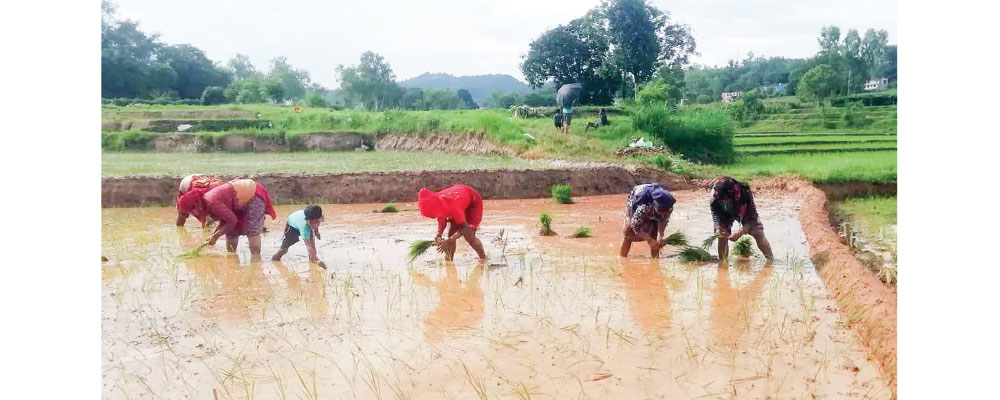

By Laxman Kafle,Kathmandu,Aug,1: Poor and delayed rainfall has affected paddy plantation significantly this year.
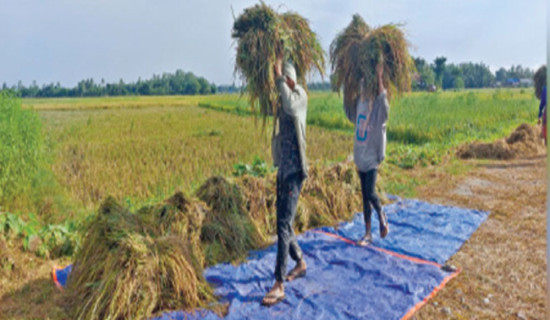
Paddy plantation has completed only in about 77 per cent of the total paddy fields across the country as of July 28 while the plantation season normally ends by the first week of August.
According to the statistics of the Ministry of Agriculture and Livestock Development, paddy plantation has been carried out only in 1.053 million hectares of 1.357 million hectares of paddy fields.
According to the Ministry, owing to weak and late monsoon, paddy plantation has been less by 13 per cent during the review period as compared to the same period last year.
By July 28 last year, paddy plantation had completed in 90 per cent of paddy fields. According to the Ministry, farmers were unable to plant paddy in time this year due to delayed and weak monsoon rains as well as the lumpy skin disease in oxen because most farmers use oxen to plough their fields.
It, however, said that paddy plantation has been taking place across the country, especially in the hilly and Terai regions after the recent precipitation.
By now, paddy plantation has almost completed in Sudurpashchim Province followed by Karnali Province.
In Sudurpashchim Province, paddy plantation was at 99 per cent while 85 per cent in Karnali and 84 in Koshi Province by Friday. Paddy plantation has been completed in about 169,761 hectares out of 171,476 hectares paddy fields in Sudurpashchim Province. Similarly, paddy plantation has been completed in 32,918 hectares out of a total 38,727 hectares of paddy fields in Karnali Province and 231,112 hectares out of 275,133 hectares in Koshi Province.
Similarly, paddy plantation has been completed in 82 per cent (85,790 hectares) of the total paddy fields in Gandaki Province, 81 per cent (243,318 hectares) in Lumbini and 72 per cent (81,420 hectares) in Bagmati Province till date.
The paddy plantation is the lowest in Madhes Province where plantation has completed only in 59 per cent (209,086 hectares) of the total paddy fields of 354,383 hectares. The paddy plantation has been significantly affected in Madhes Province this year compared to last year. The plantation was completed in 89 per cent of the total paddy fields last year.
The Ministry, however, expected that the pace of paddy plantation would gradually increase as the monsoon becomes more active, the availability of chemical fertilisers is ensured and the effect of lumpy skin disease is reduced.
Likely to hit production
The paddy plantation scenario showed that paddy production was likely to be affected due to late and weak monsoon, said Ram Krishna Shrestha, Chief of Centre for Crop Development and Agro Biodiversity Conservation.
Technically, productivity of paddy planted after the second week of Shrawan will gradually decrease, he said, adding that the production of paddy might be decreased this year than last year’s production.
However, further monsoon and rainfall will determine paddy plantation area and production this year.
“The average rainfall this monsoon is lower this year than last as per our earlier projection. So, due to lack of sufficient rainfalls across the country has directly hit the plantation as many fields are depending on rains for plantation,” he said.
The paddy fields of Madhes and other provinces where there is no access to irrigation facilities have remained barren, he said.
Due to the impact of climate change, the paddy plantation activity was affected for the past few years, not only this year, he said.
The area of cultivation and production depends on rains as most of the farms lack irrigation facilities. Due to unusual rains, the productivity dropped to 3.5 tonnes per hectare last year while it was 3.8 in the year 2020/21.
Around 5.486 million tonnes of paddy was produced last year. Nepal produced a record amount of paddy of 5.621 million tonnes in the fiscal year 2020/21. However, paddy production was limited at 5.13 million tonnes in 2021/22.
Stating that the present scenario showed climate change hit the agriculture system in Nepal, he said that the government should adopt climate-friendly technologies and seeds for increased productivity and production of crops, especially paddy, without delay.
The country marked this year's plantation with the slogan "Climate resilient farmer-friendly technology for increasing rice production”.