- Wednesday, 3 June 2026

Translation, Not Robbery

In 2018, former US first lady Michelle Obama revealed that her fictional hero was Pippi Longstocking, the beloved children’s character invented by world-renowned Swedish writer Astrid Lindgren in 1945. Upon reading the book, it is not hard to see why.
Longstocking breaks the mould of children’s characters. She is not the ideal role model we usually get in literature written for kids. She is rude, reckless, and lacks social graces, something moralists across the world continue to criticise her and her maker, Lindgren, for to this day.
But this is exactly what makes Pippi real. She has flaws, yet they do not define her. She is strong, sensitive, and brave, and, at just nine years of age, she displays virtues that even adults can look up to. Pippi is unapologetically herself, and she embraces her "unconventional" qualities with unwavering confidence.
She is not uncomfortable living alone in a big house or wearing mismatched clothes, and she is able to face life’s challenges with resilience and resourcefulness. And isn’t this what we want to teach our children? That they need not be two-dimensional and that it is okay to be unique. That their differences do not diminish them should not diminish them.
As Obama said, "She would not allow her voice to be diminished by anyone. She is independent, clever, and adventurous, and she is clearly a good person, someone who always does right by her friends."
It does not give this reviewer any pride to admit that he came late to this book. The first time he read the book in full was to review this translation by Surendra Bahadur Neupane. However, reading the book through adult eyes gave him a clarity that he perhaps would not have obtained as a child. Pippi is complex and has layers. As per author Lindgren, Pippi represents a childish longing for a person who has power but does not abuse it. Pippi is Pippi; she can never be anyone but Pippi; her charm transcends cultures; and the context Lindgren created her in makes her story a timeless literary gem.
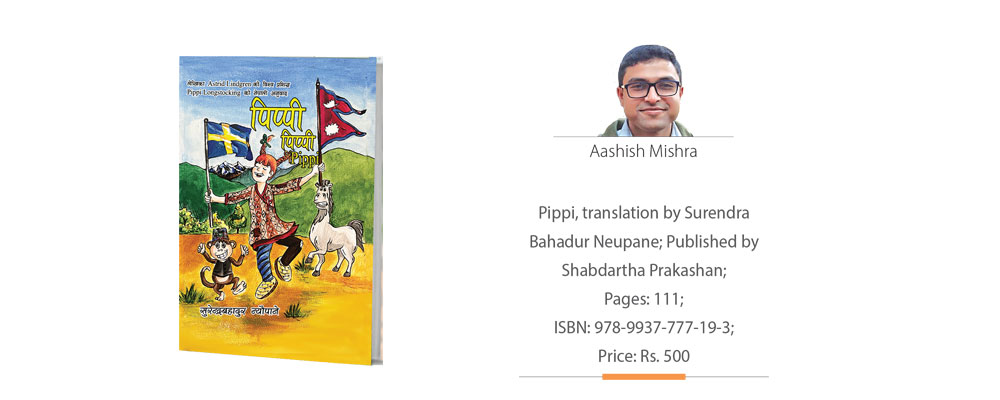
Neupane also appears to have known this. The chapter ‘Why did I translate Pippi Longstocking, he included at the start of his translated book ‘Pippi’ comes off as almost a disclaimer, a clarification that he knew the enormity of the task he had undertaken and an admission that he was daunted by it. The original book is a classic that has captivated readers for generations. Can a translation do the same? Perhaps not. But Neupane does a great job of introducing Pippi Longstocking to Nepali readers, translating not just the words but the spirit of Lindgren’s chef-d'oeuvre to match Nepal’s social realities. His book brilliantly captures the magic and charm of the beloved story.
Often with literary translations, either only the words get translated and everything else stays the same, creating a mismatch between the story and the language it is being conveyed through, or, too much of it gets changed to "make it relatable for a different audience," which erases the taste and sensibilities of the original work.
Neupane manages to balance both. Pippi’s story has been Nepal-ised (for example, the name of Pippi’s monkey is Hanumante, from the Hindu monkey god Hanuman; many other supporting characters also sport Nepali names), but her personality and warmth have not been compromised. Her spirit remains intact, making her just as endearing to Nepali audiences as she is to readers worldwide. Neupane’s careful translation ensures that those reading the Nepali translation are not deprived of experiencing the same adventures and emotions as those reading the original tale.
Neupane’s translation is indeed a translation, not a robbery. Furthermore, Neupane adeptly captures the vibrancy of Pippi’s world, the anchor for which is Villa Villekulla, or Vale-Kulo in the translation. The words he selects paint a rich and colourful picture of Pippi’s escapades and transport the reader to Kande-Danda Island, where they can soak in the magical atmosphere.
The translation also succeeds in conveying the layers of Lindgren’s original work. Pippi Longstocking is more than just a rebellious child. She is a message to young girls that embracing individuality and challenging societal norms is okay.
There are valuable lessons about family, friendship, loyalty, and love woven into Pippi’s narrative that Neupane has been able to translate into the Nepali language.
The translation is also easy to read. It does not have big and complex words. The natural and graceful flow shows Neupane’s understanding of the nuances of both the source material and the Nepali language. This translation is ideal for both new readers discovering the joy of Pippi Longstocking for the first time and revisitors wishing to experience a familiar story with a novel flavour.
In conclusion, Surendra Bahadur Neupane’s Nepali ‘Pippi’ is a delight that pours a foreign tale into a Nepali mould and gives Nepali-language readers a chance to rejoice in the magic of Pippi Longstocking. The translator’s command over the Nepali language and comprehension of the subtleties of Swedish and Nepali societies make this book a good read.
(The author is a journalist at The Rising Nepal.)


-square-thumb.jpg)