- Tuesday, 2 June 2026

Jumbo job: Women join mahout's profession
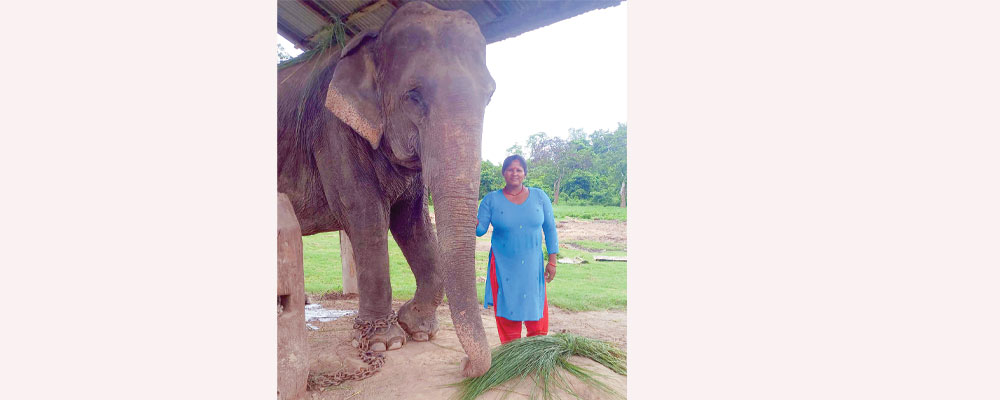

By Basanta Parajuli,Bharatpur, July 22: A giant elephant tamed by a woman - quite surprising, isn't it? Well, meet Meena Chaudhary from Bachheuli, near the tourist town of Sauraha, she is accomplishing the incredible feat of being a mahout. Even among wild animals, taming the largest beast and making it obey your commands is an exceptionally challenging task. However, Meena has been fearless in her undertaking, for the past 12 years.
In 2011, Chaudhary passed the Public Service Commission exam for the position of mahout, responsible for taking care of elephants. "Since women with normal literacy were also eligible to apply for this post, I decided to give it a try," she stated. "I successfully passed the exam," she added.
Currently, Meena is working as the caretaker of Devikali, at the Elephant Breeding Centre. Recently, she was diligently cleaning the elephants and preparing their food, known as 'Kuchi', which consists of grasses, small plants, bushes, fruits, twigs, tree bark and roots.
A mahout is considered the lowest level of staff, responsible for cleaning and feeding them, while the Pachhuwa graze and mow them.
The mahout is the master of an elephant and works together with three people to guide the elephant, whether it's for patrolling, carrying tourists, or any other tasks. Meena currently holds this unranked post of a caretaker at the Elephant Breeding Centre.
Meena describes her regular tasks, "If you push the joints of the head and ears with your feet and say 'sit,' the elephant will obey you immediately. If you want the elephant to sleep on the ground, you push the joints with your feet and say 'sleep,' and the elephant sleeps. 'Agat' makes it go forward, and 'everagat' brings it back towards you."
These commands are taught to elephants during their training, and since most mahouts and caretakers who provide training are Tharu, the ethnic group indigenous to the Tarai in southern Nepal, the elephant is trained using the Tharu language. Meena, being a Tharu herself, found it relatively easy to learn the language of the elephant.
"After passing the public service exam, I felt overwhelmed by the duty I was expected to accomplish. However, I gradually got used to the job," she explained.
She also mentioned that her husband, Rameshwar Chaudhary, a retired non-gazetted Subba, too was a mahout at Hattisar, which made it easier for her to adapt to certain situations in her work.
Back then when the headquarters of the Chitwan National Park was in Kasara, female soldiers used to drive elephants themselves during patrols. Meena recalled, "Maybe because we are women, when we go to the forest, only women are allowed to go. During forest patrols, female soldiers would always take me on an elephant."
After being transferred to the Elephant Breeding Centre, she no longer had to go on patrols and focused on her responsibilities in the forest, where she was assigned to feed elephants. As a mother of an eight-year-old daughter, Meena now has the opportunity to take care of her child along with the elephants.
She mentioned that her daughter was born after she started her job and added, "After taking care of the elephants, I spend my spare time at home looking after my daughter. The proximity between work and home has made it easier for me."
In the park, a total of 139 mahouts work, including those at the Elephant Breeding Centre. Among them, five are women, with three stationed at the breeding centre and two at Chitwan National Park.
According to the park authorities, Meena Mahatto, Meena Chaudhary, Chinmaya Kumal, and Sunaina Panjiyar of Bachyyuli are currently working as mahouts. Some of these women entered the profession due to their fathers' or husbands' association with the profession.
Furthermore, there are two women serving as elephant mahouts in Koshi National Park, and one each in Bardiya, Banke, and Shuklaphata National Park.
The head of the centre, Manipuran Chaudhary, acknowledged that when the Public Service Commission introduced inclusivity, women like Meena got the opportunity to work as mahout.
"It's a challenging job to train an elephant. It requires bravery and involves risks, especially when chasing wild elephants at night. One has to go to the forest carrying fire making it an even more arduous job for women,” she stated.
Sunaina Panjiyar, another mahout at the Elephant Breeding Centre, does not agree with this notion. Panjiyar's husband was also a mahout, and she firmly believes that she is no less capable than a man, as she handles everything from cleaning the elephants to guiding them during jungle safaris.