- Tuesday, 2 June 2026

Dealing With Long-term Impacts Of COVID-19

The COVID-19 pandemic has left far-reaching repercussions on Nepal’s economy, with closure of businesses, high unemployment rate and soaring inflation. Numerous micro and small entrepreneurs were forced to shut down their businesses, triggering financial instability and psychological stress among the people. The magnitude of social, financial and mental problems that the global health emergency caused has made it urgent to roll out comprehensive support measures to deal with its long-term impacts.
The pandemic-induced socio-economic and psychological consequences also developed suicidal behavior among the individuals. According to the data of the Nepal Police Headquarters, a total of 7,141 individuals committed suicide in the fiscal year 2020/21. This number is higher than the daily average of 19 suicides. Likewise, in the fiscal year 2021/22, there were 6,830 incidents of suicide. This represents a daily average of 18 suicides, which is also quite high. This data reveals an increase in the suicide rate during the early period of COVID-19. As a lasting effect, many families, who lost their loved ones, are still going through emotional distress. As a considerable number of families lost their breadwinners, they are still struggling to make ends meet. Psychologists have observed a rise in suicide attempts as long-term consequences of the COVID-19 pandemic. The enduring effects of the crisis, including changes in social interactions, economic instability, and mental health challenges, have cumulative impacts on the life of people.
Depressed mood
COVID-19 has shattered the dreams of many entrepreneurs. Sobars Ghimire, 33, is such an enthusiastic businessman left high and dry after he was compelled to close his restaurant in the midst of pandemic. Ghimire opened a restaurant at Kapan of Kathmandu in February 2020. He had invested all the loans he managed from his relatives and cooperatives. However, the unforeseen challenges he encountered with the restrictions imposed by the government in March 2020 were overwhelming. With the emergence of COVID-19, he faced difficulty in hiring staff and paying the rising rent of house. Despite all his efforts, the burden of the business became too much to bear for him. He finally put up the shutters. Ghimire found himself deep in debt after being unable to pay the loans. "I sought support from the government authorities to claim compensation," shared Ghimire. But he was not eligible to receive the government’s subsidies as he had not taken the loan through the bank channel.
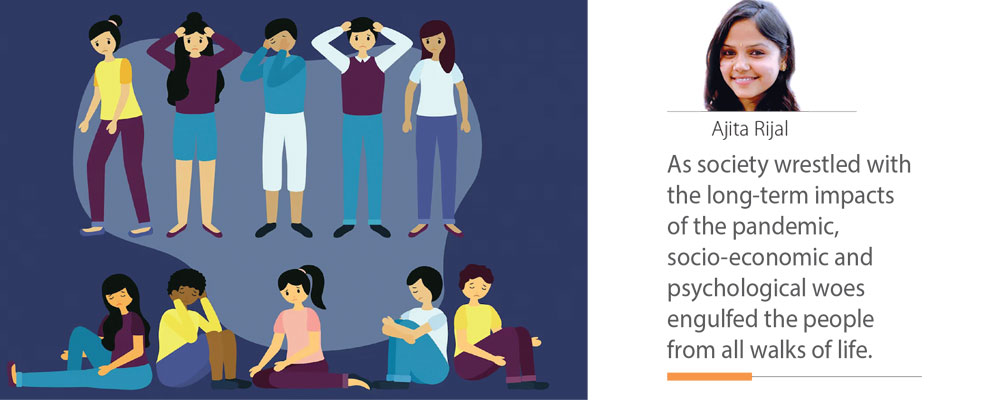
As society wrestled with the long-term impacts of the pandemic, socio-economic and psychological woes engulfed the people from all walks of life. Laxman Phuyal, a 43-year-old entrepreneur, is now mulling to close down his business and going abroad. "I am finding it hard to pay salary of staff and rent of house,” said Phuyal, who is running a sunglass shop inside the Bishal Bazaar shopping complex in Kathmandu. Like Phuyal, many are planning to stop doing business while some others have felt depressed as their initiatives to revitalise their businesses have gone down the tube even after the end of COVID. Increasing number of entrepreneurs are either quitting their business or planning to leave for foreign countries for employment as the recession is biting the economy.
Sima Aryal, who had gone to Bangkok to pursue her higher studies, was compelled to return home after the world was gripped by the pandemic. She completed her course online and graduated virtually. Upon completion of her degree, she spent two years in search of job but of no avail. A sense of depressed feeling has caught her. "I have an international level master's degree from a renowned university, and I am determined to find a job in an international organisation," Aryal aired her frustration.
Running business and getting job has become more difficult owing to the lingering implications of the pandemic. Many companies and organisations are currently struggling to survive, some of them are doubtful of their own competency to sustain their business. The pandemic-induced economic downturns crippled the core economy – manufacturing, construction, poultry, food and automobile industries. This has domino effect on other spheres of economy, hindering businesspeople to thrive in the current milieu.
The condition of a sizable section of the population is getting worse despite the post-pandemic economic recovery that has been disappointingly sluggish. For instance, daily wage earners such as porters largely rely on their wages to keep the hearth burning. This segment of people is now facing the double whammy - on one hand, they are feeling the heat of rising inflation and on the other the firms where they are working are also battling to run smoothly. These vulnerable people have seen a substantial drop in their chances to find work under the depressing economic environment.
Lingering impact
Dr. Basudev Karki, a senior consultant psychiatrist, has stated that the long-term effects of COVID-19 have generated mental health problems. Younger people are more at risk of their mental complications owing to the reasons like joblessness. This poses a challenge to new firms. The youths constitute vulnerable age group reeling from the blows of pandemic. “Of late the young people are experiencing increased stress, anxiety, and depression,” said Dr. Karki. To address their mental health issues, it is essential to provide proper support and counselling services to them, he added.
Rajendra Malla, president of Nepal Chamber of Commerce, shared that, based on his 35 years of experience, this year has been highly excruciating from the commercial perspective. The last two years were directly hit by the consequences of COVID-19 but now we are suffering from its lingering impacts, he added. Malla lamented that the current business environment has made it extremely difficult to launch a new venture and sustain existing ones. “The main business hubs in Kathmandu and other big cities across the nation have either been shut down or have put up a notice of ‘On Sale’ or ‘To Let’,” said Malla. He noted that business owners had found it almost impossible to pay rent and meet daily expenses due to a decrease in consumers’ activity. He also informed that physical businesses had been significantly downsized due to the reduction in the sales of goods.
Dandu Raj Ghimire, Joint Secretary and spokesperson at the Ministry of Labour, Employment, and Social Security, mentioned that the budget for the employment programme had been drastically slashed as a result of the COVID-19 pandemic. “Unfortunately, this downsizing has hampered our ability to meet our targeted employment creation goals. However, in response to the situation, the ministry has taken steps to reintegrate the migrant returnees into society by offering them with reintegration schemes and socio-psychological counselling,” added Ghimire. These initiatives aim to assist them in starting new business ventures in their own country. Given the current high unemployment rate, the ministry has also implemented training programmes to enhance skills and create job opportunities for individuals affected by the health crisis. It has attached importance to the measures in mitigating the negative impacts of the pandemic on employment and attaining economic recovery.
Need of integrated efforts
In order to deal with the pandemic-induced economic, social and mental crisis, an integrated and comprehensive efforts are essential. Nepal government had announced incentives to tackle the immediate effects of pandemic on the national economy. It began to distribute one-time cash grant of Rs. 10,000 to around Rs. 500,000 poor households last year.
During the fiscal year 2021-22, the then government announced incentives and tax rebates to the traders. In July 2020, Nepal Rastra Bank, through its monetary policy, introduced measures such as the extension of the loan repayment deadline, refinance facility and targeted lending in the productive sectors, among others.
However, these measures are not sufficient to revive economy and address the lingering effects of COVID. The affected people should have access to employment options, financial aid and mental health treatment. A lack of information on the socio-economic and psychological aspects of the people is a formidable obstacle to developing efficient policies and strategies to lessen the pandemic's long-term upshots. Growing financial stress has not only given rise to anxiety at the individual level but it has also triggered family feud and unhealthy disagreements. The emotional trauma arising from onerous and prolonged lockdown continue to haunt the people. This calls for giving priority to coping techniques, mental health interventions and awareness campaign. All stakeholders should join hands to support and enforce the measures to regain faster economic recovery and people’s mental health, thereby building a better, strong and resilient society.
(The author is a journalist at The Rising Nepal.)
-original-thumb.jpg)