- Tuesday, 2 June 2026

Proper Utilisation Of COVID Holding Centres

The COVID-19 pandemic posed unprecedented challenges to healthcare systems, weakening their ability to effectively cope with the global health emergency. The government had to struggle to tackle the returnee migrant workers at the border points as the deadly virus reared its tentacles in almost all parts of the country. The nationwide lockdown and restrictions on public transport forced many Nepali migrants to get stranded in the border areas. Adding to the country’s woes was the inadequate number of quarantine facilities. Many private and public-owned open areas and buildings were used as quarantine facilities to protect the returnees and contain the spread of the virus.
After being criticised for using public places, including schools and colleges as quarantine facilities due to the lack of holding centres in the first and second waves of COVID-19, the government, following the decision of the Council of Ministers on April 18, 2021, proceeded with the construction of holding centres at different checkpoints across the nation. With the high demand for holding centres in times of health emergencies, the government decided to construct them in all seven provinces. The holding centres were constructed near the border entry points of all seven provinces. The centres were initially meant for holding, diagnosing and treating COVID-19-infected people.
Lack of proper management
The construction of most of the holding centres began in June 2021 and was completed just 10 months ago. The holding centres were constructed with a budget from the federal government, and the construction authorisation was provided to the Nepal Army (NA). According to the NA the centres were constructed at a total cost of Rs. 2.01 billion. It cost Rs. 280 million to construct holding centres in Mechinagar of Jhapa, Rs. 280 million in Birgunj of Parsa, Rs. 281 million in Bhimduttanagar Municipality-18 of Salghari of Kanchanpur, and Rs. 293 million at Bhabaniyapur of Nepalgunj Sub-metropolitan City-14 of Banke. Similarly, it cost Rs. 289 million to build the holding centre at the Jogbani border of Biratnagar in Morang, Rs. 267 million in Krishnanagar of Kapilvastu, and Rs. 288 million at Trinagar of Dhangadi in Kailali district. Among them, two holding centres – each in Mahendranagar of Kachanpur and Nepalgunj of Banke -- were built by the Nepali Army, and five others by Hanuman Construction Company.
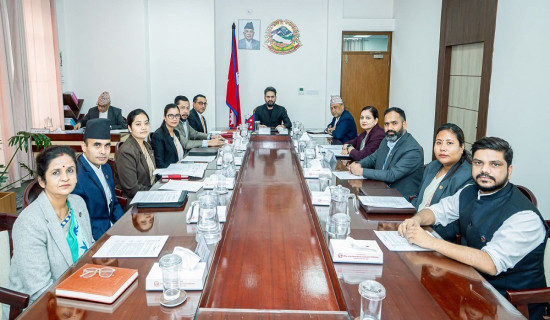
However, in the post-pandemic situation, these holding centres have ramained unused now, facing a crucial question regarding its proper management and ownership. In order to provide opinions and suggestions regarding the operation, management and transfer of the centre, a committee was formed under the coordination of the head of the Planning and International Coordination Division of the Ministry of Defense, the Office of the Prime Minister and the Council of Ministers, joint secretaries of the Ministry of Home Affairs and Ministry of Health and Population (MoHP) and high-ranking officials of the Nepali Army. According to Dr. Sameer Kumar Adhikari, deputy spokesperson at the MoHP, the ministry has prepared working procedure of holding centre and submitted it to the government. No update has been received from the government yet, said Dr. Adhikari.
All the holding centres, with their infrastructure including beds and some with medical oxygen, are now under the supervision of the Nepali Army and should have been handed over to the federal government as of now. But it has not materialised due to various technical reasons. According to Krishna Prasad Bhandari, Brigadier General and Spokesperson of the Nepal Army, at least 95 army personnel have been deployed for the daily care taking and management of the holding centres. The government is yet to decide who will operate and manage the holding centres.
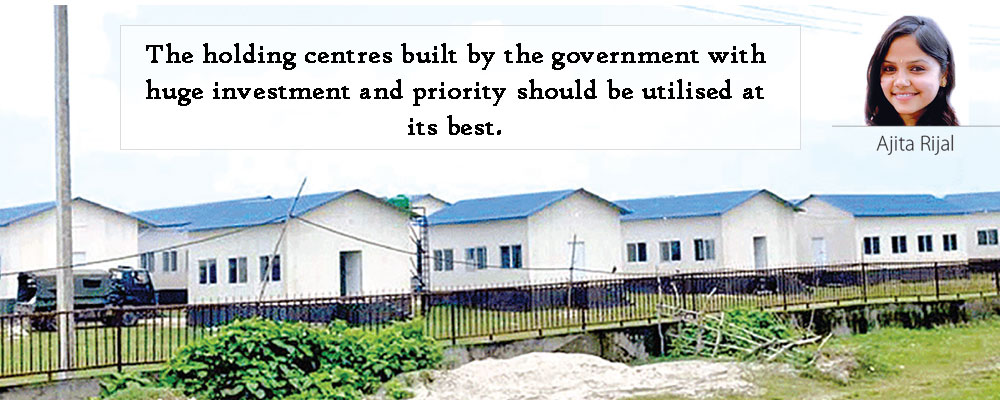
The construction of holding centres was exemplary work carried out by the government as it was a d ire need of the nation to hold the migrant workers who were at risk of contracting and transmitting COVID-19 infection. More than 20 structures with at least 1,000 beds facility have been built in a particular location of each holding centre. One such is the holding centre built at Mechinagar-14 which lies about 14km southwest of the eastern border of Kakadbhitta. A total of 22 small buildings that can accommodate up to 1,000 people, with beds, oxygen supply and electricity, among others were set up there.
Similarly, a total of 60 buildings have been constructed in Parsa. Among them, 13 kitchens, 22 toilets and 22 quarantine buildings have been constructed. There are 900 general beds, and 100 beds have been designated for patients with complicated conditions. Built in about two bigha of land near the warehouse on the west side of the Birgunj customs office, the holding centre can accommodate 1,000 people. Likewise, three other buildings with air conditioned rooms have been constructed for the government representatives designated to those who visit the place for the monitoring purpose. Due to the delay in handing over the holding centres, the financial and security challenges have emerged.
Working procedures
The holding centres built by the government with huge investment and priority should be utilised at its best. However, due to the confusion over the operation and management of the infrastructure, the liability related to electricity and water supply remains challenging. The holding centres were hastily constructed with the aim of holding migrant workers and examining their health condition before departing them to their destinations. They were designated to be utilised at the time of emergency. If proper management and maintenance is not carried out, they may not be utilised at the time of need.
In order to maintain and operate the centres, they can be utilised in various ways. They can be used as storage of relief materials, equipment, food stores and operation of health centres during the health crisis or natural disasters. Some experts have also suggested that these structures can be used for providing training to the people interested to go abroad for work or those wanting to work as security personnel in industrial entities. The concerned authorities should come up with the practical and effective plan to utilise these holding centres.
(The author is a journalist at The Rising Nepal.)