- Tuesday, 2 June 2026

Country roads: Beautiful yet not safe enough
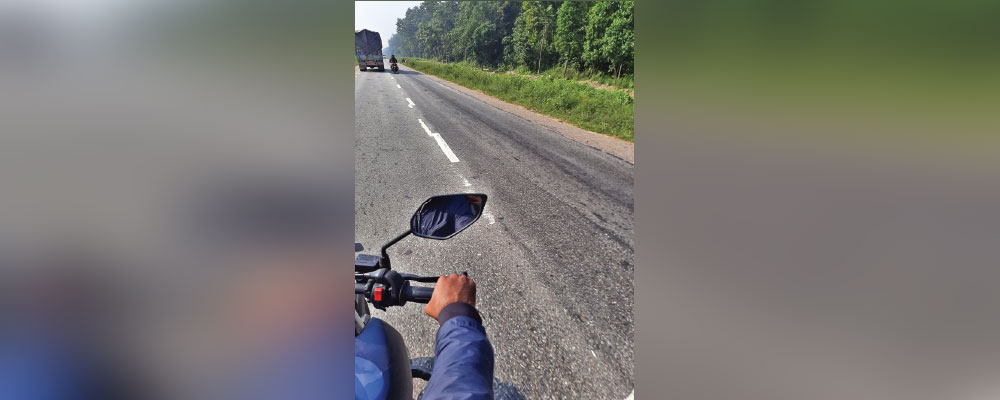

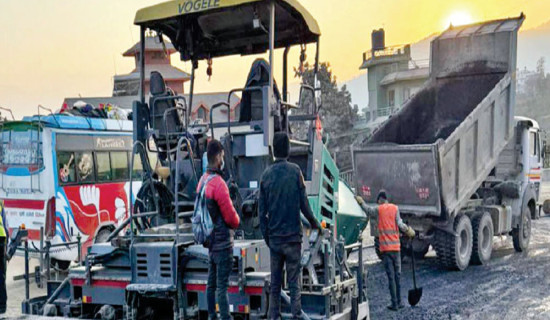
By Nayak Paudel,Kathmandu, May 25: Road transport has always been the most dominant mode of transport for freight and passengers across Nepal. So the road network has been expanded to different corners of the country.
However, drivers and travellers argued that the roads are dangerous.
"Roads have reached to places irrespective of the terrain. It is not easy to ride along many such roads because of their condition. In other words, roads have been constructed but are far from safe," said Sabin BK, a jeep owner and driver who takes people to different places on tours.
BK, who was en-route to Solukhumbu with a jeep full of people via Khurkot on Friday, added, "I have travelled to Solukhumbu before as well. The road is extremely narrow and damaged in many places. It seems that the road has been constructed just for show."
According to drivers, majority of roads in the Hill and Himalayan regions are narrow and S-shaped making it difficult for two vehicles coming from opposite directions to cross safely.
"We are aware of the geography of our country. Roads cannot be as wide and straight as we want them to be. However, the constructed roads should be in proper condition," said Hari Khadka, a bus driver en-route to Kathmandu from Dhangadhi.
Khadka, who looked tired while waiting for food in Mungling area on Tuesday, added, "It has been around 15 years that I have been driving buses along different routes across the country. But, whenever I am travelling to Kathmandu, I still find the Mungling route dangerous."
Experts argued that the road transport will continue to become dominant in Nepal and the authorities will continue investing in the sector. However, the number of vehicles is increasing at a faster rate than the improvement of road connectivity.
Tulasi Sitaula, Ph. D., P. Eng., in the article "Road safety initiatives in Nepal: An overview" published in August 2022 in Newsletter Vol. 29 of the Department of Roads, states that Nepal has a trend of increasing road length by 6.9 per cent and growth of vehicles by about 10 per cent annually.
Several drivers with whom The Rising Nepal spoke to along the BP Highway, East-West Highway, Dhalkebar-Janakpur section and Pathlaiya-Birgunj section, among others, informed that the major highways were now narrower and poorer than feeder roads. "I had to ride with extra pressure until I arrived Bardibas from Kathmandu via BP Highway because of its narrowness. While there were many potholes in the blind spots during turns, the repaired pot holes had improper bumps," said Kunjan Rajbhandari, a mobile app developer who was en-route to Chitwan from Dhalkebar on Sunday after visiting Janakpur.
Meanwhile, Ratan Karki, a 40-year-old engineer travelling to Rupandehi from Birgunj on a motorcycle along the East-West Highway, said that it hurts to see the poor condition of the country's major highways.
"There are three sections of small paths on different heights in a five-metre single lane along the Pathlaiya-Hetauda-Chitwan section of the East-West Highway. It is even difficult to ride slowly because of the volume of the traffic," Karki added.
According to Rajbhandari and Karki, the major highways failed to meet their standards while the feeder roads were getting bigger and better.
Nevertheless, they both argued that the beautiful and bigger feeder roads were similarly riskier as they lacked effective safety measures.
"The Dhalkebar-Janakpur section has three lanes on each side separated by a divider.
After I started my journey from Dhalkebar, I planned to slow down in exit passages along the section. However, in less than a kilometre, I saw a motorcycle riding over the divider and entering the opposite lane. The scene was then common for the next 40 kilometres to Janakpur," said Rajbhandari.
According to Karki, he felt like walking instead of riding his motorcycle when he saw autorickshaws, e-rickshaws, two-wheelers, trucks, buses, bicycles and pedestrians using the roads in Birgunj without following traffic rules such as lane discipline and use of footpaths and zebra crossings.
"The inner roads in Birgunj are beautiful and bigger. I saw similar roads when I travelled to Jhapa and Chitwan, among other districts, last year. However, all of them were risky because people did not follow traffic rules. I found that people drove recklessly in good roads."
Nevertheless, drivers and passengers stressed the need of expanding the major highways with respect to the rise in the number of vehicles and to implement traffic rules strictly even in feeder roads.
According to Nepal Police Mirror 2022, 2,883 individuals died and 7,282 were severely injured in road mishaps in the last fiscal year 2021/22. Similarly, 19,974 two-wheelers were involved in accidents during the same period.
The data also shows that 21,675 road accidents during the last fiscal year were a result of drivers' negligence and 1,014 due to poor road condition.


-square-thumb.jpg)