- Tuesday, 2 June 2026

‘First 15 years of republican system a milestone’
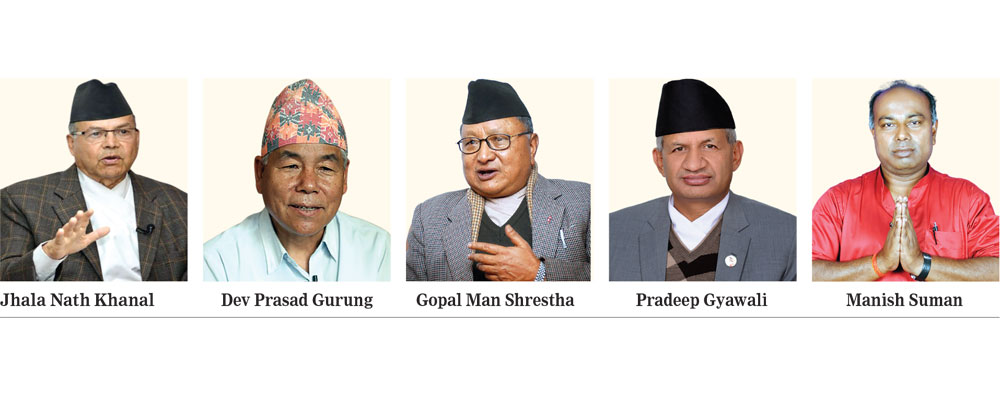

By A Staff Reporter,Kathmandu, May 25: Former Prime Minister and senior leader of the ruling CPN (Unified Socialist) Jhala Nath Khanal said that the first 15 years of the federal republic system was a milestone.
He highlighted that the establishment of the republic system was instrumental in guaranteeing fundamental rights for the Nepali people and solidifying the adoption of a constitutional democratic framework.
Recalling the pivotal 2017 elections, Khanal noted the remarkable success of the Communist forces, which secured an impressive near two-thirds majority. This triumph allowed them to form governments across all seven provinces, signifying a significant breakthrough after enduring decades of political instability.
Reflecting on the country's journey of the system, Khanal attributed the achievement to significant political events, notably the People's Movement that effectively ended the autocratic monarchy spanning 240 years.
"After 10 years, Nepal successfully promulgated the constitution through extensive consultation, marking a truly historic achievement," said Khanal.
"However, Nepal's domestic politics took an abrupt turn into turbulence when former Prime Minister KP Sharma Oli dissolved the House of Representatives, once again pushing the country into a state of political instability," said Khanal.
Despite optimistic expectations surrounding the parliamentary election held in November last year, the outcome resulted in a hung parliament at both the federal and provincial levels, rendering the formation of a stable government unattainable.
Expounding on the consequences, Khanal remarked, "This ongoing political turmoil has given rise to pressing concerns encompassing corruption, economic crisis, social and cultural challenges, as well as issues pertaining to nationality. Geopolitical forces are also exerting their influence, while major political parties struggle to presenw t a coherent vision."
Khanal stressed the severe impact of corruption and unemployment in Nepal, underscoring the urgent need for unification among socialist, nationalist, progressive, and democratic forces to confront these challenges.
He firmly asserted that unity was essential for system reform, ultimately paving the way for Nepal's journey towards prosperity and development.
General Secretary of CPN (Maoist Centre), Dev Prasad Gurung said that Nepal's achievement in abolishing the centuries-old monarchy and establishing a federal democratic republic system is historic. He asserts that Nepal is recognised globally as a federal democratic republic country, which is an achievement.
He added that there are two opposing ideas in the country: one aims to steer the country towards progressive socialism aligned with the foundation of the republican system and constitution, while the other intends to maintain the status quo.
So he emphasised the responsibility of all democratic forces to safeguard and strengthen the federal democratic republic system and constitution, ensuring stability in the country.
Similarly, Nepali Congress leader Gopal Man Shrestha said that many things were forwarded after the establishment of the Republican system, but not rightly.
Stating the country has been moving ahead in a system with a parliamentary party system and federal system in place but still the lower levels have not been empowered as they should have been.
"So we have to give power to lower government or review on the federal republic system," he said.
Shrestha said after the establishment of the republic set up, a Federal Democratic Republic constitution has been promulgated, but the state was not delivering good governance and development as per the people’s aspirations.
He worried about the present economic crisis and asked the government to take a bold decision to recover the economy and the lawmakers should be ready to give up their facilities as well.
"The Finance Minister should take a bold step to cut the facilities, import luxurious things," he said.
He also said the agriculture sector was slow and an agrarian country that was exporting rice, fruit and vegetables in past is now importing them
He asked to utilise water, land and youth power and introduce the education policy useful to life.
Likewise, former Foreign Minister and CPN-UML Deputy General Secretary Pradeep Gyawali highlighted the significance of Nepal's Federal Democratic Republic, stating that it is regarded as the best system of governance.
“The establishment of the republic marked an important event in Nepali history, bringing positive outcomes such as ending a decade-long political conflict and steering the country towards peace, empowering commoners to assume leadership roles, and establishing the sovereignty of the people. It also marked the logical conclusion of seven decades of struggles for political rights and democracy. He, however, admitted that even 15 years after its establishment, the process of fully institutionalising the system is still ongoing.
Emphasising the need for patience, he stated that the system is still premature to conduct a comprehensive assessment at this stage.
He acknowledged that while important milestones have been achieved after the establishment of the system, the aspirations of the people have not been fully met.
“Political stability remains a major challenge, leading to instances of misconduct in Nepali politics. This has also raised questions about the effectiveness of the system and created a gap between the system and the general population. This has also hindered their sense of ownership towards the system.”
In light of these challenges, Gyawali emphasised the collective responsibility to institutionalise the republic and utilise its potential to improve people's lives.
He also highlighted the need for collective efforts to establish political stability, promoting good governance, and upholding values and practices aligned with the foundations of the republican system.
“Only through concerted efforts, can Nepal realise its vision of prosperity, development, and socio-economic transformation,” he added.
Manish Suman, Central Executive Committee Member & Spokesperson for Janata Samajbadi Party Nepal (JSPN) said that as per the mandate of some political struggles and movements, the current Republican System was established. It is the atest and vibrant version of the political systems.
"Federalism, secularism and inclusive democracy are the additional features of our political system. Even monarchists are enjoying the freedom bestowed by the republican constitution to oppose the very political system. This is another beauty of the political system," Jha said.
Nepal has formulated the new constitution in 2015 to institutionalise the federal democratic republican system in the country, he further said. "Although we, as a stakeholder of a Madhes-based party, have some reservations with the contents of the constitution, we have participated not only in the two general elections but also in the provincial and federal governments. It is true that we are demanding amendments to some provisions of the constitution to improve the federal structure and other contents.
But we don’t want to repeal the constitution’s basic features likes republicanism, federalism and secularism. We have a strong desire to prosper our country working under this constitution and the current political system. The country is smoothly moving ahead under the current republican system," he said.
-square-thumb.jpg)