- Tuesday, 2 June 2026

Govt policies, programmes draw mixed reactions
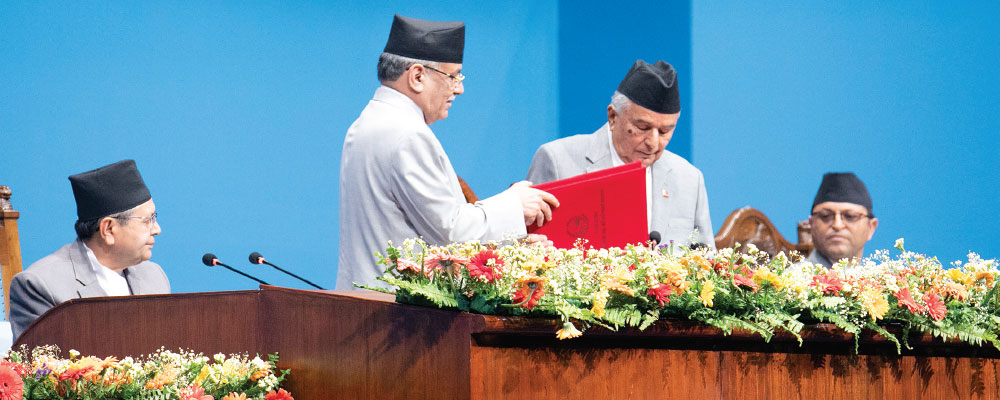

By Ram Prasad Dahal/Laxman Kafle,Kathmandu, May 21: Politicians, economists and business leaders have expressed mixed reactions over policies and programmes for the fiscal year 2023/24 presented by the government on Friday.
Commenting on the policy document, Nepali Congress leader Mohan Basnet, who is also Health and Population Minister, said the policies and programmes have incorporated wider areas.
After President Ram Chandra Paudel unveiled the policies and programmes in the joint session of the parliament on Friday, Minister Basnet said the policies and programmes have given a message regarding the priority areas of the upcoming fiscal budget.
“Now the economic crisis is seen due to COVID-19 and the Russian invasion of Ukraine. The policies and programmes cover all areas. We have to implement it effectively to achieve the targets,” he said. NC lawmaker Pradeep Paudel said that the policies and programmes were ear-friendly although they are traditional.
Main opposition CPN-UM’s secretary Yogesh Bhattarai said the policy document had a body but no life.
He claimed there was no concrete proposal to resolve the problem the country was facing. “It has no concrete action plan to resolve challenges faced by the economy,” he said.
Rastriya Swatantra Party said the policies and programmes could not address the present economic crisis.
Talking with journalists after the House session, RSP chief whip Santos Pariyar said no concreate thing could be noticed in the document.
“We will discuss it in the House. But the policies and programmes will not address the economic problem,” he said.
Likewise, Rastriya Prajatantra Party chairman Rajendra Lingden stated the government policies and programmes were an ‘old essay’.
He wrote on his social media that the policies and programmes would not address the present economic crisis.
Not specific
Likewise, economist and former member of National Planning Commission Dr. Chandra Mani Adhikari said that the policies and programmes of the government covered wide range of issues instead of specific needs to save the economy and life of the people.
“It is time to adopt concrete policies and programmes to save the economy, not to accelerate the pace of the economy. But, the government is unable to include concrete policies in this regard,” he told The Rising Nepal.
Covering a wide range of issues will only increase the demand for budget, he said, adding that the size of the budget is likely to be higher than the existing budget ceiling of Rs. 1,688 billion for the next fiscal year. He said that the government had forwarded the programmes which were already adopted but not implemented.
“Hetauda Textile Industry, Gorakhkali Rubber Industry and Butwal Yarn Industry, which have the possibility of re-operation, will be brought into operation. It is not possible to implement this progammme this year,” he said.
Implementation challenges
President of Nepal Chamber of Commerce Rajendra Malla welcomed the policies and programmes. He, however, doubted effective implementation of the policies and programmes.
“The policies and programmes unveiled by the government are positive. It is equally important to implement them properly,” he said.
Giving his preliminary comments on the policies and programmes, President Malla said that the government should allocate the budget properly in line with the policies and programmes.
“The policies and programmes say that competitiveness of the industry will be increased by providing, at subsidised rates, electricity saved after domestic consumption and export. These are positive and expected to promote local industries,” Vishnu Kumar Agrawal, President of Confederation of Nepalese Industries (CNI) said.
He said that through the policies and programmes, the government has recognised the problems faced by the private sector which is positive and encouraged the private sector.
“The decline in overall demand of the economy, liquidity crunch, high interest rate, inflation, low capital expenditure, declining revenue mobilization and increasing pressure on the external sector will be addressed. Distribution of national income will be made equitable. These are appreciable,” he said.
He said that the policies and programmes have focused on local production, consumption and support for promoting ‘Make in Nepal’ and ‘Made in Nepal’ campaigns which will help increase the production and consumption of domestic goods.