- Tuesday, 2 June 2026

A Pensioner’s Time Travel

One sunny winter morning, as I was passing through a street, I chanced to witness a funny exchange between a 70-year-old pensioner and a young fellow. The pensioner was expressly talking about his emotions without commas or full stops for the stranger that stood before him, frozen and quiet. His torso was upright but had clear ageing signs like a caved-in throat and a wrinkled face, while his hands waved sideways as he spoke in a deep voice. The way he spoke showed that they had a strong bond and were meeting after quite a long gap. As they hung out on the sidewalk, the street plunged into commotion second by second. That was the signal of rush hour for the movers to the offices, schools and colleges. It had swiftly flooded with pedestrians, aside from the motion and noise of cars, tempos and buses.
In truth, the metropolis had to keep wide awake until late in the night. The listener was glad that he’d met with his senior and, in a show of courtesy, had just stood by. But as
the discourse had its course, he stole the eyes frequently over the cellphone clock if he was truly late.
And the topic? The speaker truly wandered off! Once he complained about his untrendy bowels, next he complained about the nights’ lack of sleep! Those moments, though, were for them both—fluid for the one, hard for the other. The funny part was that the listener neither cheered him on, saying, "Please continue," nor said, "Sorry, I don’t have one free minute!' The speaker's not enjoying it yet. Finally, the topic had changed to the nation’s politics and its bad leaders.
In a way, the topic wasn’t strange for me because politics is the very dessert course next to the staple food of dal-bhat on any tongue today. It’s not sweet, though! And before the listener had said, "No, no, you’re too much!’ the pensioner jerked off to a big relief, "Oh god, I'm out for my wife’s prescription drug!’ The two fellows there were prisoners of time. Their preview then put me into multiple questions. The first was: "Time’s money! But how? I assumed that the answer could vary as regards both time and money. For the 24/365 free speaker, once time was money. For the 24/365 busy listener, now money was time. The speaker had his golden past to ferry back. Ageing had now teased him since he’d no relief in bowel motion or regular sleep. The listener, being young, had a golden dream that wished him to glide forward into the future.
But as he stood in no motion, it reminded me of Leo Tolstoy’s short story Three Questions. In the story, Tolstoy explained the connected relativity of the right time, the right man, and the right task. All these had but split here! Next that came to mind was Wordsworth, the great poet, who had said, "The world’s too much with us!' As such, it had trolled Wordsworth too! In short, the listener failed to free himself early. Then I reviewed the term of retirement. I knew that retirement was a natural visitation for the worker at a certain age! Does a retirement sound like falling from grace and being a mere face in the crowd?
Their view also raised a question about mismatching companions, like when one is the right company and when the other isn’t. I remembered how my students had an interest in the classroom and how they’d ignore me soon after for their peers. Likewise, I also understood the kids who loved me but loved to flock, chat, and play together more with the same-feather group.
Ride off to retirement
I had my eyes on the pensioners again: how’re they on the finish line? I imagined a government secretary riding off their power. Their table-pen was otherwise mightier than the sword to write off millions. Likewise, in the case of a professor emeritus, their marker pen had otherwise exclusively scratched off between 1 and 100 full marks; it’s their liberty on student papers. Now where are they? Were they disgraced, otherwise with the power to reward or punish? In like manner, how do other such pensioners take their retirement? Shouldn’t they have a purpose to guide?
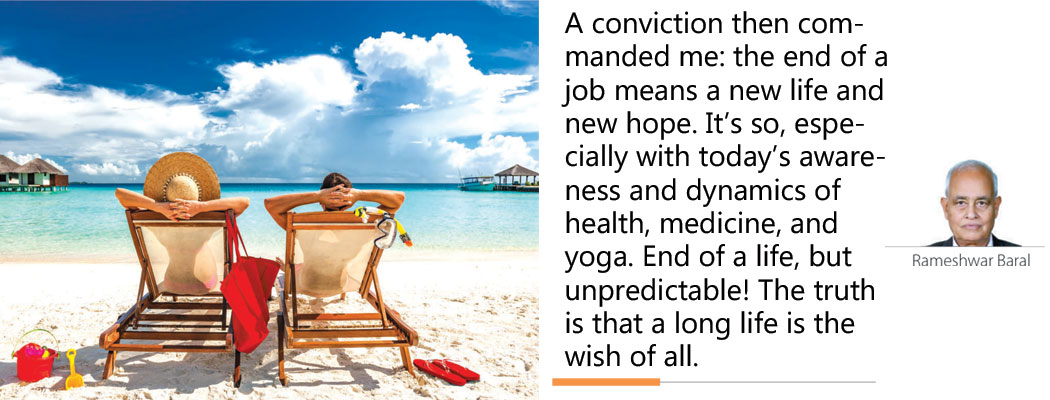
Casually, then, I meditated upon the two incidents: the end of my job and the end of my life. Age is a scale of arithmetic, and life is a trail of geometry. A conviction then commanded me: the end of a job means a new life and new hope. It’s so, especially with today’s awareness and dynamics of health, medicine, and yoga. End of a life, but unpredictable! The truth is that a long life is the wish of all.
One can perceive this in a terminally ill patient and a death convict alike. As such, we all wish to stay alive for one more year, one more month, one more day, one more hour, and, in the least bit, one more second.
The time vessel is thus shrouded in indefinite years. This again implies that the Yamaraj’s no-fear bug will cry out, "No, Mr. Death, be not unfairly! Be not early!' Then, why not say, "The show must go on! I’ve known a pensioner join post-graduation with a true thirst for education. I also read about an African octogenarian lady taking part in the marathon race. In the beginning, she had complaints in her knees that denied her smooth movements. But she had an adorable confidence. She cured them, took months of self-training in running, and finally joined the race to win.
Unbounded love
Aside from these, one can see how a housewife in any family is ever buried in housekeeping! She keeps going as long as the legs stand up in an unbounded love for the grandkids and spouse. This is an example of why retirement is not a resentment of physical and mental activities. It’s just riding off a direct authority; it’s merely the end of one purpose and a transit to another. Why not better say, "Life’s one; jobs are twenty-one," since a pensioner’s rich IQ and profile have the potency of smooth and wise decisions. They lurk as a treasure to pull back the juniors from fault lines.
With all these in mind, I finally understood that a pensioner is the one who sets out for time travel along varied social, national, and continental skies.
On my evening walks too, I’d pass by them on the desks like a Chautari, at the foot of a tree, or on the stepladders of a roadside showroom to loll on and chat. The old peers thus together implies that though their age of making’s over, they've got a higher potency of virtual desks that are now not theirs!
(Baral is a retired lecturer of English)


-square-thumb.jpg)
-original-thumb.jpg)