- Tuesday, 2 June 2026

As Assad returns to Arab fold, Syrians watch with hope and fear
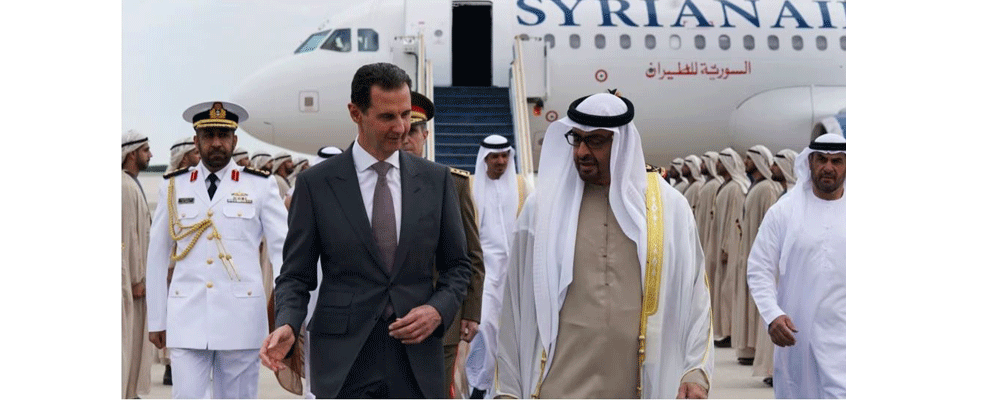

Beirut, Apr. 27: Syrians living on opposite sides of the largely frozen battle lines dividing their country are watching the accelerating normalization of ties between the government of Bashar Assad and Syria's neighbours through starkly different lenses.
In government-held Syria, residents struggling with ballooning inflation, fuel and electricity shortages hope the rapprochement will bring more trade and investment and ease a crippling economic crisis.
Meanwhile, in the remaining opposition-held areas of the north, Syrians who once saw Saudi Arabia and other Arab countries as allies in their fight against Assad's rule feel increasingly isolated and abandoned.
Turkey, which has been a main backer of the armed opposition to Assad, has been holding talks with Damascus for months — most recently on Tuesday, when the defence ministers of Turkey, Russia, Iran and Syria met in Moscow.
And in recent weeks, regional heavyweight Saudi Arabia — which once backed Syrian rebel groups — has done an about-face in its stance on the Assad government and is pushing its neighbours to follow suit. Saudi Foreign Minister Prince Faisal bin Farhan visited Damascus last week for the first time since the kingdom cut ties with Syria more than a decade ago.
The kingdom, which will host a meeting of the Arab League next month, has been coaxing other member states to restore Syria’s membership, although some holdouts remain, chief among them Qatar. The League is a confederation of Arab administrations established to promote cooperation among its members.
A 49-year-old tailor in Damascus who gave only his nickname, Abu Shadi (“father of Shadi”) said he hopes the mending of ties between Syria and Saudi Arabia will improve the economy and kickstart reconstruction in the war-battered country.
“We’ve had enough of wars — we have suffered for 12 years,” he said. “God willing, relations will improve with not just the Kingdom of Saudi Arabia but with all the Gulf countries and the people will benefit on both sides. There will be more movement, more security and everything will be better, God willing.”
In the country's opposition-held northwest, the rapprochement is a cause for fear. Opposition activists took to social media with an Arabic hashtag translating to “normalization with Assad is betrayal,” and hundreds turned out at protests over the past two weeks against the move by Arab states to restore relations with Assad.
Khaled Khatib, 27, a worker at a non-governmental organization in northwest Syria, said he is increasingly afraid that the government will recapture control of the remaining opposition territory.
“From the first day I participated in a peaceful demonstration until today, I am at risk of being killed or injured or kidnapped or hit by aerial bombardment,” he said. Seeing the regional warming of relations with Damascus is “very painful, shameful and frustrating to the aspirations of Syrians,” he said.
Rashid Hamzawi Mahmoud, who joined a protest in Idlib earlier this month, said the Saudi move was the latest in a string of disappointments for the Syrian opposition.
“The (U.N.) Security Council has failed us — so have the Arab countries, and human rights and Islamic groups,” he said.
Syria was ostracized by Arab governments over Assad’s brutal crackdown on protesters in a 2011 uprising that descended into civil war. However, in recent years, as Assad consolidated control over most of the country, Syria’s neighbours have begun to take steps toward rapprochement. (AP)