- Tuesday, 2 June 2026

Words Of Insightful Sayings

Words are inputs of languages. But, if inputs for the right outputs of expressions are incorrect, we do not get any sensible meaning. However, there is also another aspect to talk about on it.
It is the thing in which words take valued form and give meanings for all times purposively to advise human beings
and show them a way towards wisdom and knowledge. Such words do not come easily. They come out only from devotion and truth.
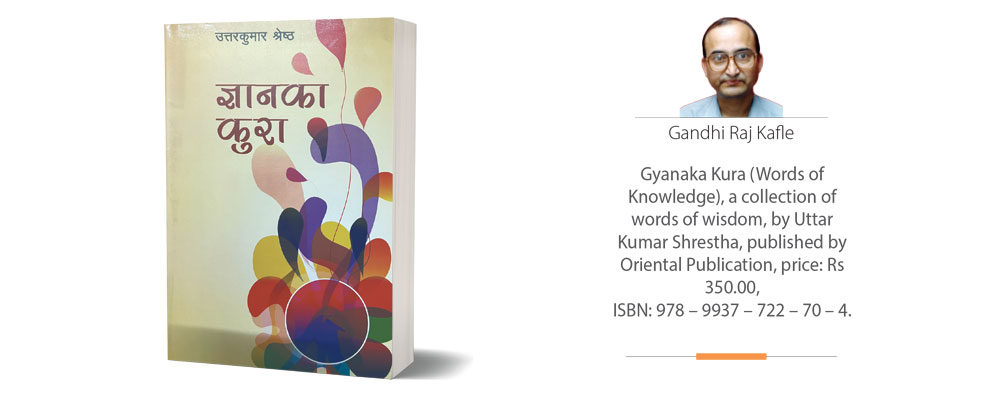
We here have the under-review book entitled “Gyanka Kura”, collected by Uttar Kumar Shrestha to talk on the importance of words of wisdom in human life. Physically speaking, it is a collection of a few words sentences. The number of Gyanka Kura is huge because the author happens to be an impassionate collector of precious thoughts.
How much time did he spend collecting these precious views? The author is Mum. Maybe, he is unwilling to count or show. Our Shastras insist sacred works of interest should not be related to the count of times, profits, or loss. So, as per the views of these Shastras, we can only say these 4484
quotable quotes, which have come in form of a book, is a beyond count
thing because it shows the level of passion of the author.
What is knowledge? The quotes offered by Shrestha make readers inquisitive to find the true point. We can present some such examples to see how broad and deep these views are.
The author writes:
Gyan Dan Mahadan. (Donation of knowledge is the great donation.): Page 1
Isworia Gyanbina Aham Bhagdaina. (We can’t kill ego without divine knowledge.): Page: 23
Paramatma ‘attention’ Herchhan, Duniyan ‘presentation’. (The god seeks attention, but the world seeks presentation.): Page: 39
Jo Manan Garchha, Tyo Manushya Thaharchha. (One who does soul-searching is a man in the true sense.) Page: 87
Omkar Angalaun, Aatma Samhalaun, Antya Saparaun, Amar Banaun. (Embrace Omkar, take care of Aatma, make the end great and attain immortality.) Page: 257
These are sample quotes from the book "Gyanka Kura", which tell us what importance is there in knowledge for life. Shrestha's quotes are not limited to carrying meanings of knowledge from the flow of information only. They contain true values of knowledge because they are built up in the line of views envisioned by Lord Krishna in the Gita. So, let’s remember Lord Krishna who says Adhyatma Vidhya (Spiritual Knowledge) is the synonymous name of God himself.
So, we can say the quotes of this book share opinions in line with the knowledge of the Vedas, the Vagawad Gita, the Upanishads and sayings of the great personalities of the world. Besides this, these words are precious because they have come from the realization of an experienced author who devoted his entire life to contributing to society through the medium of education.
Author Uttar Kumar Shrestha is enjoying free life after retirement from the day-to-day works of the profession. He is eighty-four years old now. Here the good fruit for him to remember is the work he has sown in society carries ageless values. For example, the establishment of the English medium Siddhartha Primary School in Damak of Jhapa District which he established four decades ago is still running and he is ever ready there to help the school to impart quality education in Damak and its surroundings.
One more thing to mention in the context of this book is these quotes which the author has collected also reflect the positive line of thoughts, especially from own life of Shrestha. We need to appreciate the author for this. All individuals should try to keep their morale high because it is that element with which we can respond to social endeavours appropriately.
Let's see this line of thought from the book. The numbers 2271 and 2280 sayings on page 138, 'Effects change with the change of sentiments’, but ‘we must have sanctity in our body, heart, property, thoughts and work’. Likewise, two other quotes from the book, the numbers 2304 and 2308 on page 139, 'We should neither give trouble nor should take it' and 'Only change can make you winner, not revenge'. These lines of thought carry enormous practical values.
In conclusion, what must be said is the life of an individual, too, is an institution of learning. The praiseworthy thing in this vein is: Shrestha, the author of 'Gyanka Kura' has presented mature knowledge based on long experience of his own life, which is praiseworthy. In addition to it, his inclination towards creative writings and social works at the time of mature age now both deserve appreciation.
(Kafle is a former TRN Journalist)