- Friday, 29 May 2026

Sindhuligadhi Durbar restored to its former glory

By Baburam Devkota,Sindhuligadhi, Feb. 15: Sindhuligadhi Ghumera Herda, Suntalimai, Katima Ramro Durbara, Maryo ni Mayale Maryo. This hit folk song sung by Krishna Bikram Thapa describes the beauty of the Sindhuligadhi Durbar.
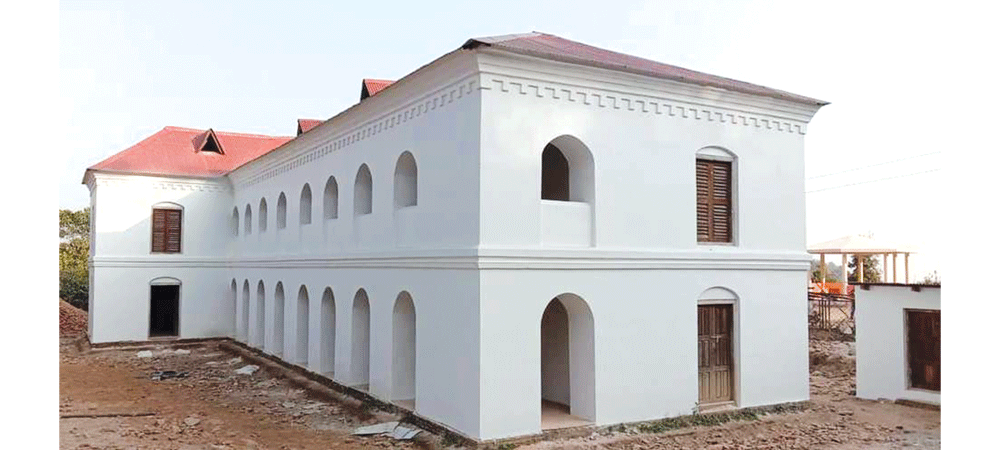
This historic palace at a strategic location, which had remained in ruins for decades, has now restored to its former glory, just like the above song states.
The palace that is now in Kamalamai Municipality-3 has been reconstructed and beautified with the help of the Bagmati Province Government.
When Radio Nepal held a nationwide folk song competition in 1979, folk singer late Thapa’s song that described the palace won the first place.
Devi Prasad Sigdel, 75, of Kamalamai Municipality-3, said that the durbar was reduced to rubbles after none of the concerned organisations showed any interest in preserving it.
He said, “Now, after completing the reconstruction of the palace in its original appearance, it has been decorated like a bride.” The durbar has restored to its former glory.
According to the Municipality, the reconstruction of the palace had started in February last year with the help of the Bagmati Provincial Government after the physical structures of the palace and the fort were damaged in lack of protection for a long time.
The provincial government has spent Rs. 43.8 million for reconstructing the Durbar.
Rabindra Shrestha of Tulsi-Arisa JV Bhaktapur informed that an agreement was reached to complete the reconstruction work of the palace by May 16 last year, but the deadline was extended due to the COVID-19 pandemic. The reconstruction was completed by mid-January this year. He said, “Now, we are in the process of handing it over to the provincial government,” he said.
The durbar, which was the headquarters for the administration of the East No. 2 in 1964, became lifeless after the administration centre was shifted to Sindhulimadhi.
Upendra Kumar Pokhrel, Mayor of Kamalamai Municipality, said that keeping in mind the historical and archaeological importance of the palace, it was rebuilt in the original style. He said that the municipality was trying to make the Sindhuligadhi area a tourist destination. Sagar Kumar Dhakal, head of the environmental branch of the municipality, said that the durbar was built by Bambir Bikram Rana, the son of Bam Bahadur Rana, the brother of first Rana Prime Minister Junga Bahadur Rana, but the inscription mentions that the palace was built for the residence of chiefs and soldiers.
To the south of the palace were Ganesh, Saraswati, and Lakshmi temples, with stream, well and pond to the west. Colonel Pushkar Bikram Junga Bahadur Rana, the son of Drupada Rani, rebuilt the durbar and named it Rani Durbar. He said that it was mentioned in the inscription that the construction of the durbar was completed in 1929.
He said that the number of tourists visiting Sindhuligadhi is increasing every day with the construction of a war museum by the Nepali Army. There is a statue of Prithvi Narayan Shah, a picnic spot and a fence within the durbar complex. Construction of a mausoleum has been started at the place where the British soldiers died during the Anglo-Nepal war.
The fort is important for being the place where the Nepali army defeated the better-equipped British army led by captain Kinlock.
-original-thumb.jpg)
-square-thumb.jpg)
-square-thumb.jpg)