- Thursday, 28 May 2026

German caution on Ukraine arms rooted in political culture
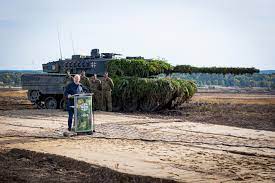

Berlin, Jan. 22: Germany has become one of Ukraine’s leading weapons suppliers in the 11 months since Russia’s invasion, but Chancellor Olaf Scholz also has gained a reputation for hesitating to take each new step — generating impatience among allies.
Berlin’s perceived foot-dragging, most recently on the Leopard 2 battle tanks that Kyiv has long sought, is rooted at least partly in a post-World War II political culture of military caution, along with present-day worries about a possible escalation in the war.
On Friday, Germany inched closer to a decision to deliver the tanks, ordering a review of its Leopard stocks in preparation for a possible green light.
There was still no commitment, however. Defence Minister Boris Pistorius rejected the suggestion that Germany was standing in the way but said, “we have to balance all the pros and contras before we decide things like that, just like that.”
It’s a pattern that has been repeated over the months as Scholz first held off pledging new, heavier equipment, then eventually agreed to do so. Most recently, Germany said in early January that it would send 40 Marder armoured personnel carriers to Ukraine — doing so in a joint announcement with the U.S., which pledged 50 Bradley armoured vehicles.
That decision followed months of calls for Berlin to send the Marder and stoked pressure for it to move up another step to the Leopard tank.
“There is a discrepancy between the actual size of the commitment and weapons deliveries — it’s the second-largest European supplier — and the hesitancy with which it is done,” said Thomas Kleine-Brockhoff, a Berlin-based senior analyst with the German Marshall Fund of the United States think tank.
Scholz, an unshakably self-confident politician with a stubborn streak and little taste for bowing to public calls for action, has stuck resolutely to his approach. He has said that Germany won’t go it alone on weapons decisions and pointed to the need to avoid NATO becoming a direct party to the war with Russia.
As pressure mounted last week, he declared that he wouldn’t be rushed into important security decisions by “excited comments.” And he insisted that a majority in Germany supports his government’s “calm, well-considered and careful” decision-making.
Speaking at the World Economic Forum in Davos, Switzerland, on Wednesday, Scholz listed some of the equipment Germany has sent to Ukraine, declaring that it marks “a profound turning point in German foreign and security policy.”
That is, at least to some extent, true. Germany refused to provide lethal weapons before the invasion started, reflecting a political culture rooted in part in the memory of Germany’s own history of aggression during the 20th century — including the Nazi invasion of the Soviet Union.
“No German chancellor, of no party, wants to be seen out front in pushing a military agenda — you want to try all other options before you resort to that,” Kleine-Brockhoff said. “And therefore for domestic consumption, it is seen as a positive thing for a German chancellor not to lead on this, to be cautious, to be resistant, to have tried all other options.” (AP)