- Thursday, 28 May 2026

Brazil authorities seek to punish pro-Bolsonaro rioters
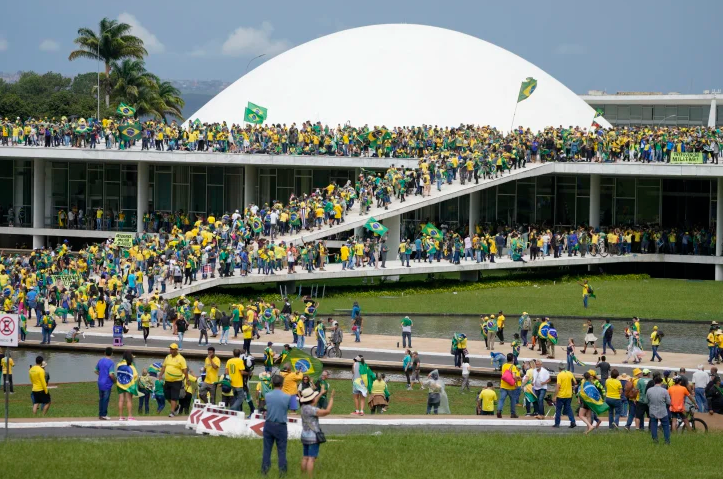

Rio De Janeiro, Jan. 10: Brazilian authorities were
picking up pieces and investigating Monday after thousands of ex-President Jair
Bolsonaro’s supporters stormed Congress, the Supreme Court and presidential
palace then trashed the nation’s highest seats of power.
The protesters were seeking
military intervention to either restore the far-right Bolsonaro to power or
oust the newly inaugurated leftist Luiz Inácio Lula da Silva in scenes of chaos
and destruction reminiscent of the Jan. 6, 2021, insurrection at the U.S.
Capitol.
Rioters donning the green and
yellow of the national flag on Sunday broke windows, toppled furniture, hurled
computers and printers to the ground. They punctured a massive Emiliano Di
Cavalcanti painting in five places, overturned the U-shaped table at which
Supreme Court justices convene, ripped a door off one justice’s office and
vandalized an iconic statue outside the court. The monumental buildings’
interiors were left in states of ruin.
In a news conference late
Sunday, Brazil’s minister of institutional relations said the buildings would
be inspected for evidence including fingerprints and images to hold people to
account, and that the rioters apparently intended to spark similar such actions
nationwide. Justice Minister Flávio Dino said the acts amounted to terrorism
and coup-mongering and that authorities have begun tracking those who paid for
the buses that transported protesters to the capital.
“They will not succeed in
destroying Brazilian democracy. We need to say that fully, with all firmness
and conviction,” Dino said. “We will not accept the path of criminality to
carry out political fights in Brazil. A criminal is treated like a criminal.”
So far, 300 people have been
arrested, the federal district’s civil police said on Twitter.
In the months that followed
Bolsonaro’s Oct. 30 electoral defeat, Brazil was on edge – leery of any avenue
he might pursue to cling to power. Bolsonaro had been stoking belief among his
hardcore supporters that the electronic voting system was prone to fraud — though he
never presented any evidence. And his lawmaker son Eduardo Bolsonaro held
several meetings with Trump, Trump’s longtime ally Steve Bannon and his senior
campaign adviser, Jason Miller.
Results
from Brazil’s election — the closest in over three decades — were quickly
recognized by politicians across the spectrum, including some Bolsonaro allies,
as well as dozens of governments. And Bolsonaro surprised nearly everyone by
promptly fading
from view. He neither
conceded defeat nor emphatically cried fraud, though he and his party submitted
a request to nullify
millions of votes that
was swiftly
dismissed.
Brazilians
have used electronic voting since 1996. Election security experts consider such
systems less secure than hand-marked paper ballots because they leave no
auditable paper trail. Brazil’s system is, however, closely scrutinized and
domestic authorities and international observers have never found
evidence of it being exploited to commit fraud.
Still,
Bolsonaro’s supporters refused to accept results. They blocked roads and camped
outside military buildings, urging the armed forces to intervene. Protests were
overwhelmingly peaceful, but isolated threats of
terrorism — including a
bomb found on a fuel truck headed to Brasilia’s airport — had prompted security
concerns.
Two
days before Lula’s Jan. 1 inauguration, Bolsonaro flew to the U.S. and took up
temporary residence in Orlando. Many Brazilians expressed relief that, while he
declined to participate in the transition of power, his absence allowed it to
occur without incident.
Or
so it had been, until Sunday’s havoc.
“Bolsonarism
mimics the same strategies as Trumpism. Our Jan. 8 — an unprecedented
manifestation in Brazilian politics — is clearly copied from Jan. 6 in the
Capitol,” said Paulo Calmon, a political science professor at the University of
Brasilia. “Today’s sad episodes represent yet another attempt to destabilize
democracy and demonstrate that the authoritarian, populist radicalism of
Brazil’s extreme right remains active under the command of former President
Bolsonaro, the ‘Trump of Latin America.’”
U.S.
President Joe Biden tweeted that the riots were an “assault on democracy and on
the peaceful transfer of power in Brazil,” and that he looked forward to continue
working with Lula.
In
a news conference from Sao Paulo state, Lula read a freshly signed decree for
the federal government to assume control of security in the federal district.
He said that the so-called “fascist fanatics,” as well as those who financed
their activities, must be punished, and also accused Bolsonaro of encouraging
their uprising.
Bolsonaro
repudiated the president’s accusation late Sunday. Writing on Twitter, he said
peaceful protest is part of democracy, but vandalism and invasion of public
buildings are “exceptions to the rule.” He made no specific mention of the
protesters’ actions in Brasilia.
“He
is evidently the intellectual mentor of what is happening, so he cannot
dissociate from it,” said Mario Sérgio Lima, political analyst at Medley
Advisors. “These groups were created by him, by the radicalism he imposed on
politics. There is no way to undo that. ... It seems his group has already
crossed the Rubicon.”
Unlike
the 2021 attack in the U.S., few officials would have been working in the top
government buildings on a Sunday. And videos showed limited presence of the
capital’s military police. That led many in Brazil to question whether the
police had ignored abundant warnings, underestimated their abilities or had
been somehow complicit.
One
video showed a group of protesters pushing through a police barricade with
limited struggle, and only a few officers deploying pepper spray. Another
showed officers standing by as protestors stormed Congress, including one
recording images on his phone.
“This
was a gross error by the federal district’s government. It was a tragedy
foretold,” said Thiago de Aragão, director of strategy at Brasilia-based
politican consultancy Arko Advice. “Everyone knew they (the protesters) were
coming to Brasilia. The expectation was that the federal district’s government
was going to mount a response to protect the capital. They didn’t do any of
that.”
Lula
said at his news conference there was “incompetence or bad faith” on the part
of police, and he promised some would be punished.
Federal
District Gov. Ibaneis Rocha confirmed on Twitter he had fired the capital
city’s head of public security, Anderson Torres. Local media reported that
Torres is in Orlando for vacation, and that he denied having met with Bolsonaro
there.
“Two years since Jan. 6, Trump’s legacy continues to poison our hemisphere,” U.S. Sen. Bob Menendez, who chairs the Senate’s foreign relations committee, tweeted, adding that he blamed Bolsonaro for inciting the acts. “Protecting democracy & holding malign actors to account is essential.” (AP)

-original-thumb.jpg)