- Thursday, 28 May 2026

Make Service Delivery Efficient

Despite promises made by the political parties and successive governments to advance the public service delivery system in Nepal, the people have hardly experienced any perceptible transformation in this vital area. They often go through unnecessary hassles in the course of receiving public services. It appears that the service delivery is still in low in priority of the state. It needs no reiteration that the state has a crucial role to play in the delivery of numerous public services ranging from administrative and security to justice for every citizen and private enterprises. Customers such as citizens, residents and businesses seek to get services from the public administration. As taxpayers, they want the administration to deliver services to them in an effective, efficient, reliable and friendly manner.
It is significant that the state has already started applying modern information and communication technologies in its public administration in order to facilitate the citizens and provide them with services in an efficient and predictable way. But the mindset of public officials does not seem to have changed. However, many government offices that are supposed to work directly with the people have now gone for an electronic service delivery. This type of digital service delivery system can be instrumental in slashing both costs and time for service recipients and the relevant government bodies alike.
Ineffective governance
Nevertheless, the citizens have continued to reel from hitches in public offices in one way or the other. Offices looking after land revenue and transport management, immigration, tourism and labour have already got a bad name for their inefficiency and lack of maintaining good governance. Housing map permit and property tax offices under the local government are also infamous for troubling citizens on different pretexts. Most service recipients bear the brunt of ineffective governance in such public organisations.
It is appalling that even the Department of Passport (DoP) under the Ministry of Foreign Affairs (MoFA) has now been fallen into the category of those offices. It has not been an easy process for people to have their passports issued. They have been forced to undergo additional difficulties since the DoP began issuing e-passports in mid-November 2021.
Since hundreds of thousands of Nepali migrant workers go abroad in search of a job annually, a lot of people visit the DoP daily to get their e-passports. An estimated 1,500 Nepalis depart for different countries every day to make some money for them and their families. No doubt, they will have to face numerous challenges while working abroad. But what is saddening is that they start passing through unnecessary ordeals when they first approach the DoP at Tripureshwar of Kathmandu to get the travel document. They have to stand in a long queue from early in the morning to late afternoon. Some are forced to continue visiting the DoP for several days to have an appointment with officials for biometrics. A couple of months ago, even the police personnel had to use force to manage the incontrollable crowds gathered on the DoP premises.
In fact, the citizens were not responsible for such an unwanted situation. In the absence of an efficient administrative system, such a mess is in existence. Another reason for this disorder is that the government launched the e-passport without making necessary preparations. What is more distressing is that no initiative has so far been taken to deal with this problem permanently despite repeated calls from the general public. The media has also been raising this issue frequently since the beginning. One of the factors behind such apathy on the part of the authorities concerned is that only the underprivileged people have been facing this difficulty. Those in power as well as others having access to influential persons or groups may not have to struggle as hard as the ordinary people to get an e-passport.
Though the DoP has introduced an online service for e-passports, this service is not reliable. People usually get upset while applying for this vital travel document online because of server dysfunction. The DoP solicits 1,700 applications via online daily. In addition, different districts around the country also call for applications for the e-passport. But the daily demand stands at over 10,000. The department supplies about 6,000 passports within and outside the country daily.
Matter of shame
Political leaders and high-ranking bureaucrats are often found harping on governance reforms while the common people are facing such a hopeless situation. This is really a matter of shame. The MoFA leadership must stop giving its deaf ear to such a serious matter. Instead, it should come up with a solution to this problem without further delay. If the crunch of human resources is the main issue, the Ministry needs to step up measures to manage it immediately. It could open additional counters so as to provide services to citizens efficiently.
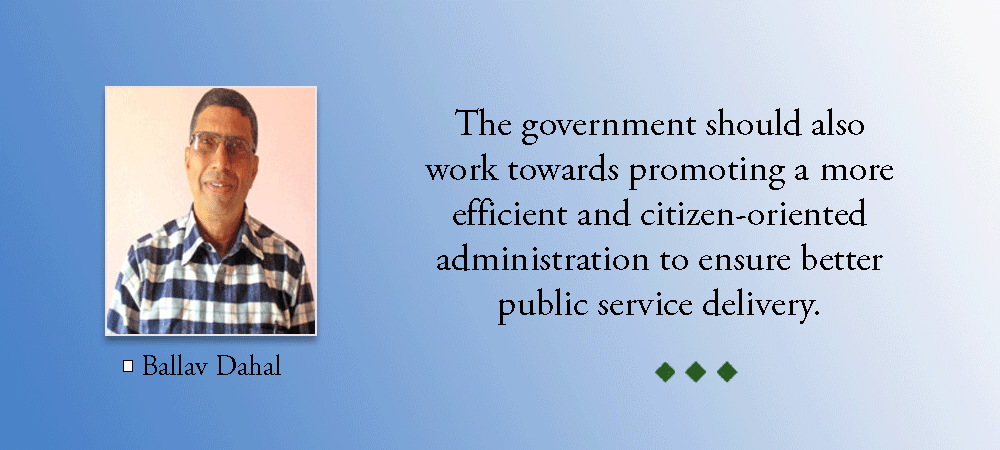
A strong political commitment and determination is essential for addressing such problems. The government should also work towards promoting a more efficient and citizen-oriented administration to ensure better public service delivery. The officials working with public organisations must be held accountable to their activities. Much emphasis should also be laid on putting coherent regulatory and other mechanisms to make sure that the citizens get quality public services.
(Dahal is a deputy executive editor of this daily.)