- Thursday, 28 May 2026

Propaganda For Political Agenda

Aggressive or otherwise, persistent propaganda for political agenda acts as a mischief-laden content designed to serve a particular side’s interests and mislead the rest of the target groups. Although propaganda through various means might have commenced since deep into the prehistoric times, content creators with the desire, incentives and motivation are far better equipped today than any time previously for fostering the art of propaganda in its numerous shades.
To those with the intent and resources, the channel of propaganda serves as a tool for power, false pride, disinformation or distortion of information. Thanks to development of sophisticated information dissemination models and advanced communication technology, most people are left misled or confused by the barrage of contents they are bombarded with so persistently and persuasively.
The ongoing Ukraine war, which broke out in February, offers a running commentary on propaganda, disguised as reflection of patriotism and national interest. The black sheep among news outlets scout for angling stories that suit their unprofessional purposes.
In journalism, only deep conviction works; anything otherwise will, sooner or later, prove ill-advised. This is at least in theory and universally acknowledged.
Misleading methods
Exaggeration, misrepresentation of facts and information distortion combine to misinform people. Winston Churchill, Britain’s prime minister during World War II and later, continues to be hailed as a hero by commentators while others condemn him for racism, reactionary attitude, die hard defender of the empire and reactionary in praise of the exploitative and other disgraceful aspects of imperial times.
Exaggeration, fact misrepresentation and deliberate distortion combine to misinform and mislead people. The consequences sow confusion, chaos and wrong conclusions. One could describe the content creating such havoc among the less informed as a branch of yellow journalism that had its heydays in the American press in the 1830s and after.
The phrase yellow journalism got frequently invoked by those genuinely disgusted with distorted information. At the same time, individuals, whose false public image gets unmasked, vainly cry “yellow journalism”.
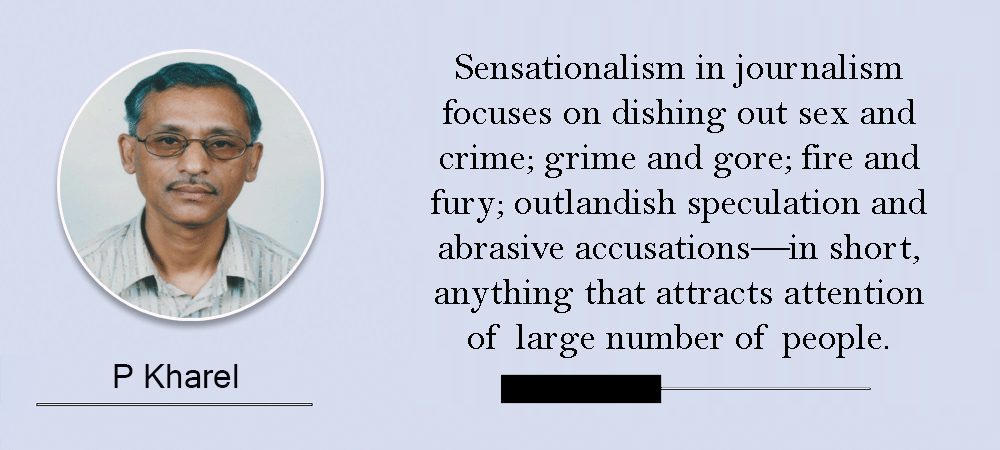
Sensationalism in journalism focuses on dishing out sex and crime; grime and gore; fire and fury; outlandish speculation and abrasive accusations—in short, anything that attracts attention of large number of people. Titillating detail of incidents and events, celebrity affairs and what have you constitute fodder for this variety of information flow. Unlike yellow journalism, sensationalism does not denote deliberate dissemination of baseless information. The design is not to feed false information but pass on facts of sensational nature—trivial, trifle, obliviously tormenting or even degrading. The prime objective is to attract audiences in large numbers. It might even raise ethical questions, except that it strives to stick to facts.
The acid test of objectivity and professional honesty in crisis-ridden times—war, pandemic, disasters and other tragedies or prospects of gains at the expense of others—proves too demanding for many to bother much.
During my college days in the early 1970s, the American library, then located at New Road in Kathmandu, had in its shelves books with titles like Escape to Freedom, Wall of Shame and Wall of Tears, only to disappear after the 1989 fall of Berlin Wall and the 1991 Soviet disintegration.
The West celebrated the world’s first communist country’s collapse as end to what they had it had coined as “Cold War”. That one-party communist regimes in Eastern Europe also gave way to multiparty free elections but a military alliance like NATO continued to expand is another glaring anomaly.
The Soviets and the Chinese agencies also had stacked with their publications, known primarily for their propaganda purposes. Mao lockets and pocket size Red books were also distributed, much to the chagrin of Western embassies in Kathmandu. Such activity stopped after Deng Xiaoping’s rise as the paramount leader in 1978, that is after Mao’s death in 1976.
In the Ukraine war, Western press give prominence to reports of minor gains of the invaded country while downplaying Russian advances. However, the war of disinformation is not a one-way street. Although the West has an upper hand regarding the Russian invasion of Ukraine, the Putin regime in not far behind. It has persuaded, coaxed or purchased news outlets to highlights side of the story denigrating the Ukrainian president and his Western supporters.
This media critic has spotted at least a few big news outlets in South Asia, which relentlessly oblige the Putin regime’s propaganda policy of disseminating their side of the story, manufactured or otherwise.
Lost in lies
John Pilger, an Australian journalist mostly based in London, is put off by mainstream media coverage of the Ukraine war in the American press: “Nothing is to be believed.” His disgust is also over “faked” chemical war and “so much tsunami of jingoism”.
A war correspondent in Vietnam, Cambodia, Bangladesh and Biafra, and mostly based in London, Pilger was named for the Journalist of the Year Award in 1967 and 1979 in Britain, and won a string of prestigious prizes.
In the war of propaganda, the degree of intensity wells up in deference to the gravity of urgency, the extent of resources and who the power players are behind the scheme. Professional integrity boosts the image and reputation of a news outlet of any denomination. People sooner or later test its through tiered filtrations, impact assessment, conclusions thus drawn—and ultimately cross-verified by the ultimate post of history.
Professionally honest, intellectually competent and socially responsible information gatherers and disseminators are essential for crises-hit times and territories, when accuracies and professional practices are the need of the hour for mass audiences. But those with deciding powers are persistent with propaganda for aggressive agenda. The extent of their success determines how deep the general public gets lost in lies heaped without let up.
Nazi Germany’s propaganda minister Goebbels proved to be a past master in the art of mobilising media channels, including print, broadcast and visuals. The Nazi regime succeeded in constantly triggering media blitz for disinformation. Goebbels’ methods were highly effective. Although reviled by the Western alliance, it was keenly adapted by big the World War II victors ever after.
(Professor Kharel specialises in political communication.)