- Tuesday, 26 May 2026

Printer’s Devil And Red Faces
P Kharel
Having just marked the 50th year as a feature article contributor and columnist with an unbeaten record innings, this scribe chooses to mark The Rising Nepal entering its 57th birth anniversary with tidbits that weathered acute embarrassment when they first occurred but can be recalled as lessons.
It so happens that the October which just went by two months ago also signified the 50th year since yours humbly had his first article published in The Rising Nepal, with a heading supplied by the features section.
A journalist witnesses, and experiences, how printing errors play pranks that sometimes trigger something seriously embarrassing or painful to the ones directly affected. Such incidents carry fun, frolic, errors, engaging exercises and even bitter reactions.
Hence the rule that at least two pairs of eyes go through a script in order to reduce chances of slip-ups and ensure that the professional quality of publications does not lose credibility.
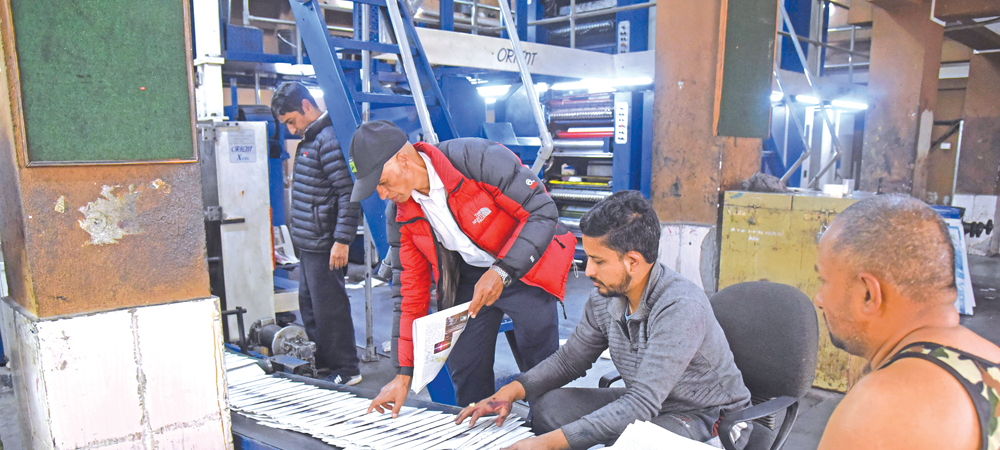
Coined sometime in the 1750s, Printer’s Devil originated as an address to the apprentice in the back shop, that is, the printing press, including the composition room where each character of words was manually and painstakingly assembled, carrying the legacy of Johannes Guttenberg who invented the movable press in German town of Mainz in the mid-15th century.
Guttenberg printed the Bible as his debut venture in substantive publication but with each chapter’s first letter hand-written in a vain attempt at keeping his invention a secret. He died a poor man but his technology revolutionised the communications world and gave a huge fillip to mass education.
Some who went through the Gutenberg Bible suspected the printer of possessing black magic that enabled him to produce a book with letters so evenly and uniformly arranged as to very well be the work of an
evil power.
Sense and Sensibility
In the course of time, Printer’s Devil denoted not only an apprentice but also typos that occurred unwittingly, oversight or carelessness. Printing errors at times rub their unintended victims the wrong way.
In the 21st century, too, publishing technology and professional process are not immune to occasional slip-ups anywhere and anytime, including The Rising Nepal.
As a columnist with the longest innings and not yet done with pen and paper in constant company of a computer, this scribe would like to mention a few random cases of confusion in translation and the uncivil art of Printer’s Devil having spilt ink in both TRN and other publications.
Although I gathered work experience in all sections and shifts of the TRN editorial department, the stints in the reporting group and the features and editorial sections were longer than those in the news desk. The night job was particularly tortuous in the 1970s, with the paper folding up, on an average, not before 1 am.
Yours humbly began his career as a journalist working in the reporting section, which also involved translating news items written by Gorkhapatra correspondents who did likewise with TRN stories. Within the first fortnight or so, this novice slipped up in a translation task.
It was not any typo but a product of casual oversight. A report on Rastriya Banijya Bank got translated as Nepal Bank Limited throughout the item that received a multiple-column front-page treatment.
A complaint from the bank made this reporter sit up in painful embarrassment, looking foolish and chastened. But errors in various forms and under different circumstances rear their heads from the most unexpected quarters. A few weeks later, another translation work went amok in that the story’s entire meaning got lost in translation.
A Gorkhapatra report on a programme organised in the capital city’s Vrikutimandap was translated as “butterfly exhibition” for what should have been “doll exhibition”.
Having watched from close quarters school mates meticulously preserving butterflies carefully collected at the foothills of Phulchowki hill at Godavari, Kathmandu Valley’s tallest tree-topped hill, the “putali” show was wrongly translated as “butterfly”.
That “putali” in Nepali stands as much for doll as for butterfly proved little consolation.
Such can be professional hazards, but readers cannot be blamed for showing displeasure over errors, even if not committed by design.
Colleagues at TRN, Gorkhapatra and the national news agency, RSS, used to recall in amused chats the many incidents that turned reporters red-faced and their organisations embarrassed. In the process, tales get spun and it became difficult in sifting fact from fiction.
Grim Spell
Probably in 1974, a TRN staff-reported news filler on the front page, after a particularly long summer evening of hail and storm, had a related story whose last line read: “News of electrocution is keenly awaited.”
That was no work of Printer’s Devil or confusion in translation, but an untenable outpouring of a peg or two too many. It unsurprisingly enraged electricity authorities the next day.
When Kathmandu was in the midst of winter, a natural disaster struck a tropical country, whereby an editorial in the Gorkhapatra tried sympathising with the calamity-hit country’s people who enveloped in “chilly winter”.
Another claim circulating in the Gorkhapatra newsroom was that during the visit to Nepal by a South Asian country’s head of state, a write-up in the country’s first newspaper narrated
that the foreign VVIP must have witnessed with “both of his eyes” Nepal’s development
efforts. As it turned out, the narrator’s oversight missed the fact that the state guest had only
one eye.
By the way, veteran Indian journalists long ago floated a tale about a publication carrying the headline “Bandit Nehru Crime Minister” in reference to Pandit Jawaharlal Nehru’s being sworn in as India’s first prime minister.
But then a British journalism instructor in 1978 told this trainee that Imperial Britain had once been compelled to suffer the Printer’s Devil that infected a newspaper announcing “
Clown” for Crown while the first letter in Buckingham Palace was misspelt with a riotous
letter that rhymed with a four-letter contributor that frequents novels, movies and informal/enraged conversations, particularly in the United Kingdom and the United States, among many others.
A noted English essayist darts anger at those who grin when someone slips and trips on the ground: They show me bones, not teeth.
The same logic should apply to victims of no fault of theirs but Printer’s Devil or when intended meanings vanish in translation.
Until next time, in similar or another vein.
(A senior media instructor, Kharel is a former editor-in-chief of this daily)
How did you feel after reading this news?