- Tuesday, 26 May 2026

Contest Of Old And New Faces
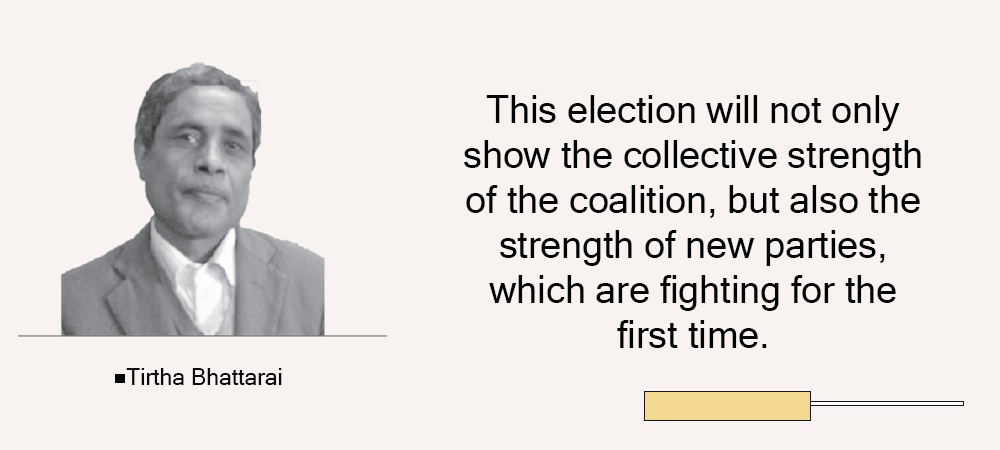
Tirtha Bhattarai, Nepal is going to polls to elect a 275-member House of Representatives (HoR) including 165 in direct and 110 in proportional seats in general election slated for November 20. It is expected to end the months of political upheavals following the dissolution of parliament twice by the then Prime Minister KP Sharma Oli.
The intra-party bickering within the then CPN resulted in expelling of each other from the party which later divided through a Supreme Court verdict that the name CPN belonged to another smaller faction. As the court ordered them to relinquish the new name CPN, they had to reorganise their pre-merger parties - CPN-UML under leader Oli and CPN-Maoist Centre under Prachanda. But the top leaders driven by mutual hostility and blame game were not inclined to start a new process of unification.
As the unification of the CPN was undone by the court, the two factions within UML began to blame each other for political unrest and non-delivery of the government.
Though Oli and Madhav Nepal were in the same party, their conflict grew to a situation where they expelled each other from the party, and a separate party CPN (Unified Socialist) was formed under Nepal splitting from the CPN-UML. Maoist Centre chairman Prachanda and Unified Socialist chairman Nepal joined hands to oust Oli from the premiership, and supported NC president Sher Bahadur Deuba to lead a coalition government of five parties.
The Supreme Court ordered the Office of President for the formation of Deuba-led five-party government that is determined to conduct the elections in a free and fair manner. One of the major achievements of Deuba-led government is that the HoR completed its full five-year term and provided stability to the country.
Fate of coalition
Some 18 million voters are casting votes in some 22,226 polling centres across the country. Anyone reaching 18 years on the previous day of the election will be eligible for the voting. Voters will also elect provincial assemblies in the seven provinces of the country. This general election is going to be very interesting in many ways. It will be an answer to what will be the fate of the coalition government that is formed under Deuba citing his predecessor attempted regression in the country. It will answer questions as to how will the general public react to the dissolution of parliament.
Prime Minister Deuba's rival and independent candidate Sagar Dhakal has asked the people to elect people like him who are educated in foreign universities. This election will show what will be the fate of popular media presenter Rabi Lamichhane, who claims to be independent candidate though he has formed a party called Rastriya Swotantra Party, and other actually independent candidates, amid debates that old leaders failed to deliver on their promises, and young leaders should come up with vision for the future.
It will also show what will be the fate of old generation leaders in Nepali Congress and other parties. NC youth leaders Gagan Thapa and Bishwo Prakash Sharma have claimed to bid for sitting in the driving seat of new government. The election will be also a litmus test for Oli-led UML that is blamed for putting the nation on the path of regression by dissolving the parliament.
This election will also be a litmus test for heavyweight leaders like like Shekhar Koirala, Sashanka Koirala and Ram Chandra Poudel who often vent their desire for the post of prime minister.
The election in the constituency of Gorkha where CPN-Maoist Centre chairman Pushpa Kamal Dahal 'Prachanda' is a candidate, and the constituency in Rautahat district where CPN- Unified Socialist chairman Madhav Kumar Nepal is contesting, will also be interesting to note when the leaders stand with the strong support of the five-party alliance.
The country will also see what will be the voters’ reaction to the changing colour by popular media person Rabindra Mishra who chose to join the pro-monarchy RPP led by Rajendra Lingden, when he was searching for an alternative force in the country saying the traditional parties were unable to give a government based on good governance. Film celebrity Manisha Koirala has thrown her support behind Lingden and Mishra and participated in their poll campaigns.
Test of parties
This election will certainly gauge the strength of the five-party alliance, whereas UML stands alone in most of the constituencies of the country except for some seat adjustments in some districts with Janata Samajbadi Party (JSP) led by Upendra Yadav and RPP of Lingden. It will be interesting when Yadav himself stands in a constituency in Saptari with UML support against CK Raut, who once launched a separatist movement in Terai, but later joined the mainstream politics. Results of Lingden's battle with NC leader Krishna Prasad Sitaula will be another interesting contest in a constituency in Jhapa.
This election will not only show the collective strength of the coalition, but also the strength of new parties, which are fighting for the first time, and also the people's reactions to the leaders of old and new generations. The polls will also strengthen the federal democratic republic adopted with the promulgation of the Constitution of Nepal, 2015.
(Bhattarai is former Chief Reporter of National News Agency)


-original-thumb.jpg)