- Sunday, 24 May 2026

Need To Invest In Outer Space Exploration

The occasional and peripheral conversations around Outer Space in Nepal are often met with scepticism, as arguments around power, geopolitics, and the domestic scenarios are far more fascinating than the unseen and quieter tenets. While the cosmos may feel distant, its absence in Nepal's policy imagination has had very real consequences on the ground. Suresh Bhattarai, the founder and Chairperson of the Nepal Astronomical Society, has spent over two decades making this argument.
He believes that space is not a luxury reserved for wealthy nations, but rather a tool and a means through which we can achieve development. He mentioned that Nepal spends approximately six billion rupees annually on foreign satellite services alone, money that could instead be invested in a domestic multipurpose satellite that would pay for itself over its lifetime.
Political will
"Nepal has two geostationary orbital slots from the ITU at 50 degrees East longitude and another at 123.3 degrees East longitude," he has noted, “but has rarely used them." For Bhattarai, it is a failure of political will and institutional imagination. Jiten Thapa, co-founder of Orion Space, noted that Nepal lacked a domestic radio licensing mechanism, calling the absence of a dedicated policy "a major hurdle." “If Nepal relies entirely on foreign satellites for communication and mapping, it remains vulnerable to the political conditionalities attached to that dependence,” Jiten added.
Er. Hari Ram Shrestha, Head of the Space Research Centre (SRC), mentioned that NAST was working continuously to lessen Nepal's dependence on satellite data from other countries. “This reliance has often resulted in significant delays in disaster response and planning for the data hub. SRC is focused on creating local systems and technical knowledge to ensure that satellite data is accessible quickly, reliably, and without foreign influence.
Milestone projects like NepaliSat-1, SanoSat-1, Slipper2Sat, and Munal show Nepal’s early achievements in space technology. However, Shrestha pointed out that hardware development alone is not enough. NAST has been drafting the National Space and Astronomy Research Centre Work Procedure 2083 and is contributing to the National Satellite Regulations Framework for the Ministry of Education, Science, and Technology (MOEST). Yet, progress has been slow due to coordination issues between ministries and challenges from the Gen-Z movement.
“Startups need stronger support from regulations and clearer backing from institutions." He added, "Initiatives like Munal show great promise, but we must create an environment where Nepali innovation is not just welcomed but also protected and sustained for real growth in the sector." In Nepal, the discourse around Outer Space either oscillates between acknowledging that the market is niche and in its infancy, or conversations about needing "Space Laws," an "Outer Space Authority," or even “Nepal's very own organisations like the ISRO”.
Pioneers of this field, like Abhas Maskey, founder of Antarikchya Pratisthan Nepal (APN), believe that the basics must come first - infrastructure, resources, manufacturing capacity and only then can the space sector meaningfully evolve. He pointed to countries like the Philippines, Mongolia, and Nigeria as emerging markets Nepal could learn from in building such reliable frameworks.
The Geo-Satellite Policy 2077 was approved by the Cabinet on Ashadh 2, 2077 BS, carrying strong ambitions, including establishing Nepal's own satellite by 2022. Curious young engineers are working, finding and paving their own ways to push this industry forward.
In 2015, at the age of 17, Bikalpa Dhungana built a solar-powered scooter without any formal education. Today, he is working on expanding FLAP, a start-up that works on areas of Radio-frequency, Ultra High Frequency (RFID), Near Field Communication (NFC) and more and is based in Tokha, Kathmandu. “Despite the lack of resources in Nepal, as a researcher, the ethos should be to further expand this area, and to solve problems,” he said.
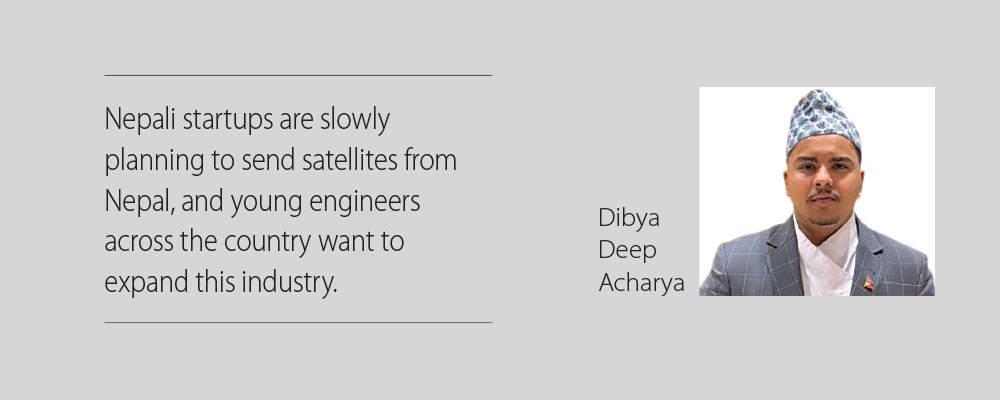
Other Nepali startups are slowly planning to send satellites from Nepal, and young engineers across the country want to expand this industry. Achieving such an expansion can only be realised with meaningful, dedicated and sustained government support.
Chairperson of Nepal Astronomical Society, Suresh Bhattarai, argues that Nepal urgently needs a dedicated space law and not merely a satellite policy, as well as a space agency housed directly under the Prime Minister's Office, given that space intersects with defence, communication, education, disaster management, and foreign affairs simultaneously.
Budget
The budget of fiscal year 81/82 allocates Rs. 7.72 billion to the Ministry of Communication and Information Technology, of which only Rs. 740 million is designated for digital infrastructure and ecosystem development, which is approximately 0.037 per cent of the total budget of Rs. 1,964.11 billion. In paragraph 129 of the Budget Speech 81/82, a single line is specifically dedicated to the Outer Space industry. It says, “The foundation will be laid for the establishment of Nepal's satellite in geostationary satellite orbit.”
The said foundations are what can actually build this market from the ground up. Potential areas of Nepal’s competitive advantage – such as astro-tourism, disaster risk management such as expanding areas of early warning systems, soft power and international visibility, GLOF (Glacial Lake Outburst Flood) tracking, Himalayan climate monitoring, tele-education for remote communities, and precision agriculture mapping – are opportunities for the future of Nepal’s Outer Space exploration, ones it has barely even begun to scratch the surface of.
(The author is a Section Officer at the Ministry of Foreign Affairs. The opinion expressed here is personal and doesn't necessarily reflect the views of the Ministry.)