- Tuesday, 26 May 2026

Gender Lens For Tackling Climate Change
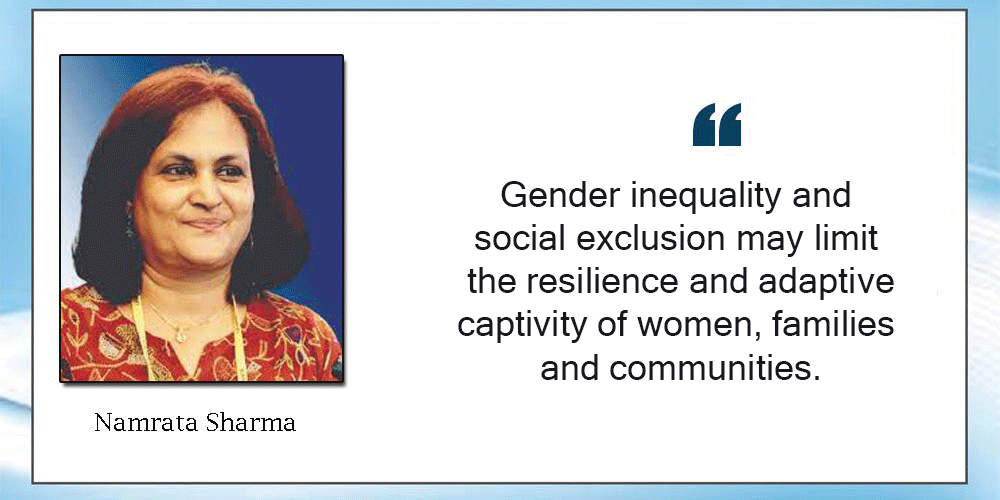
Namrata Sharma
The 27th session of the Conference of Parties (COP27) is now going on in Egypt. Organised by the UNFCCC, world leaders and activists have gathered during the COP sessions to try to pave way to combat the global challenges imposed by climate change. Like others, leadership of Nepal also commits to contributing towards the goals of reducing the carbon emissions.
“Environmentalism has become a major political issue in the world today. Meanwhile, at the 2015 Paris Agreement, countries pledged to reduce carbon emissions and limit warming to 1.5 degrees Celsius. However, even now, looking at the work of countries, it is estimated that the earth will heat at a rate of 2.8 degrees Celsius. Scientists believe that if people's lifestyle does not change radically, the very existence of life on earth will be in danger” writes Shilshila Acharya, a young environmentalist, in Himalkhabar.
Adaptation process
While talking about changing people’s lifestyle drastically, it has to be reflected how this may affect people so that strategies can be developed to make sure those who are the most vulnerable do not get to suffer the most. There are several UN reports which show that women and men are experiencing climate change differently. There are several discriminations being faced by people worldwide due to their gender, social and cultural aspects, among other factors.
This affects the abilities of individuals and communities in the adaptation process. During an interaction in Hetauda, organised by the Antenna Foundation Nepal on 14th November, radio journalists from that region discussed various approaches of covering climate change in order to give voice to the voiceless.
According to the UN Food and Agriculture Organisation, if women had the same access to productive resources as men, they could increase yields on their farms by 20-30 per cent which could raise total agricultural output in developing countries by 2.5-4 per cent. Climate change effects, in an intersectional level and is different in different wealth groups, communities, sexual minorities, and people living with different abilities.
During international policy-making events like the COP27, there are representations by activists all over the world who try to raise voices of the voiceless. However, how will the majority of the people who are engrossed in meeting their daily necessities understand the need to save the environment and the world when every day they have to battle the pangs of hunger and the domestic and communal battles of leading a safe and secure life?
While talking about changing lifestyles, it is also very important to look at the impact of climate change on the lives of people by disaggregating gender related data to understand how impact of global warming is affecting men and women differently and what strategies could be sustainable while changing habits.
It is important to recognise the important contribution of women as decision-makers, stakeholders, care givers and experts in different professions.
When disasters like earthquakes, landslides, floods hit communities, vulnerabilities of people increase. There are several instances when people get displaced pushing them into more vicious cycles of poverty and several risks of being exploited.
The issue here is how can governments ensure proper strategies where the most vulnerable are resettled so their livelihoods and lifestyles can be protected and they do not get into workforces which help in creating adverse impacts on climate change.
In a day-to-day life, women are more involved in caring and nurturing and when disasters hit them, they could be in a situation where they have to successfully steer the family to safety even while the conditions could be very fragile.
Research has shown that women have proven to be leading the way towards more equitable and sustainable solutions to climate change, transforming lives and livelihoods and increasing climate resilience leading towards overall well-being. It is important to recognise that global conferences which affect policy making in different topics have been realising this and COP sessions have also been addressing issues faced by women and marginalised communities. It has been realised that continued progress towards gender equality can help in achieving a successful climate action.
Media role
While world conferences take place, one important fact is that the general population mostly in the developing world are not aware of what decisions have been taken and what rights they have to access support in mitigating adverse impacts of climate change.
It is, therefore, important for the mass media to now cover reports using the Gender Equality and Social Inclusion (GESI) lens. How can this be done? It is a fact that women are still responsible for gathering and producing food, water and sourcing fuel for heating and cooking. These tasks are now being harder and extreme weather conditions like droughts and floods have greater effects on the poor.
Nearly 70 per cent of the poor are women. The mass media can capitalise on the fact that most people now have mobiles in their hands. So short messages, podcasts and audio-visual clips that give messages which hit the minds and create awareness among people on where they can access support and how they can move towards more sustainable life styles can be produced and shared in a regular fashion. There is a need to support climate change with a concentrated, proactive and holistic approach.
Gender inequality and social exclusion may limit the resilience and adaptive captivity of women, families and communities. This could lead towards restricting options for climate change mitigation. Therefore, time has now come for mass media to actually tap on the current digital facilities and produce simple messages that reach the hand of people in a repeated manner to help them understand what climate change actually is and how they can be involved in making a better world for themselves and their future generations.
(Sharma is a journalist and women rights advocate.namrata1964@yahoo.com Twitter handle: @NamrataSharmaP)

-original-thumb.jpg)