- Wednesday, 27 May 2026

Civil Service Day Improving Public Service Delivery
Every year Bhadra 22 is celebrated as the Civil Service Day. Some even call it as Civil Service Workers’ Day. The essence of this day marks the crucial role that the civil administration plays in implementing public policies and delivering services. Nepal’s bureaucracy in general and civil service in particular, have immensely contributed towards democratising the governance, developing the country and serving the people. As many as 9,443 public offices across the nation provide a host of public services to the people. A total of 1, 37, 618 public positions have been created in the civil service alone. With the improvement in the quality of its human resources and adoption of better technology, the bureaucracy’s service delivery has also been improving significantly over the years. However, various reports show that crucial gaps still exist in public service delivery. In this context, this article is an attempt to highlight those gaps and propose some remedial measures for enhancing the delivery to match the expectations of beneficiaries.
Gaps
Compliance gap: The difference between principle and practice is a compliance gap. Many provisions stated in various rules and laws remain unmaterialised or under-materialised. It is said that justice is lost in Nepal’s forest of laws. New management concepts such as New Public Management, New Public Governance and New Public Service are translated only minimally in actual service delivery. In public offices, not all customers are treated as kings, there are very few services with smiling faces and performance as per Citizen Charters. Transparency largely remains in paper as most of the information officers and spokespersons more closed than open. Accountability in decision-making and action is limited and weak. Most public offices are either budget constrained or fail to spend and thereby provide inadequate public services. Against the demand for smart performance, employees are lowly-paid.
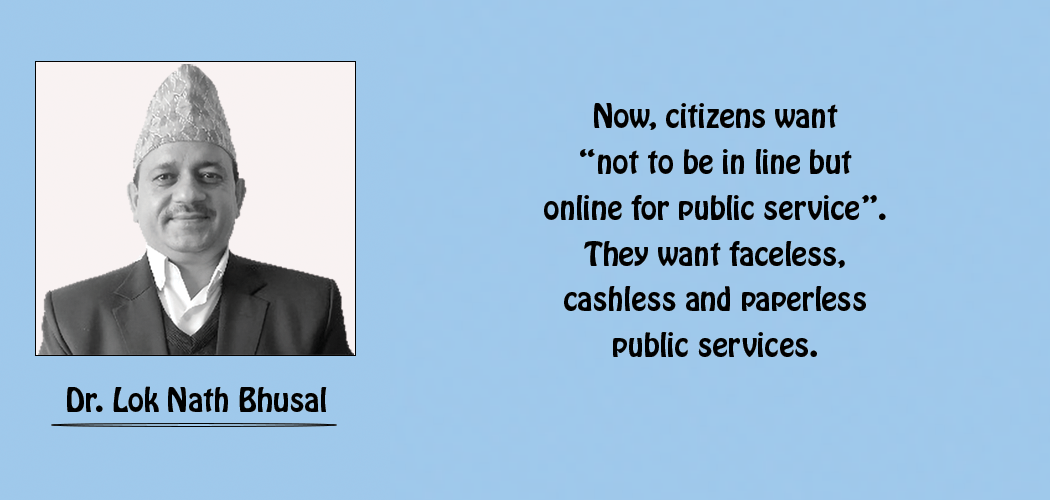
Intelligence gap: Bureaucracy still faces knowledge, skill and technology deficits for effective public service delivery. Most of the administrative leaders suffer from inadequate qualifications required for the task they perform. Their horizon is narrow, vision limited and mission polluted. Crucial management skills are still inadequate in most civil servants. Their adaptation to modern technology is still low. Some of them lack computer, language proficiency, especially English language, and driving skills. Now, citizens want “not to be in line but online for public service”. They want faceless, cashless and paperless public services. However, constrained by the qualifications required for catering these citizens’ demands, we are largely failing to deliver and are surrounded by their complaints and dissatisfactions on a daily basis.
Networking gap: There are persistent coordination and cooperation failures across three levels of government and across different government departments. Currently, 14 ministries are providing 87 types of social protection schemes without any coordination among themselves. Several local governments and NGOs are also doing the same, again without any horizontal or vertical coordination. Eight ministries are running vocational and skills training centres, but there is no coordination among these centres. The Ministry of Forest and Environment is blocking road construction and extension of digital infrastructures in several parts of the country. These networking gaps are costing money and slow delivery of public services. The concepts of co-construction, co-governance, co-production remain limited to documents. Narrow departmentalism and ego have narrowed down the prospects for better coordination. Few civil servants also benefit from lack of or inadequate coordination. This disincentivises coordination efforts.
Awareness gap: Average citizens are innocent in this country. They still consider that service providers are their masters. They follow what these ‘masters’ instruct them or indicate them to do. Taking this advantage, many civil servants ask bribes or other favours from the citizens. In doing this, service is delayed and sometimes even denied. These innocent citizens cannot simply complain it formally. Only few citizens are now really empowered and know that access to and timely service delivery is their right. These smart citizens also know the hooks and crooks of civil servants created for bribe-taking, and are able to fight against such malpractices. They always demand for more and better services. Such aware and smart public is indeed an important pillar for taking the bureaucracy to newer heights.
Ethical values
Ethical gap: Devoid of ethical values, bureaucracy is reported to be heavily engaged in corrupt practices. National and international corruption reports, audit reports and media coverage provide evidence of this heinous act. Corruption is cunningly performed everywhere by almost everyone in every possible way every time. Bureaucracy has been politicised just to deepen and widen corrupt networks. Spiritualism and ethical education are also eroding. Mind dominates public decision-making and action instead of the spirit or soul while our eastern philosophy has taught us to be governed only by the soul. Young bureaucrats tend to ignore such ideas and follow a hollow path. Not tied by any principle, they are superficial and cosmetic. They are less sensitive in terms of their constitutional duties of protecting national sovereignty, saving national property, following law and order and providing their service in national emergency, both as a citizen and public employee.
In order to overcome these critical gaps, we need to genuinely reform our policies, implement them very strictly, and promote policy and programmatic coordination. The whole government system must be strengthened in partnership with new technology, media and civil society through innovative networking. It is said that the test of pudding lies in eating. Following this, behaviours of public servants and the public as a whole must be transformed to meet ethical standards and to improve service delivery. As reform is a journey rather than a destination, these reform efforts must be nonstop to address emerging challenges in public service delivery. Let us make commitment to aspiring and working for all this to happen in this year’s Civil Service Day.
(The author works at the National Planning Commission. bhusalln75@gmail.com)