- Wednesday, 27 May 2026

Make Microfinances More Effective

The last three-decade has witnessed a tremendous expansion of microfinance institutions (MFIs) in Nepal. In the beginning, in 1993, there were only two government established microfinance institutions in the name of rural development bank in a regional level. Later on, the private sector also showed their interest in opening microfinance institutions. Since 1997, the private sector started taking license from the Nepal Rastra Bank (NRB) to establish microfinance institutions.
As a result, the number of microfinance institutions started growing year by year, reaching 65 in 2018. In 2019, 24 financial NGOs were also converted into retail MFIs making the number of MFIs as high as 91 with addition of some new MFIs as well. Since then, given the higher number of MFIs, NRB has started pushing them for merger and acquisition to make them strong.
Merger & acquisition
Hence, with the merger and acquisition process, the number of MFIs has declined to 65 as of mid-July 2022. Out them, four are wholesale, 42 national level of MFIs, 13 provincial level and six regional /district level. Despite decline in the number of MFIs, they have been expanding in other dimensions such as branches, number of borrowers and credit volume. In 2013, there were only 646 branches of MFIs with less than a million (0.9 million) borrowers with outstanding lending of Rs. 23.4 million. As of mid-July 2022, the number of their branches has increased eight times to 5134, the number of borrowers to 3.3 million (3.6 times) and the outstanding loans to Rs. 450 billion (more than 19 times). Because of rapid of growth in lending of MFIs, per borrower lending increased from Rs. 26,000 to more than Rs. 136,000 during that time.
The outreach of MFIs has reached all 77 districts, only few local bodies do not have such institutions. But, many of their branches are concentrated in the Terai districts, urban and semi-urban areas. With the rapid expansion of MFIs, some discontents have been surfaced in the society as some borrowers have started protesting against them in an organised way in recent times, blaming them for charging higher interest rates on loans, giving lower rates on deposits and adopting merciless measures for loan recovery. Since 2020, the central bank has put cap on lending interest rate at 15 per cent which is quite reasonable given the operational cost of MFIs. Other blames may be true in practice, to a great extent.
In this context, the following issues need to be solved for making them effective in poverty reduction mission as discussed here. First, there is tough competition within MFIs as well as with other institutions like banks and financial institutions (BFIs) and cooperatives. Some BFIs have been aggressively engaging in microfinance activities and many cooperatives also provide small-scale loans to their members. This harsh competition has brought many anomalies to the microfinance sector.
The second issue is the heavy concentration of MFIs in limited urban and semi-urban areas resulting in multiple borrowing, which may lead to over indebtedness for the borrowers and default risks for MFIs. Many needy areas and people are yet to get microfinance service, on the other hand.
Third, there is a clear mission drift in MFIs' operations. They are supposed to engage in social banking with credit plus approach. Doing banking with the poor in a small scale is different from other types of banking. But, many MFIs have laid their focus on credit expansion with clear motive of profit, ignoring the other supports that they should provide to borrowers who are comparatively poor, and mostly illiterate women. Mercenary types of lending in the beginning to those who may not need a loan, and forceful loan recovery later from the borrowers has created a bad image for MFIs, compelling borrowers to protest in recent days.
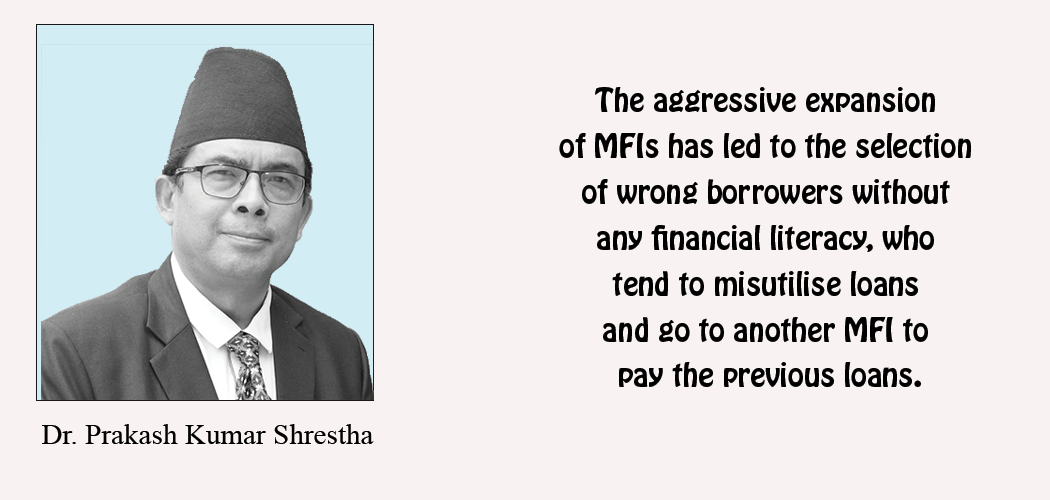
Fourth, there is weak management and monitoring of borrowers. Many MFIs have nationwide branch network. For MFIs with small capital and manpower, it is not easy to manage and monitor the nationwide network with a large number of branches. As a result, some frauds by staff as well as borrowers are reported. The aggressive expansion of MFIs has led to the selection of wrong borrowers without any financial literacy, who tend to misutilise loans and go to another MFI to pay the previous loans.
Fifth, despite the expansion of MFIs, they have not been reached the ultra-poor as reflected by substantial presence of money lenders in the society. Even in Madhes Province where the branches of MFIs are the highest and geographically easy to reach to the borrowers, a large number of people have been found borrowing from money lenders. Scattered settlements and geographical difficulties are hindrances in hilly and mountain regions.
No visible impact
Sixth, even after the three decades of expansion of MFIs across the country, there is no visible impact on macro level data. Imports have been increasing year by year, and more importantly, Nepal has been importing even agro products worth billion rupees which MFIs' borrowers can and should produce easily. It shows that MFIs' lending has been mostly used for consumption and trading purpose only.
Going forwards, MFIs have to tackle the above-mentioned issues to be effective in poverty reduction and survive in a competitive environment. The government also needs to support them by providing incentives like tax concession and others. The current fiscal year budget statement has two ambitious and ambiguous policies such as establishing National Microfinance Fund without allocating any budget for it and expanding the network of Grameen Development MFI to all local bodies with their share investment irrespective of their needs. In the past, because of weak financial performance, the then five rural development banks were merged into one and renamed as Grameen Development MFI which financial status is still not strong compared to other peer MFIs. These two policies will be implemented effectively. Even then, without tackling these issues by the concerned stockholders, more discontents and protests are likely to emerge, making MFIs less effective.
(Dr. Shrestha is an executive director at Nepal Rastra Bank. (praks.shrestha@gmail.com)