- Wednesday, 8 April 2026

Derided At Home, Wowed In West
Someone being praised at home but condemned in other countries is not an exception. At times, a political figure gets commended both at home and in foreign lands. However, it is extremely rare that a prominent name attracts profuse praise in other parts of the world but remains derided at home.
Mikhail Gorbachev, the last Soviet president, was hailed in especially the West in contrast to being derided and demonised in his own country. When he breathed his last on Tuesday at the age of 91, the news was met with nothing more than bare formality at best. For the larger part, it attracted indifference. Not long after he became president in 1985, Gorbachev responded positively to the capitalist West’s suggestions and proposals. His perestroika (restructuring) and glasnost (openness) policies were greeted in the capitalist capitals as landmark steps.
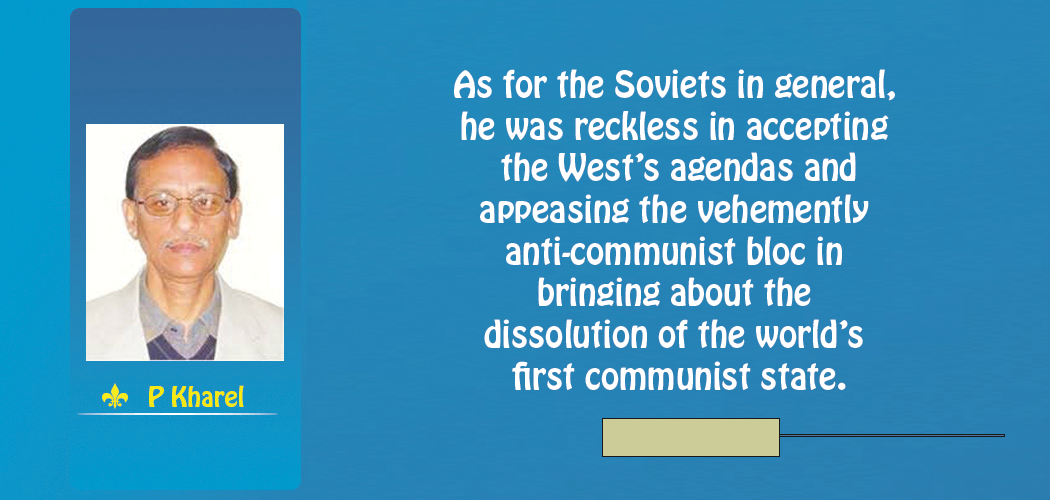
He was awarded the Nobel Prize for peace. The West hails him as the great leader who defied his predecessors’ ideological dogmas and significantly contributed to ending the Cold War. As for the Soviets in general, he was reckless in accepting the West’s agendas and appeasing the vehemently anti-communist bloc in bringing about the dissolution of the world’s first communist state.
Relief & rancour
With the Soviet breakup, Russia lost its superpower status much to the delight of its traditional ideological opponents. Boris Yeltsin succeeded him for two terms, only to demonstrate rank mismanagement and allowing uncontrolled corruption, which led to the rise of financial dons, better known as oligarchs.
Hyperinflation was another of the Yeltsin regime’s backbreaking feature. So much that, on pay day, most salaried workers rushed to the groceries as the first thing to do in the morning office hour. Were they to wait for the day’s work to be over, the prices of basic goods would have risen by double digits. The employers acknowledged the staff members’ plight and allowed them the time for quick purchases in the very first hour at office.
As such, Russians in general would like to forget Gorbachev, who presided over the Soviet Union’s dissolution. Gorbachev tried to introduce measures designed to boost the economy but retaining the one party communist system. Western leaders and media lustily put him on the pedestal of praise. British Prime Minister Margaret Thatcher and American President Ronald Reagan were at the forefront of indicating that Gorbachev knew what reforms to introduce in his country and what policies to adopt for a better rapport with the “democratic” world.
Russia as a superpower was the West’s biggest ideological competitor —something the latter would like to break and enjoy the monopoly of a unipolar world. On his part, Gorbachev had no intention of ending the communist system, committed as he was to one-party system. His idea was to loosen the state’s vice-like grip on the union’s states, and wanted to introduce moderate economic reforms. The problem was he simply did not know how to achieve.
Showering him with commendations, the United States and the European Union members recruited and planted local agents in various groups to direct demands radically deviating from the long established systemic policies. Gorbachev might have been disappointed when the ailing Konstantin Chernenko became president after Yuri Andropov’s death in 1984. But the personal setback ended within a year when Chernenko died. He gave indications of taking new political initiatives, one of which could be taken as the first ever free elections for the Congress of People's Deputies.
In 1990, Gorbachev directed his military generals to recall Russian troops from Afghanistan. The Soviet troops had invaded Afghanistan in 1979 and installed a government that took orders from Moscow. But the war dragged on for a decade, mainly because of the Mujahedeen fighters that were trained and financed mainly by the US.
In appreciation, Gorbachev was awarded the Nobel Peace Prize in 1991. Assessing that he had gone too far to please the West without taking into consideration the country’s own roots, strategic interests and other needs, a group of military generals arrested him in August the same year. The coup bid failed, and Boris Yeltsin, who rallied mass protests against the military measure, emerged as a leader of reckoning in the changed situation.
Yeltsin, the former chief of the communist party in Moscow, seized the situation in his favour and ascended the throne left vacant after Gorbachev, already stripped of much of his executive powers, resigned in December 1991. The trauma Russians suffered in the 1990s until Vladimir Putin became president on the last day of 1999 was translated into intense anger against Gorbachev, who was held responsible for all the ills and mess that arrived with the Soviet disintegration and the accompanying corruption, unemployment and disorder.
No surprise
It was no surprise that voters gave their piece of mind in a stunning manner when Gorbachev took part in the 1996 presidential race. He obtained a humiliating 0.5 per cent of the votes cast, placing him seventh in a ten-candidate race. How his people rated him in the annals of Soviet political landscape could not have been stamped more firmly. The event announced a formal burial of his active political career.
Gorbachev’s dismal performance was, however, a shock to his ardent supporters abroad, who realised their hero’s actual position among his own people. They did show their appreciation of him for playing a role that complied with their interests and values by inviting him to give lectures that fetched lucrative remunerations.
By the turn of the millennium, Gorbachev’s relevance to the foreign supporters slumped. He continued to be tolerated no doubt for his direct or indirect contributions to the collapse of the superpower communist Soviet Union. This had also paved way for East European communist states to distance themselves from Moscow. That Russians in general continue supporting Putin as their leader with 70 per cent approval rating even after for 22 years in power tells a lot. His leadership has restored many key features Russians lost when Gorbachev presided over the Soviet disintegration three decades ago.
(Professor Kharel specialises in political communication.)


-original-thumb.jpg)
-original-thumb.jpg)