- Friday, 10 April 2026

Rare sarus crane spotted in Kailali
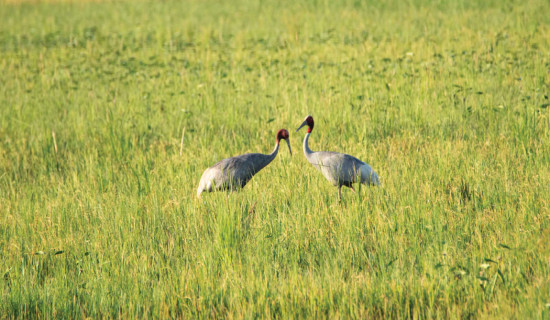

By Abinash Chaudhary, Dhangadhi, Aug. 17:The rare species of Sarus Crane are being spotted regularly in Mantriphanta, in Bhajani Municipality-3, Kailali district.
For the last few years, the birds started appearing regularly in that area during the summer season. This season too, three Sarus Cranes with one chick have been appearing in the area.
Ornithologist Hirulal Dangoura said that the birds have made a comeback in the area after years of disappearing.
It was heard that the bird nested in the encroached Purina Lake area in Bhajani last year but that was not confirmed, said Dangoura. However, the baby must have been bred somewhere. Last year, a pair of the bird were seen in Purina Lake.
Four species of Sarus Crane are found in Nepal. Among them, Greater scaup and Sarus Crane are rare species in the world. A sensitive species on the International Union for Conservation of Nature (IUCN) Red List, it is a year-round bird found in the Lumbini region of Western Terai.
Common Crane and demoiselle cranes are winter visitors and important birds. Dangoura said that after the snowfall in the North Pole, these two species of crane go to India and Sri Lanka every year through Nepal in search of favourable weather, safe habitat and grass. In the meantime, if those birds find a suitable place, they also live in Nepal.
According to a research done in Mustang, every year about 15,000 demoiselle Crane enters Nepal through the skies over the Kali Gandaki Valley.
The Sarus Crane is considered an indicator species of wetlands. According to Dangoura, the presence of the bird means that the wetlands and ecosystem are healthy.
Besides controlling the population of snakes, the birds of this species help in grain production by eating a variety of insects, including snails, which are harmful to crops.
Similarly, when violent animals such as tigers and leopards are about to attack people, the bird will give information by shouting and protecting them from being attacked.
The use of pesticides and herbicides in agriculture, as well as excessive and exploitation of water areas have led to the reduction in wetlands, putting the habitat of the bird at grave risk.
Dangoura said that the main challenge facing the bird is that the wetlands are rapidly disappearing. "Also, they are facing problems due to poaching and water pollution.”











-original-thumb.jpg)