- Friday, 10 April 2026

Piling garbage further risks spread of infectious diseases
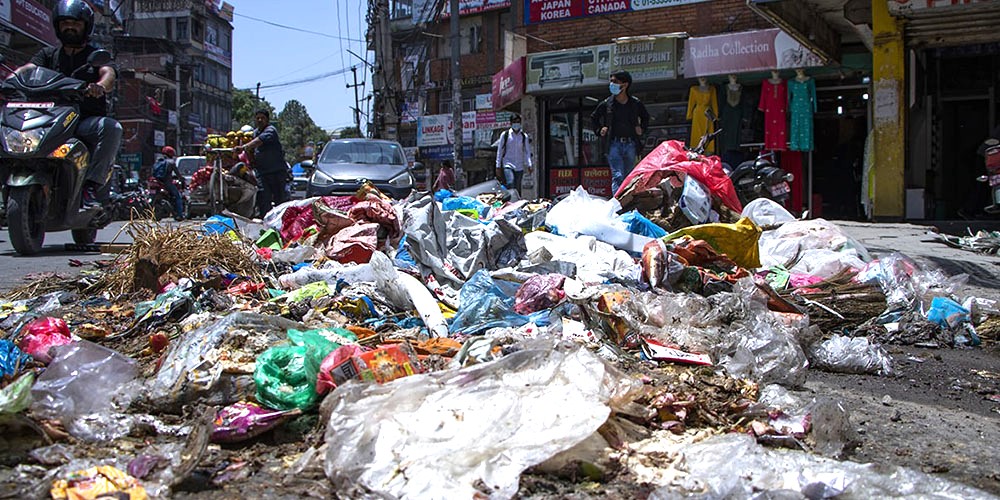
File
By Mahima Devkota, Kathmandu, Aug 16: When Nepal is already dealing with infectious and communicable diseases such as dengue, cholera, malaria, viral fever, and COVID-19, directly and indirectly, triggered by contaminated food and water, the piling waste and garbage risk further spread and infection of such diseases.
Health officials said that the most common form of spread of infectious diseases includes fecal-oral, food, insect bites, contact with contaminated fomites, droplets, or skin contact, and garbage piles provide a suitable environment for vectors to breed and contaminate food and water sources responsible for communicable and infectious diseases.
The report from the Ministry of Health and Population (MoHP), showed that different water sources in Kathmandu Valley and districts of the country are contaminated by E. coli and coliform.
Dr. Gokarna Dahal, Chief of the Vector Control Section at the Epidemiology and Disease Control Division (EDCD), more than 900 cases of dengue were detected from January till mid-June this year in Nepal, where, Bagmati and Lumbini provinces carry the most caseload.
He said, “Cases of dengue will be persistent for two more months. Dengue is a mosquito-borne viral disease with increasing cases in Nepal, which is caused by the bite of infected mosquitoes. The primary vectors that transmit the disease are Aedes aegypti mosquitos, which grow in the contaminated stalled water.”
Likewise, 391 cases of malaria have been detected throughout the country. Of them, 359 were imported cases and of the total imported cases, 336 were from India, according to data provided by the EDCD.
According to World Health Organization (WHO), malaria is caused by parasites that are transmitted by people through the bites of infected female Anopheles mosquitos.
Dr. Chuman Lal Das, Director of the EDCD, said that contaminated food and water are responsible for communicable, water, and food-borne diseases every year in Nepal.
He said, “49 cases of cholera have been recorded within two months in Nepal. The first cases of Cholera were detected on June 16. Similarly, daily cases of diarrhoea up to 20 were recorded at the peak of cholera contamination.”
Dr. Ram Hari Chapagain, a senior consultant at the Kanti Children's Hospital, said that unhygienic food and water are responsible for food poisoning, diarrhoea, vomiting, and other food-borne diseases in children. Therefore, children must be given clean, fresh food and water.
Currently, adenovirus-induced fever is reported in children in Nepal.
Dr. Sher Bahadur Pun, chief of the Clinical Research Unit at Sukraraj Tropical and Infectious Disease Hospital in Teku, said that if the waste is not managed properly, then infectious diseases will spread due to bacteria generated from the waste.
He said, “Rainy season is already prone to water-induced diseases like cholera, diarrhea, malaria, dengue, hepatitis, and even viral fever. This year, cases of water-induced diseases are still persistent and in such a scenario, dirty and garbage piling in nook and corner of cities gives shelter to bacteria’s triggering such diseases.”
Likewise, cases of COVID-19 are also increasing in the country, and washing hands with clean water and eating proper food are recommended to contain coronavirus infection. When the infected food and water are consumed by the infected, it further deteriorates the cases.
With 848 new cases (RT-PCR and antigen tests combined) of COVID-19 confirmed on Tuesday, the nation's novel coronavirus tally has reached 993,858.
Dr. Rabindra Pandey, a public health expert said that the lack of waste management has, directly and indirectly, affected human health besides making the outlook of the city dirty.
He said that the piled-up garbage becomes home to many bacteria responsible for water-borne diseases. The development and growth of flies and other bacteria are fast in rotting waste, such bacteria contaminate food, and eating such food can cause diarrhoea, vomiting, and the spread of cholera.
If that waste is mixed with water streams then it further triggers water-borne diseases.
Similarly, money pox infection has been found in more than 80 countries. According to WHO, 97.5 percent of sexual and minority communities have contracted this disease.
In Southeast Asia, monkeypox infection has been confirmed in India and Thailand. Therefore, public health experts said that there is a high risk of monkeypox entering Nepal as well.
-original-thumb.jpg)