- Thursday, 28 May 2026

Inadequate rain, fertiliser shortage hit paddy plantation


By Laxman Kafle Kathmandu, July 16: Farmers are now busy planting paddy across the country despite facing a shortage of chemical fertilisers and rainfall.
Paddy plantation has been completed in more than a half of the total paddy cultivation area – 54.13 per cent – by July 12. Plantation was delayed in some areas for a lack of fertiliser and poor monsoon rains.
According to the Department of Agriculture, under the Ministry of Agriculture and Livestock Development, paddy plantation has been completed in around 814,350 hectares of paddy field. Farmers in Nepal grow paddy in 1.504 million hectares of land.
Plantation area up
The area of paddy plantation has increased this year compared to the previous fiscal years. Earlier, paddy used to be planted in around 1.37 million hectares of land across the country. This year that number has increased to 1.504 million hectares.
According to Dr. Rewati Raman Poudel, director general of the Department of Agriculture, rice planation area has increased this year compared to the year before.
“Based on the data received from the provinces, it is estimated that rice will be planted in 1.504 million hectares this year while that figure was 1.371 million hectares last year,” he told The Rising Nepal.
This is the preliminary projection, he said, adding that that final statistics will come only after paddy plantation gets completed.
“The area of paddy plantation might have increased in all provinces as the three levels of governments – federal, provincial and local – are encouraging farmers not to keep land barren. Local levels are offering incentives for farming in barren land. This has increased the plantation area,” he said.
The paddy plantation has decreased by around 20 per cent during the review period compared to the previous year due to the lack of sufficient rainfall and chemical fertilisers.
By July 15 last year, paddy plantations were completed in about 76.44 per cent of the total paddy fields.
After the monsoon became active, the plantation gathered momentum, said Rewati Raman Poudel.
According to him, paddy planting will be done this year in line with last year as well. However, he said that there was a problem due to unavailability of fertilisers and the lack of rainfall in some districts.
Sudurpashchim tops plantation
By now, paddy plantation has been completed in the largest area in Sudurpashchim Province, with 155,878 hectares (87.49 per cent) of paddy field being planted, followed by Bagmati and Gandaki provinces. Those figures for Bagmati and Gandaki are 78,795 (65 per cent) and 62, 515 hectares (62.32 percent) on Wednesday respectively.
Paddy is grown in around 178,167 hectares in the Sudurpashchim, 120,569 hectares in Bagmati and 100,310 hectares in Gandaki.
Paddy plantation has been completed in 56.31 per cent (21,894 hectares) in Karnali, 53 per cent (171,475 hectares) in Lumbini and 48.64 per cent (165,771 hectares) of the total paddy field in Province-1 till date.
Likewise, the lowest paddy plantation has been done in Madhes Province where plantation has been completed only in 39 per cent of the total paddy field. Poudel said that due to a lack of irrigation facilities, farmers have been compelled to wait for the rains to come and that the plantation is not moving in full swing in many districts due to the lack of rainfall.
He added that only about one-third of the total paddy cultivation area has access to irrigation facilities throughout the year. However, there are a few districts such as Sankhuwasabha, Panchthar, Dhankuta and Morang of Province 1 and Myagdi and Parbat of Gandaki Province and Surkhet of Karnali province where plantation is comparatively lower than other districts due to shortfall of rains. In the meantime, paddy plantation has almost completed in some districts, including Jumla, Humla and Dolpa.
Effort to bring fertiliser
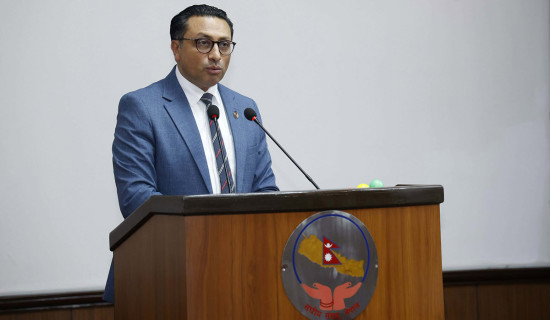
Meanwhile, according to Our Sarlahi Correspondent, Minister of Agriculture and Livestock Development Mrigendra Kumar Singh Yadav has said that the government is trying to import required amount of chemical fertilisers as soon as possible.
While discussing with the chiefs of various offices of Madhes province under the federal government related to agriculture and livestock, Minister Singh said that efforts were being made to import fertilisers by the end of July this year.
Minister Yadav informed that the government is importing around 50,000 tonnes of urea fertiliser from Oman through Kolkata dry port. He claimed that this fertiliser is likely to arrive in Nepal by the end of July.