- Thursday, 28 May 2026

Occupation of Thabai in jeopardy
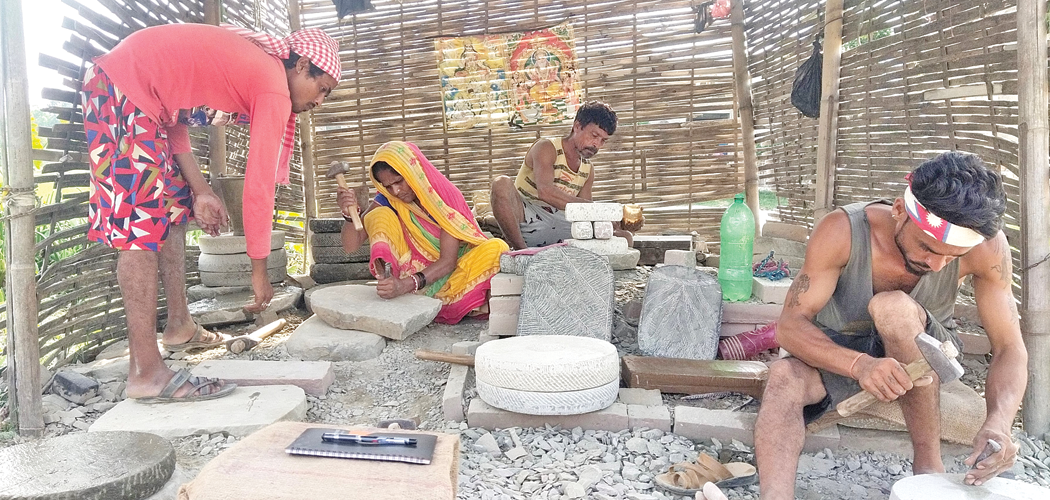

By Vijay Kumar Sah Dhalkebar, July 10: Members of the Thabai community have, for generations, been making manual grinders. The caste group, categorised as endangered by the government of Nepal, make Jaanto and Silauto out of the stone and sell in the market to earn a living. But now, thanks to the availability of modern appliances, their livelihood is in crisis.
Even in the rural areas, electric grinding machines are easily available at cheap prices.
This has caused a sharp decline in the sale of traditional grinders, putting the occupation of the Thabai caste group in jeopardy, 55-year-old Jayaram Thabai of Bhathihan, Sabaila Municipality–9, expressed his concern. Thabai, who has been making hand grinders for the past 30 years, shared that he could sell up to a dozen Jaanto and Silauto a day in the past. “Now, I am lucky if I sell two.”
A Silauta fetches around Rs. 600 in the market and a Jaanto can go for anything between Rs. 1,000 to Rs. 1,500. “It takes a full day to make one Jaanto or two Silauto and it’s hard to recuperate our costs when we are selling so few,” Jayaram complained.
With their occupation failing and income dropping, many Thabai individuals have left the country to go work abroad. Jayaram himself went to Qatar twice but had to return in less than a month both times after failing in the physical fitness test there. “I am in severe debt and my family is in financial crisis,” he said emotionally. “I see no way out for us.”
Jayaram has a family of seven, all of whom are in this occupation with him.
In addition to the dropping sales, they are also troubled by the lack of stones. The best stones for carving Jaanto and Silauto are found in the hills of Katari, Udaypur.
“But the authorities and local forest committees do not let us in,” Jayaram’s eldest son Ajay Thabai shared. “So, we have to bring the stones from Jaipur and Rajasthan in India which increases the price of our products, further hampering their sales.”
“It is a vicious cycle,” an upset Ajay said.
As per the latest census, there are only 200 Thabai households in the whole of Nepal.