By Our CorrespondentArghakhanchi, Apr 19 : Locals in Thada, in Arghakhanchi, have started earning good income from Duna-tamari (plates made of leaves from the 'Saal' tree) business. Most of the women of Sitganga Municipality are on cloud nine after they started making good money from the business. They have been selling Duna-tamari both individually and in a group after collecting leaves from the forest. Demand for such plates increased after the municipality was declared a plastic-free market zone. Municipality Chief Surya Prasad Adhikari said that it was made a plastic-free zone with the objective of making Damaru Daha, in Thada, a tourist attraction and making the city clean and pollution-free. The municipality has been teaching the women to make the plates in order to make the city a beautiful tourist destination.An area covering a distance of around 400 meters from Thada has been made plastic-free. For the first time, about one year ago, 17 women from this region were trained to make Duna-tamari. The women have been able to earn a good income since then. Chiuri and Saal trees abound in the nearby community forests. The women can collect their leaves easily to make Duna-tamari. The women's group of the Local Sagarmatha Women's Cooperative has been making Duna- tapers to sell in the market. "We are creating self-employment by selling Duna-tapers in the market," said Laxmi Belbase, chairperson of the group. Instead of plastic cups, plates, and bowls, people have now started using Duna-tamari in ceremonies and functions.
Drowning in rivers, rivulets, lakes and other water bodies has been a major problem even in Nepal where many such incidents are reported time and again. Swimming lovers, especially adolescents and young adults, are found falling prey to their adventurous steps into water bodies. There has been a rising propensity among school and college-level students to go for swimming as a recreation and sporting activity. Since the densely populated Kathmandu Valley does not have natural swimming facilities, a number of people interested in water sports go to different places. The Trishuli River and the Sunkoshi River are the two key water bodies that many Kathmandu dwellers visit each year to enjoy swimming. People find it quite convenient to go there on weekends and other holidays as these water bodies are located close to Kathmandu. One of the obvious reasons for drowning is that many swimmers hardly have basic floating skills. Besides, they sometimes fail to calculate the depth of the river or lake before entering into water. They also rarely use swimming gear like a life jacket while jumping into rivers or lakes. It is quite worrying that the country reports more than 500 cases related to drowning annually. According to a news report published in this daily on Monday, as many as 16 persons, including seven children, died of drowning nationwide in the past two weeks (April 3-16) alone. A 22-year-old boy from Dolakha was among them. The boy along with his friends had gone to the Sunkoshi River for swimming on April 16. However, six of his friends survived. The boy had dived too deep and gone missing in the river. Because the unfortunate incident had taken place in an isolated area, no rescue team was able to reach there on time. The boy’s body was recovered only the following day. Drowning-related incidents are mostly reported during the hot season when more people opt for swimming for cooking. Currently, temperatures have gone up considerably, prompting people to take different measures to beat the heat. The situation is worsening in the Terai as it is the hottest region of the country. Most people living in the Terai districts go swimming during this season. Even small children are seen swimming in rivers and lakes. An eight-year-old boy in the Saptari district and another five-year-old girl in the Rautahat district met the same fate last week. Drowning is also a worldwide problem. As per the World Health Organisation (WHO), some 236,000 people die of drowning globally each year. The global health body’s data shows that the highest drowning rates are among children aged 1–4 years followed by those aged 5–9 years.Looking at children’s vulnerability to drowning, officials at the National Disaster Risk Reduction and Management Authority under the Ministry of Home Affairs (MoHA) have stressed the need for the respective families to properly monitor the activities of their kids to save them from drowning and other risks. It is also the responsibility of the local government institutions to create massive public awareness in the communities against the possible risks of drowning. They also need to have well-trained rescue people to deal with this problem. What is equally essential is teaching school-age children basic swimming, water safety, and safe rescue skills to help prevent the incidents of drowning.
Uttam MaharjanNepal is basically a remittance- and tax-based economy. Although there are abundant internal resources that can be utilised to boost exports, such resources are left fallow and imports are prioritised. When imports are made in large quantities, the government can levy imports duties, which can be used to supplement the national budget. This can be termed an import mentality.Nepal is one of the least developed countries in the world. Although there is some development in the urban areas, the rural areas are still poor. It is estimated that one in every five rural households is poor. As the rural areas lack development infrastructure and there is a paucity of job opportunities, the rural youths tend to migrate to the urban areas or abroad for jobs. So, labour migration has been one of the important components of the economy. Labour migration has intensified, especially for the last two decades. Women also migrate abroad for jobs. But they constitute only about five per cent of the total migrant labour force. Labour destinationsThere are over 100 labour destinations for Nepalis. Among them, Qatar, the United Arab Emirates, Saudi Arabia, Kuwait and Malaysia constitute the top five labour destinations. The migrant workers working abroad send remittance money back home. As per the Nepal Living Standards Survey (NLSS) III (2010/11), 56 per cent of the households receive remittances. And one in every two rural households receives remittances as per the data issued by the Ministry of Finance (MoF) in 2020.For a poor country like ours, the importance of remittances can hardly be overstated. Remittances have played a vital role in alleviating poverty in rural areas. The reduction of poverty in the country can be attributed largely to remittances.In 2010, the rate of poverty was 25.2 per cent, which came down to 16.6 per cent in 2016. Viewed thus, remittances have a positive impact on the uplift of the standard of living of the rural folks.Most of the remittance money is, however, used to cover family and social expenditures. Remittance-receiving households tend to spend much money on food, house construction and social events. They also spend it on loan repayment, education and healthcare. Spending remittances in the productive sector such as agriculture and cottage industries would further reduce poverty in the rural areas.Remittances are also the sources of liquidity in the banking sector which is now facing a liquidity crunch. A low inflow of remittances is cited as one of the factors contributing to the liquidity crisis. In Magh, the inflow of remittances was down by 4.9 per cent, whereas it was down by 1.7 per cent in Falgun. The country had received Rs. 631.19 billion till Falgun of this fiscal year. During the corresponding period of last fiscal year, the inflow of remittances was up by 8.7 per cent. The contribution of remittances to the country’s GDP is around 25 per cent.It may be noted that banks give higher interest on remittance accounts in order to encourage migrant workers to send money back home through the banking channels. This does not, however, mean that foreign employment is bad per se. Labour migration is a global phenomenon. As per the World Bank report of 2020, there are almost 272 million international migrants throughout the world. Of them, nearly two-thirds are labour migrants. In recent times, the country has suffered a malaise in the economic sector.This is due mainly to disproportionate imports vis-à-vis exports. The foreign reserves are also dwindling. In Asadh, the country had foreign reserves of Rs. 1,399.03 billion. The foreign reserves came down by 16.3 per cent to Rs. 1,171 billion in Falgun. It may be germane to note that Nepal Oil Corporation’s inability to pay fuel bills to Indian Oil Corporation has surfaced. At the same time, the news of Sri Lanka being in economic straits is swirling around the world. And the detractors of the government, including CPN-UML chairman KP Sharma Oli, have raised false alarms that the economy of the country is going the Sri Lankan way. Banking channels The government is mulling over increasing the inflow of remittances. Not all remittances come through the banking channels. There are many Nepali migrant workers who prefer the hundi and other informal channels over the banking channels to send money back home. The Nepali migrant workers should be encouraged to use the banking channels by providing them with incentives such as increased interest. Exporting labour abroad is a lucrative business as shown by the contribution of remittances to the national economy. However, this has created problems in the rural areas. There are mostly the elderly and children in the rural areas, with the youths having migrated to the urban areas or abroad. The rural farms are left barren for lack of labour. The government has not paid heed to infrastructure development in rural areas. The rural areas have a multitude of problems, be it in education, healthcare or transportation. Moreover, there is lack of job opportunities. The government should, therefore, take concrete measures to improve the rural conditions without delay. (Maharjan has been regularly writing on contemporary issues for this daily since 2000. uttam.maharjan1964@gmail.com)
Irina ShlionskayaMany people suffer from some kind of phobia. Some are afraid of open spaces, others are closed. Someone is afraid of spiders, dogs or rats. Someone - fire or water. But there are fears that are difficult to explain. For example, how can you be afraid of stairs? After all, we have to deal with them literally at every step. Nevertheless, such a phobia exists.There are people who are afraid of heights. They will never dare to climb to the top floor of a high-rise building. But not all stairs are so high. So experts distinguish the fear of stairs into a separate variety - climacophobia. British Richard Smith is now over 50. At the age of three, he fell down the stairs in the house where he lived with his parents. Since then, the fear of stairs began to haunt him.When the boy was eight years old, he went on an excursion to one of the castles with his school class. And, although little Dick really wanted to go there, he could not enter there, because he had to climb the stairs.He began skipping classes if he needed to climb stairs to class. In physical education classes, he could not climb the Swedish wall, and during swimming, he refused to enter the pool, because there was a descent down the stairs. Peers laughed at Dick, but he could not do anything about his phobia. When he was 15, Dick began dating a pretty girl of the same age. One day she suggested meeting at the water tower. But he could not go there, because the stairs also led to the tower. Of course, he could not confess his fear to the girl. She got offended.The next time he saw his girlfriend was sitting on the steps of the bus. Dick wanted to go up to her and explain, but the girl went upstairs and looked contemptuously at the failed gentleman. Richard had to constantly struggle with his phobia and hide it. He even climbed the bell tower when it was time to propose to his future wife. But during their honeymoon, he and Katherine had to walk a lot around the city, and the newlywed realized that something was wrong with her husband.It was only at a fairly mature age that Smith finally went to see a psychotherapist. The fact is that at that time he was writing a book about the first British balloonist James Sandler, and his fears prevented him from working on the book. The psychiatrist diagnosed him with two phobias at once: acrophobia - fear of heights and climacophobia - fear of stairs. Of course, all this was due to a fall in early childhood. As a therapy, the specialist offered the man a shock method - to climb the high tower in Oxford and bend over the railing. Oddly enough, this helped Richard. The fear of stairs is gone. Soon Smith climbed the bell tower for the second time in his life and was able to enjoy a beautiful view. And after some time, he even managed to realize his old dream - to fly in a hot air balloon. In most cases, phobias are still curable. At least psychotherapy can significantly alleviate the condition of those suffering from various fears.
BY OUR CORRESPONDENT Dailekh, Apr 19 : Private sector funded "Upper Parajuli Small Hydropower Project'' of Dailekh which had been halted for nine years due to lack of funds is all set to resume work. Eighty percent of the work of the 2.15-megawatt hydropower project being built in Dungeshwor Rural Municipality–4, Biurakhet of Dailekh was completed but had to be halted due to lack of additional funds.The project was started in 2072. Firstly, the project's headworks and pipeline installment were half completed and the powerhouse was also half-built. The project which could not be completed even though the Rural Municipality invested 2.5 million rupees in shares due to a financial crunch will resume works after the Province Government invested 50 million rupees through People's Hydropower (Operation and Management Directive 2075).The project's 900-meter canal has been built. The project aims to bring water from four kilometers away through 440-meter pipeline, 2,700-meter canal and finally into the turbine to produce electricity but the works had been halted due to a lack of funds. It will resume work after the Province Government provided 50 million rupees and an additional fund of 70 million was collected totaling the investment of Rs. 120 million.Nara Singh Malla, Chairman of Rara Hydropower, said, "The project was delayed because the Nepal Electricity Authority did not build infrastructure for a long time to supply the produced electricity into the national transmission line." He added that due to the lack of a 33 KVA transmission line the project got delayed and due to the market price, the interest rate of financial institutions the project's total cost increased. He also said the company called for the application of shares in 2075 Falgun at 115 rupees per share and in Chaitra at 150 rupees per share but they still could not generate enough investment. He said, '' Now we are close to power generation.'' Compensation has also been already distributed. Millions of rupees invested by the banks were in jeopardy. The 2.15-megawatt project was started with a total capital of Rs. 550 million where Everest Bank, Siddhartha Bank and Mega Bank had 70 percent investment and shareholders had 30 percent.
By Ajita Rijal Kathmandu, Apr 19 : Headaches can be awfully upsetting as it can be persistent or recurrent. According to doctors, minor headaches can be relieved with some rest, fluid-intake or an over-the-counter medication but severe headaches need immediate medical attention. According to doctors, due to the rise in temperature, many people complain of headaches during summer season. The hot weather with bright sunlight would aggravate the headaches disorder. As temperature rises, the number of patients visiting the hospital complaining of prolonged headaches increases, said Dr. Suman Bhattarai, a consultant neurologist. During summer time, people are prone to consume sugary drinks and spicy foods which also aggravate headache. Migraine trigger, a headache that can cause severe throbbing pain or a pulsing sensation, usually on one side of the head can be caused due to various reasons, including pollution, junk food, alcohol, loud noise, stress, bright lights and glare, lack of sleep and sometimes medication, said Dr. Bhattarai. One needs to identify the cause and avoid the possible reason to keep headache at bay, suggested Dr. Bhattarai. Summer heats can cause the vascular headache as the head blood vessels expand, said Dr. Suman Prasad Adhikari, a consultant neuro-psychiatrist.Due to the rise in temperature, steroid blood level increases, causing severe headaches, said Dr. Adhikari. The headache disorders are more common among women than in men, said Dr. Suman Bhattarai, consultant neurologist. “Hormonal fluctuations are the trigger for menstrual migraines in women.” Women have more roles which cause tension and stress and it contributes to more frequent headaches, added Dr. Bhattarai. In a nation-wide population survey of Nepal in 2016, headache prevalence was 85.4 per cent with majority in female (61.6 per cent) compared to male (38.4 per cent). One needs to seek medical help if headaches are affecting your day-to-day activities, according to physicians. In order to receive appropriate treatment of headache disorders, accurate and timely diagnosis is very essential. Doctors suggest certain lifestyle modifications, including regular physical exercise, avoiding stress, adequate sleeping, incorporating more plant-based food into diet and drinking sufficient fluids to stay safe from such disorders. They also suggest wrapping head with shawl or carrying umbrella when stepping out in the sun. A major cause of summer headaches may be due to the strong-fragrance products including sunscreen, insect repellent and body perfume. One must understand the cause of headache and stay away from those products, said doctors. Despite having the lifetime prevalence of 90 per cent, primary headaches are significantly unaddressed, undermanaged and mismanaged by the treating physicians as well as the patients.
Home Minister Bal Krishna Khand has directed the subordinate bodies for the resolution of problems at Tribhuvan International Airport (TIA).
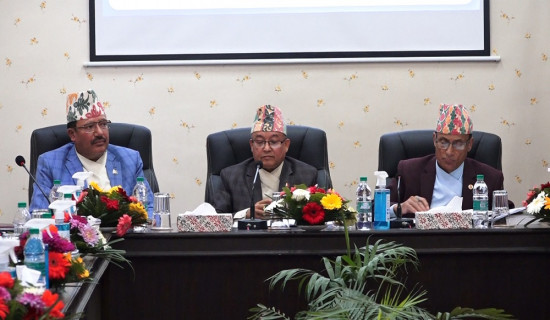
According to government spokesperson and Minister for Communications and Information Technology Gyanendra Bahadur Karki, today's meeting of the ruling parties dwelt seriously on the electoral coordination among them and that they also reached a conclusion on some issues.
Extending her gratitude towards ADB for its assistance to Nepal's development endeavors, Minister Bhusal expressed her confidence that significant cooperation in the areas of energy production and distribution would be provided by the ADB in coming days.
In 3,600 Real-Time Polymerase Chain Reaction (RT-PCR) tests done in the past 24 hours, a total of nine people were found infected with SARS-CoV-2, informed the Ministry of Health and Population (MoHP) in its regular update.
The government is administering Vitamin A capsules and deworming tablets to children under the national Vitamin A campaign from Tuesday.
The meeting of the ruling coalition is underway at the Prime Minister's residence in Baluwatar.
The seventh agriculture census is taking place from tomorrow (Tuesday). For the census that takes place every 10 years, 5,200 enumerators and 1,300 supervisors have been deployed.
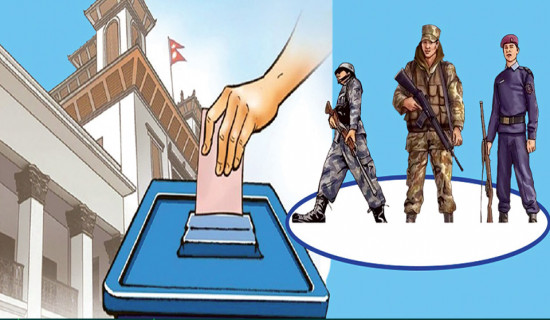
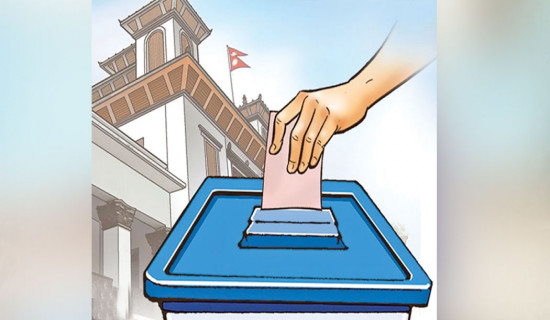
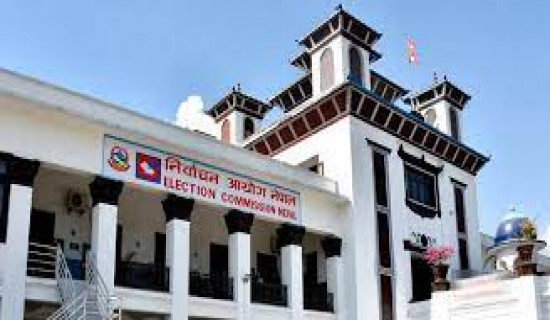
The Election Commission has completed the print of required ballot papers for 46 districts.
The decision has been taken in the wake of an increasing trade deficit, decreasing rate of remittance inflow and pressure on the foreign reserve.