- Thursday, 11 June 2026

Painful messages expose mental health issues among schoolchildren

Kathmandu, June 11:
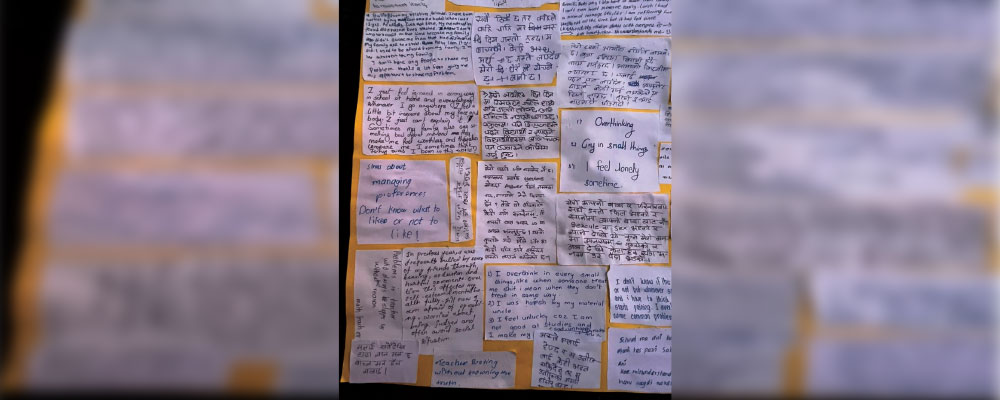
Message 1
“I have always felt isolated from my father and family. I was sexually harassed by my father when I was a child. This still haunts me and I can't tell anyone about it. Nowadays, I am very afraid to be close to my male friends.”
Message 2
“I'm a bit weak in my studies. In class, when Sir and Ma'am ask questions, they scold me for not being able to answer them, saying that I have no brain. Sir says that I will not be able to do anything in the future. Sir's words like this make me afraid that I will not be able to do anything in life.”
Message 3
“My biggest fear is my teacher who slaps me and gives me punishment.”
The aforementioned messages came from the pure souls of scores of students in various schools situated in Gokarneshwor Municipality, Kathmandu. The emotions expressed through these messages reflect the mental health condition of schoolchildren.
The messages, shared anonymously, left more than 100 school teachers, principals, local representatives, officials, and experts deeply emotional.
As a research team member read out the messages, including these, an entire seminar hall fell silent.
Recently, the “Voice, Mind and Future 2083” Summit, organized by the National Solution and Research Centre (NSRC), reviewed and expressed concern over the mental health conditions faced by school children in recent times.
Participants also focused on the future steps and policies that should be adopted by the local government to address these mental health issues.
The messages were collected from 201 students in Grades 9 and 10 from various public schools. Of the respondents, 66 per cent were female, and 33 per cent were male, aged between 13 and 21 years.
Through these messages, many students expressed various mental health challenges, including depression, pain, sorrow, fear, anger, anxiety, assault, harassment, loneliness, and many others.
As this deep and troubling reality came to light, concerns were raised about how to address the issues faced by young students.
As a step toward policy reform, mental health activist and Executive Director of NSRC, Pawan Poudel, has handed over a recommendation letter to Gokarneshwor Municipality.
While submitting the recommendations, Poudel said every school should ensure that all classrooms are emotionally safe. To achieve this, teachers should receive training on children's mental health.
Many of these complaints highlight the mental pain and pressure caused by teachers themselves, such as teachers beating students without knowing the truth and humiliating them in front of the class. "To address this problem head-on, the municipality should immediately conduct comprehensive trauma-informed and child psychology training for teachers in all schools,” activist Poudel said.
The touching and heartfelt complaints from students shed light on family abuse, psychosocial problems, teacher abuse, bullying (teasing and humiliation) among friends, and excessive examination stress, all of which could lead to serious consequences in the future.
Reviewing the situation, mental health expert Dr. Ruja Shrestha suggested that emotional issues such as anger, dissatisfaction, and anxiety among students should be addressed with love and compassion.Pointing out that teachers often become irritated with academically weaker students, Dr. Shrestha emphasised the importance of listening to and understanding students' emotions.
“We have created divisions between weak students and bright ones in schools. We become angry with weaker students and fail to listen to their feelings and emotions. This can make children isolated in the future and increase their risk of engaging in antisocial activities,” Dr. Shrestha said.Dr. Shrestha also explained that while these conditions may not always be fully reversible, they can be effectively managed through therapy and, when necessary, medication.
She further stated that school teachers, along with parents, are the frontliners in supporting children's mental health.
According to activist Poudel, mental health training for teachers will help them completely stop physical and psychological punishment and instead adopt positive disciplinary methods. This will transform classrooms into emotionally safe and fear-free environments for children.
Similarly, students should receive special training in Social and Emotional Learning (SEL), which helps them manage emotions, develop empathy, and build positive relationships, thereby strengthening their mental well-being, Poudel added.
Expressing concern over the issue, Chief Administrative Officer (CAO) of Gokarneshwor Municipality, Yaam Narayan Gauli, acknowledged that further steps should be taken to address such conditions in schools. He also assured participants that the municipality would work on policies based on the messages received from students.
“I was deeply saddened to hear about such messages from students. On behalf of the municipality, we are ready to provide financial and other forms of support to help alleviate these problems,” said CAO Gauli. Similarly, Hari Prasad Upadhyay, Chief of the Health Department at the municipality, stated that he would discuss the issue with the Mayor with the aim of incorporating these concerns into future health policies.




-original-thumb.jpg)