- Thursday, 11 June 2026

Why Middle Class Matters

The budget speech delivered by Finance Minister Dr. Swarnim Wagle in the federal parliament last fortnight has stoked larger public attention for its repeated emphasis on raising the income status of the middle class. According to modern interpretation, middle class includes such professionals as teachers, lawyers, government officials, engineers, managers, IT workers and academics. The middle class thus refers to citizens who possess a reasonable degree of economic security, education, and occupational stability. People falling in the middle class category are neither very rich nor poor. As stated above, civil servants, small entrepreneurs, doctors, engineers, shopkeepers, skilled workers, and salaried professionals often form the core of this social group.
Ideologically, the concept of middle class resonates more or less with Marx’s definition of petit bourgeoisie. However, Marx was distrustful of this class because this group is considered economically unstable, politically inconsistent, vacillating, and consequently fearful of radical social and political change. Dr. Wagle’s reference to the middle class appears guided basically by economic and democratic purposes. The budget implicitly acknowledges an important political and economic truth regarding the contribution of the middle class. No modern democracy can remain stable and prosperous without a confident and expanding middle class. The budget intends to satisfy the middle class through tax concessions and several other measures directed to stimulate consumption and enterprise promotion.
Democratic moderation
The idea of enhancing and expanding the middle class is not new. Across European and American political thought, the middle class has long been regarded as the foundation of democratic moderation, social stability, and economic vitality. From Aristotle to Alexis de Tocqueville, from Adam Smith to John Stuart Mill, political thinkers consistently argued that societies flourish when neither extreme wealth nor extreme poverty dominates public life. In the Nepali context, therefore, the current discussion on strengthening middle class is not merely about taxation or consumption. It concerns the long-term future of democracy, governance, and social stability.
The importance of the middle class can indeed be traced back to Aristotle’s Politics. Aristotle argued that the “middle element” in society produces moderation and balance. According to him, societies dominated by extreme inequality become vulnerable either to dominance by the rich or unrest by the poor. A broad middle class, however, encourages prudence, compromise, and civic participation. The Scottish economist Adam Smith, in his book, The Wealth of Nations, emphasised the role of ordinary producers, traders, and consumers in generating national prosperity. Economic growth, Smith argued, depends not solely on kings or aristocrats but on the productive energy of commercially active citizens. The rise of the middle class during the Industrial Revolution transformed Europe by creating new markets, industries, and educational institutions.
Similarly, the French thinker Alexis de Tocqueville, in Democracy in America, observed that democracy in the United States succeeded because of the existence of a large and relatively independent middle class. The growth of the middle class became one of the defining features of the United States during the twentieth century. Middle class supports moderation in politics. Middle-income citizens usually prefer stability over violent confrontation. They seek predictable governance, rule of law, and peaceful political competition. Similarly, middle class strengthens accountability. Educated citizens demand transparency, efficient public services, and constitutional governance. They are more likely to engage with media, civil society organisations, and local institutions.
Likewise, democratic participation expands when citizens possess literacy, access to information, and economic confidence. Elections become meaningful when people can deliberate freely rather than merely struggle for survival. In many successful democracies in Europe and North America, as well as India, the rise of the middle class has accompanied the growth of parliamentary institutions, universities, independent media, and civic associations. Economically, the middle class contributes in multiple ways. It drives domestic demand by purchasing goods and services. It promotes entrepreneurship through small and medium enterprises. It invests in education and skill development for future generations. It generates tax revenues that finance public infrastructure and welfare systems.
Countries with strong middle classes generally experience greater innovation and productivity because educated citizens are more capable of adopting technology and participating in modern industries. For developing countries like Nepal, this aspect is particularly important. Nepal requires not only foreign aid and remittances but also a productive domestic economy driven by educated and entrepreneurial citizens. Nepal’s middle class has gradually expanded through education, migration, urbanisation, remittance income, tourism, government employment, and the growth of private enterprise. Major cities such as Kathmandu, Pokhara, and Biratnagar and many more have witnessed the rise of salaried professionals, service-sector workers, and small entrepreneurs.
Economically vulnerable
However, Nepal’s middle class remains economically vulnerable. Rising housing costs, inflation, unemployment, educational expenses, and limited industrial growth continue to create insecurity. Many young educated Nepalis still seek opportunities abroad because domestic economic structures remain weak. Therefore, the government budgetary policies that recognise middle-class concerns may contribute positively to both economic confidence and democratic stability. Yet concessions alone are insufficient. Nepal requires broader structural reforms in such realms as quality education, industrial growth, urban planning, employment generation, digital infrastructure, and predictable governance.
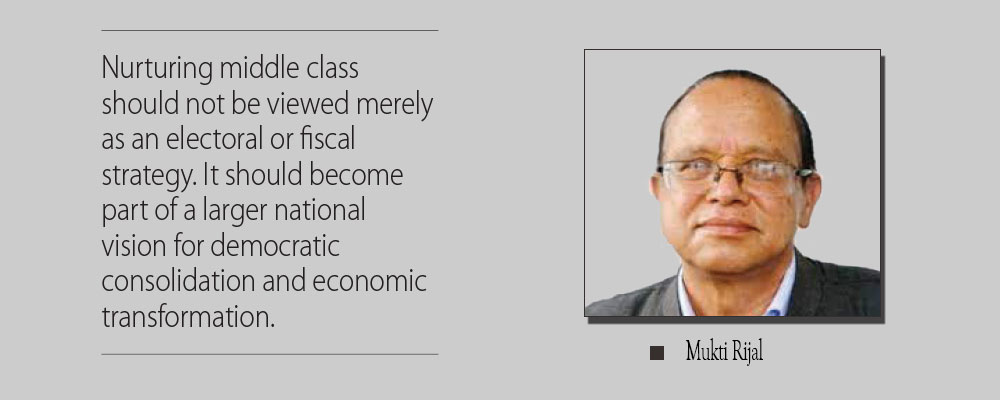
The middle class cannot flourish in an environment of corruption, policy instability, or weak public institutions. For Nepal, nurturing middle class should not be viewed merely as an electoral or fiscal strategy. It should become part of a larger national vision for democratic consolidation and economic transformation. A society divided sharply between a small wealthy elite and a large struggling population cannot sustain long-term democratic stability. But a society with an expanding middle class provides the social foundation necessary for both prosperity and freedom. In this sense, the recent budgetary emphasis on the middle class recognises the fact that the future strength of Nepal’s democracy and economy depends substantially upon the growth of this crucial social force.
(The author is presently associated with Policy Research Institute (PRI) as a senior research fellow. rijalmukti@gmail.com)



-original-thumb.jpg)