- Wednesday, 10 June 2026

Vegetable farming empowers Mahato couple
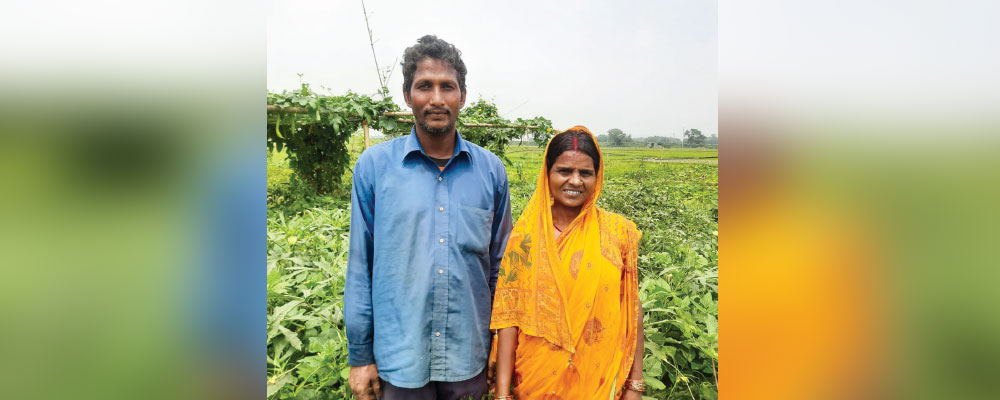
Photo: TRN Mahato couple in their vegetable farm.

By Binay Karna, Saptari, June 10: Until a few years ago, the life of 37-year-old Jaso Kumari Mahato of Lokharam, Chhinnamasta Rural Municipality-5 in Saptari, was filled with uncertainty and worry.
Hoping to improve the family’s financial condition, her husband, Arvind Kumar Mahato, travelled abroad for employment twice. However, after failing to earn as expected, he returned home disappointed on both times.
Following lack of success in foreign employment, the family’s future appeared uncertain. The Mahato couple struggled with concerns over managing daily expenses and continuing their children’s education.
“After my husband returned from foreign employment twice, life seemed dark,” Jaso recalled. “But now life has become brighter.”
Amid that difficult period, vegetable farming emerged as a ray of hope for Jaso and Arvind.
Under the Rural Women’s Economic Empowerment Programme, operated by DidiBahini and SAPPROS Nepal in partnership with the International Fund for Agricultural Development (IFAD), the World Food Programme (WFP), the Food and Agriculture Organisation (FAO), and UN Women, Jaso received training in vegetable farming.
She said the training boosted her confidence and inspired her to seek opportunities within her own village.
After completing the training, she began commercial seasonal vegetable farming on her five-kattha land. What started on a small scale has now become the family’s main source of income.
According to her husband Arvind, technical support provided by SAPPROS Nepal has helped make production more organised and effective.
Today, Jaso Mahato and her husband earn up to around Rs. 40,000 per month by selling vegetables grown on their farm. “We earn between Rs. 30,000 and Rs. 40,000 a month,” he said.
The couple’s two sons and one daughter study in private schools, and one of their sons is currently studying in Kathmandu, according to Jaso.
A family once discouraged by failed foreign employment is now leading a happier life through hard work in their own village.
The fresh vegetables produced by Jaso have become popular in the local market. Vegetables from her farm are even supplied for midday meals at the local community school.
Since local consumers buy vegetables directly from the farm, she said there is no need to search for markets.
“There is no worry about finding a market for our vegetables,” she said. “Local people come directly to the farm to buy them.”
Although foreign employment is widely viewed in Nepal as a major route to economic prosperity, many young people have failed to achieve the expected outcomes.
Due to a lack of skills, secure jobs and fair wages, many families fall into cycles of debt and disappointment.
Jaso Mahato’s family was one such example. However, her success story demonstrates that with proper training, technical support and effective use of local resources, alternatives to foreign employment can also be created within one’s own community.
According to Chandan KC, Team Leader and Agriculture Expert at SAPPROS Nepal, programmes aimed at socially and economically empowering women include flower farming training, vegetable farming promotion, technical support, skills training in making clay cups and utensils, business literacy, capacity building, and practical training on gender action learning systems.
Bimala Neupane, Saptari District Coordinator of SAPPROS Nepal, said that 90 women’s groups have been formed under the programme - 41 groups in Wards 3 and 5 of Chhinnamasta Rural Municipality and 49 groups in Wards 3, 4 and 5 of Tilathi Koiladi Rural Municipality, with 30 women participating in each group.