- Sunday, 31 May 2026

Apology To Dalits And Unmet Justice

I heard a radio programme the other day on intergenerational trauma. It spoke about how historic violence may remain within families, communities and institutions long after the original incidents. Elsewhere in the world, Indigenous peoples in Canada and Jewish survivors of the Holocaust have demonstrated how pain from colonisation and genocide may be passed down through generations. Canada’s residential schools tore children away from their families and cultures, and the Holocaust annihilated entire towns.
In both accounts, hereditary harm affects mental health, family life and future prospects. But they also indicate that healing begins when societies acknowledge the hurt and start rebuilding dignity and fairness. We are still at the doorstep of that process in Nepal. As I listened, I found myself thinking less about those distant histories and more about Nepal’s own deep history of caste-based harm. The caste system has produced its own form of inherited injury, and today we see the results in both the recent apology to Dalits and the brutal killings and custodial deaths that continue in the same breath.
Violence
In many countries, governments are trying hard to prevent violence linked to inter-caste or inter-race relationships. Laws are enforced more strictly, social norms are challenged, and public outrage usually pushes the state to act. In Nepal, the picture is different. Inter caste love and marriage can still lead to lynching, mob violence, and even death. When Dalit men cross caste lines, they are not only punished by families. They are sometimes punished by the wider community, and the state too often looks away.
In 2020, six Dalit youths were killed in Rukum West after a group of Dalit young men went to bring a girl from an upper caste family home. The case became a national scandal. Twenty four people were later sentenced to life in prison, but the killings had already shown how deeply caste hatred can still run. Human rights groups called the incident a crime against humanity and pleaded for justice and accountability. This was not a single quarrel. It was collective violence aimed at protecting an old caste order.
More recently, there have been reports of a Dalit youth who died in police custody after being held in connection with an inter-caste marriage. The case has stirred public anger and debate about how Dalits' lives are treated by law enforcement. When a person dies after being taken into custody, the question is not only about one incident. It is about whether the state sees every citizen as equally worthy of protection or whether caste bias still shapes who is safe and who is expendable.
These examples show that caste discrimination in Nepal is not only about social stigma. It is about life and death. Intergenerational trauma helps explain why such patterns persist. Harm from the past does not vanish when a new law is written. It can survive in silence, in fear, in lowered expectations, and in the way institutions respond to certain communities. When Dalit families see that violence against them often goes unpunished, they pass on a sense of vulnerability and mistrust. The injury becomes part of ordinary life.
That is why the recent apology to Dalits is important. After years of pressure, the state has taken the formal step of acknowledging historical injustice. The government has promised recognition and reconciliation. For many Dalits, this is a moment of long‑delayed dignity. It is a sign that the state can say what it has long avoided. An apology can open space for honesty and for a new kind of national conversation.
But an apology alone cannot end inherited trauma. Trauma is not only carried in memory. It is carried in institutions, in policing, in education, in land distribution, and in everyday trust. If the state apologises but does not dismantle the conditions that allow killing and custodial death, then the apology risks becoming a moral performance. The words will be heard, but the bodies will still tell a different story.
Repair
Repair must be more than talk. It involves the tough application of laws against caste discrimination and violence. When Dalits are killed or harassed by police, it means a serious inquiry. It means representation of Dalit voices in government, media and local leadership. It involves education that challenges caste beliefs and encourages younger generations to perceive difference as diversity, not hierarchy. And it means public remembrance, so that Rukum and other cases are not embarrassing secrets but national lessons of what must never be repeated.
An apology is simply the first paragraph of a lengthier story. Healing will happen when the state backs up its words with action. Dalit communities have always resisted the atrocities of caste with courage, organisation, and dignity. They have not waited for the state to see them as equals. But the state must now show that it is willing to act as if their lives truly matter.
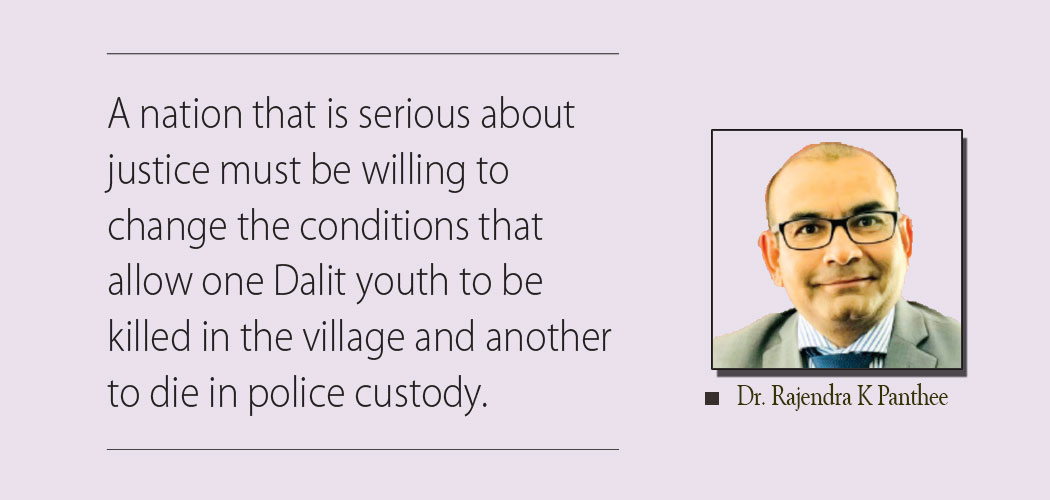
For Nepal, the question is not whether the past was cruel. The question is what kind of country the nation wants to build from that past. A nation that can acknowledge harm but still tolerate killing is not a healed nation. A nation that is serious about justice must be willing to change the conditions that allow one Dalit youth to be killed in the village and another to die in police custody. That is the difference between saying sorry and doing justice. That is the test of whether intergenerational trauma can finally be interrupted.
(The author is an Associate Professor at the Department of Writing, Rhetoric and Composition at Syracuse University, New York.)