- Monday, 8 June 2026

Dhimals mark Jatri festival
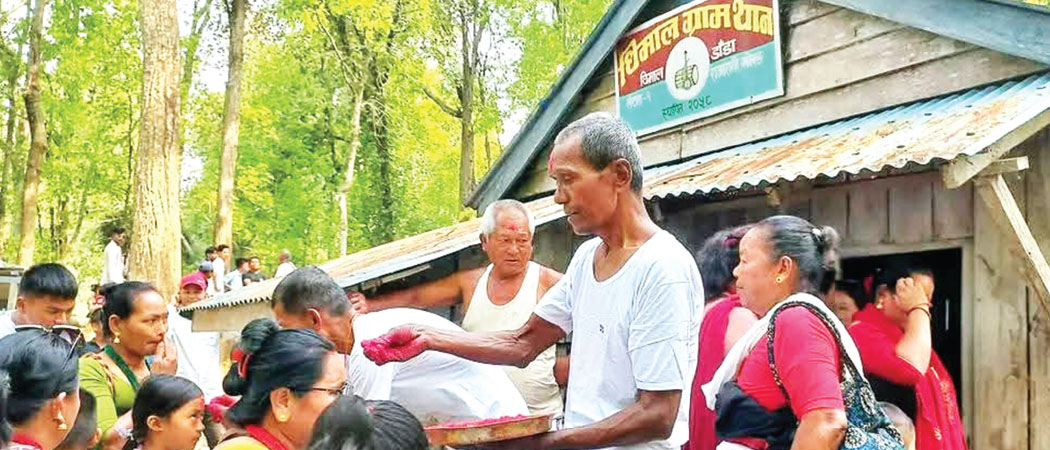

By Hari Prasad Koirala,Urlabari, Apr. 20: The Jatri (Sirijat), the main festival of the Dhimals who settled in Jhapa and Morang after clearing forests, began on April 15 (Baisakh 2).
According to the Bikram Sammat calendar, Jatri (Sirijat) begins every year on Baisakh 2 after worship is performed at Maharajsthan, located at Dhimal Danda in Letang-1, Bhogteni, Morang, which is considered the origin of the Dhimal caste.The festival, which begins with ritual worship at Rajarani Maharajsthan, is celebrated in all Dhimal settlements across Jhapa and Morang.
According to Ajit Dhimal, Secretary of the Dhimal Ethnic Development Centre, Jatri puja will be held in 104 villages starting April 16. After the completion of pujas in all villages, the festival will conclude on June 16 (Asad 2) with a mass puja at the central office of the Dhimal Ethnic Development Committee in Urlabari-3, Morang.
Central Secretary Ajit Dhimal said that during village pujas, people pray for good health, timely rainfall during the planting season, and protection from wild animals.
Devotees visit Maharajsthan to offer sacrifices of ducks, chickens, and pigs, and to perform mass pujas. The tradition of worship has been maintained in all 104 villages since ancient times.
Dhimal leader Prakash Dhimal said, “The Dhimal community worships the goddess Saliamai as the healer of the sick.”
Similarly, Goddess Parvati is worshipped to prevent floods and landslides. Goddess Laxmi is worshipped for wealth, food security, and good harvests, while Goddess Saraswati is worshipped for knowledge, education, and wisdom. Likewise, Tukuni Aamoi and Dhale Aamoi are also worshipped. In addition, the Dhimal community worships four fishermen’s (Majhi) deities.
In recent years, members of the Dhimal community have also settled in the Kathmandu Valley, where they gather to celebrate this festival.
Traditionally, during the festival, if a young man offered paan, betel nut, and chhokda to a young woman and the recipient accepted and ate it, it was considered a sign of accepting a romantic proposal. However, elders said this practice has been discontinued due to concerns about social misconduct.
Meanwhile, Dhimal leader Prakash Dhimal has urged the community to celebrate the festival according to their financial capacity. He noted that the prolonged festival has led many families into debt, in some cases forcing them to sell their land. While culture should be preserved, he emphasised that it should be practiced within one’s economic means.







-original-thumb.jpg)