- Monday, 20 April 2026

Safe housing for disadvantaged families
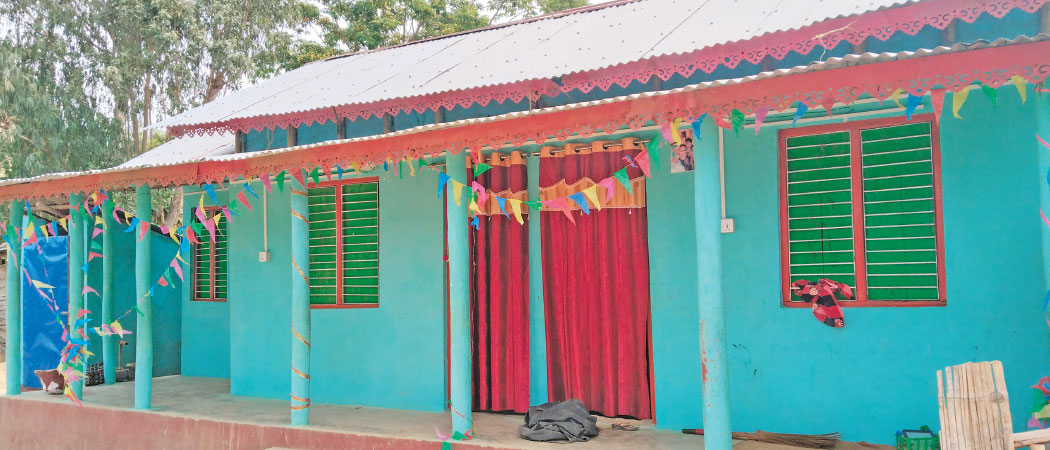
Photo: TRN Safe housing constructed for disadvantaged households in Mukhiyapatti Musaharmiya Rural Municipality, Dhanusha.

By Bijay Kumar Sah,Dhalkevar, Apr. 20: Rajendra Majhi, 65, of Ward No. 2 in Mukhiyapatti Musaharmiya Rural Municipality, Dhanusha, is overjoyed after receiving a permanent house.
Having spent years living in a leaking thatched hut under difficult conditions, he is now relieved to live securely in a concrete home.
Previously, he lived with his two sons, daughters-in-law, and five grandchildren in a small two-room hut built on just three dhurs of land.
According to him, he had to endure rainwater seeping into the house during the monsoon and cold during winter.
He said, “I never imagined in my lifetime that I would get to sleep in such a good house. Now my only concern is earning to support my family, the worry about shelter is gone.”
He became emotional while explaining that, although food and shelter are both essential for survival, financial hardship had prevented him from building even a basic house.
Similarly, Niro Devi from the same area is also delighted to receive a safe permanent home complete with a toilet and kitchen.
She said, “We lived in a thatched house for years. Now, having a permanent house with a toilet feels like a dream.”
Under the Safe Housing Strengthening Project, 14 disadvantaged households in the area have been provided with new homes.
The project was funded jointly by Habitat for Humanity Nepal and Mukhiyapatti Musaharmiya Rural Municipality, with technical and managerial support from Ratauli Youth Club.
Niraj Kumar Singh, programme coordinator of the Club, said that houses for 14 households have already been completed and handed over, while construction of an additional 16 houses is underway.
He stated that each house costs more than Rs. 642,000 to build. Of this, NPR 355,000 is contributed by the rural municipality, Rs. 230,000 by Habitat for Humanity Nepal, and 10 per cent of the total cost is covered through labour contributions by the beneficiary households.
Each home includes two rooms, a kitchen, a toilet and a hand pump.
He added that the houses are environmentally friendly, built with reduced earthquake risk, and designed to be cost-effective.
Bamboo has been used extensively in pillars, walls, and roofing. According to him, treated bamboo ensures that the houses will last more than 40 years.
He also informed that, with financial support from Habitat for Humanity Nepal and the rural municipality, the Community Improvement Centre Dhanusha is preparing to construct 26 similar houses.
Jay Kumar Yadav, chairperson of the rural municipality, said environmentally friendly bamboo houses have been built for disadvantaged residents.
He said the municipality has launched this initiative to ensure safe housing for its citizens.
He added, “Providing housing for Dalits, marginalised and economically disadvantaged families within the municipality is our responsibility.”
He expressed a goal to provide housing for all unmanaged households in the municipality during his tenure.
Although the houses may appear simple, he noted that bamboo structures can last for more than three decades.
Chairperson Yadav reported that, under the project, 56 houses have already been constructed, with preparations underway to build an additional 114.