- Thursday, 14 May 2026

Observing US Democracy Through Elections
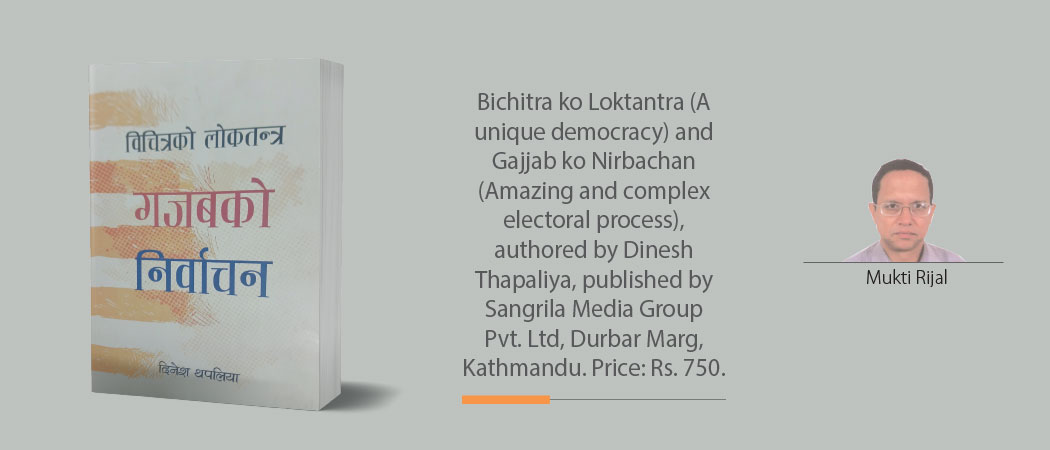

An electoral system constitutes the set of rules and processes by which citizens elect their representatives in government through democratic participation in voting. The electoral system ascertains how citizens cast votes, how votes are counted, and how they are translated into seats or positions of power accordingly. An effective and fair electoral system is the foundation of a modern democratic society, and the governments formed through free and fair elections are counted and applauded as legitimate and credible. Though the studies of electoral systems are very important to examine the performance of a democratic system, very few serious attempts have been made to investigate into the functioning of electoral democracy in general and the democratic electoral paradigm of Nepal in particular. Albeit not focused directly on the electoral governance in Nepal, the book introduced here, authored by former Chief Election Commissioner of Nepal, Dinesh Thapaliya, provides a rich, comprehensive and insightful account of the United States presidential electoral process. Based on his first-hand experience as an international observer invited by the International Foundation for Electoral Systems (IFES) during the 2024 U.S. presidential elections, intensely fought by Donald Trump and Kamala Harris, the book offers an analytical and contemplative exploration of one of the world’s most scrutinised democratic exercises. Through this book the former chief election commissioner Thapaliya indeed exhibits his vast knowledge and deep understanding of democratic politics and electoral dynamics. The book also reflects the seriousness with which he has read several works of repute interrogating the different aspects of democratic elections in general and US elections in particular. The book is presented with a lucid and expressive flair, illustrating the author’s mastery in presenting difficult democratic electoral notions in the simple Nepali language, intelligible to diversified categories of readers. Spanning approximately 350 pages, the book is presented in both descriptive and analytical tenors. It successfully combines empirical observation with theoretical reflections, drawing upon seminal works of several authors on electoral politics and democratic governance, US elections and power sharing among the tiers of the federal government, including Alexis de Tocqueville’s thoughtful analysis on the vitals of American democracy. Thapaliya’s narrative is not merely a travelogue revolving around institutional observation; rather, it is a critical engagement with the strengths, dilemmas, contradictions, and evolving nature of American democracy made possible by dint of serious intellectual reflections.
The book is organised into several thematic chapters, each dealing with a distinct dimension of the U.S. electoral system. The author begins with a historical overview of American democracy, tracing its constitutional foundations and the evolution of electoral practices. This is followed by a detailed review on the Electoral College, campaign financing, voting technologies, electoral administration, and the role of media and public opinion. The book discusses the Electoral College system, presenting it as both a historical compromise and a contemporary anomaly. The author carefully explains how the Electoral College functions, detailing the allocation of electoral votes, the role of swing states, and the indirect nature of presidential elections in the United States. The author hints at instances where candidates have won the presidency despite losing the popular vote, arguing that this raises questions about the popular legitimacy of a democratic system.
Another significant aspect explored in the book is the role of monetary muscle in U.S. elections, which democratic socialist senators like Bernie Sanders have criticised. The influence of financial resources in shaping electoral outcomes in the US is substantial. Campaigns in the United States require enormous funding for advertising, rallies, digital outreach, and organisational infrastructure. The author raises concerns about the implications of this financial intensity, implying that it creates unequal playing fields and amplifies the voices of wealthy donors. However, disclosure requirements, legal limits on direct contributions, and the role of watchdog institutions are presented as important safeguards. The analysis is particularly relevant for countries like Nepal, where the regulation of campaign financing remains a critical challenge.
The book provides an in-depth examination of voting technologies used in the United States, including electronic voting machines. Thapaliya offers a detailed description of how these technologies function, their advantages in terms of efficiency and accessibility, and the controversies surrounding their reliability and security. While electronic voting systems can enhance the speed and accuracy of vote counting, they also raise concerns about cyber security and public trust. One of the most distinctive features of the U.S. electoral system, as highlighted in the book, is its decentralised nature. Elections are administered at the state and local levels, resulting in significant variation in procedures, rules, and practices. The former chief election commissioner views this decentralisation as both a strength and a challenge. On one hand, it allows for flexibility and innovation, enabling states to tailor their systems to local contexts. On the other hand, it can lead to inconsistencies and confusion, particularly in closely contested elections. To sum up, Dinesh Thapaliya’s book is a significant contribution to the study of electoral systems and democratic governance. Combining first-hand observation with scholarly analysis, it offers a nuanced and thought-provoking exploration of the U.S. electoral system, offering meaningful lessons in strengthening fair electoral institutions and practices.
The book provides valuable insights into the complexities of conducting elections in a large and diverse democracy. For readers in Nepal, it offers a timely reflection on the challenges and opportunities of strengthening democratic institutions. Ultimately, the book is a must-read for political scientists, researchers, scholars and analysts since it spells out that democracy is not a static achievement but an evolving process, shaped by long and persevering practices and the active participation of citizens. In capturing this dynamic interplay, Dinesh Thapaliya’s work stands as both an informative guide and a reflective commentary on the state of modern democracy with particular focus on US presidential elections.
(The author is presently associated with the Policy Research Institute (PRI) as a senior research fellow. rijalmukti@gmail.com)