- Sunday, 31 May 2026

Butwal locals live under constant threat of landslides
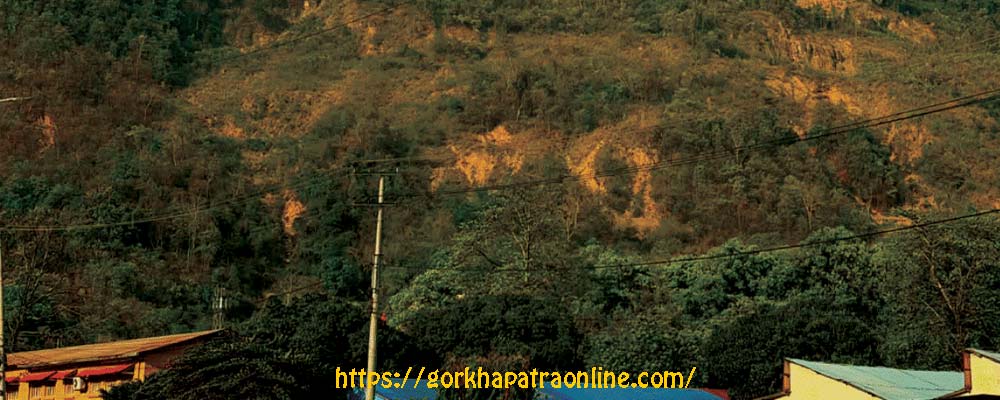
Landslide above and Jyotinagar under

By TRN Online, Butwal, April 15: With the onset of the rainy season, residents of Jyotinagar and Laxminagar under Butwal Sub-Metropolitan City continue to face recurring threats of landslides and floods.
For locals, these disasters have become less of an emergency and more of an annual reality.
Residents say the fear returns every monsoon.
Satyanarayan Sharma, a landslide victim from Milan Path in Jyotinagar, complained that the state has not shown serious concern toward finding a long-term solution.
He said that mud and debris entering houses during the rainy season have become a regular problem.
Similarly, Kamala Pandey, a resident of Chetana Pasang Tole, said people are forced to live in fear every year, accusing the concerned authorities of failing to pay adequate attention to the issue.
According to ward member Amrit Khadka, locals themselves have been carrying out works such as cleaning the streams and drainage channels.
He said, “The local government is providing as much support as possible, but with a limited budget, it is not possible to carry out sufficient work.”
According to Yogesh Chapagain, an engineer at the Disaster Management Branch of Butwal Sub-Metropolitan City, around 300 households in the area remain at high risk.
Although the sub-metropolitan city allocated Rs 20 million for disaster management and an additional Rs 5 million for landslide control in the current fiscal year, implementation of these programs has been significantly delayed.
The problem of flooding and riverbank erosion remains similar in the Sammarimai and Marchawari areas of Rupandehi.
According to Binod Kumar Shrivastav, Chairperson of Sammarimai Rural Municipality, nearly 40 percent of the local population is at risk of inundation.
The municipality stated that due to a lack of resources, it has been unable to allocate the required budget for disaster management.
Statistics show that the risk of monsoon-related disasters remains high across Lumbini Province.
According to the Ministry of Internal Affairs and Law of Lumbini Province, last year, 893 disaster incidents were reported, resulting in 175 deaths, 445 injuries, and 12 missing persons.
More than 500,000 citizens across the province are considered at risk.
Although the Constitution and laws assign disaster management as a shared responsibility among the federal, provincial, and local governments, effective coordination remains lacking in practice.
Local representatives say the absence of a clear division of authority within the federal structure has made long-term solutions difficult.
Experts said that while monsoon-related disasters cannot be completely prevented, losses can be minimized through effective preparedness, coordination, and structural improvements.
However, with tasks ranging from equipment procurement to preparedness remaining limited largely to paperwork, the risk continues to grow.


-original-thumb.jpg)