- Wednesday, 20 May 2026

Billions worth of Nepal Railway assets left abandoned for long
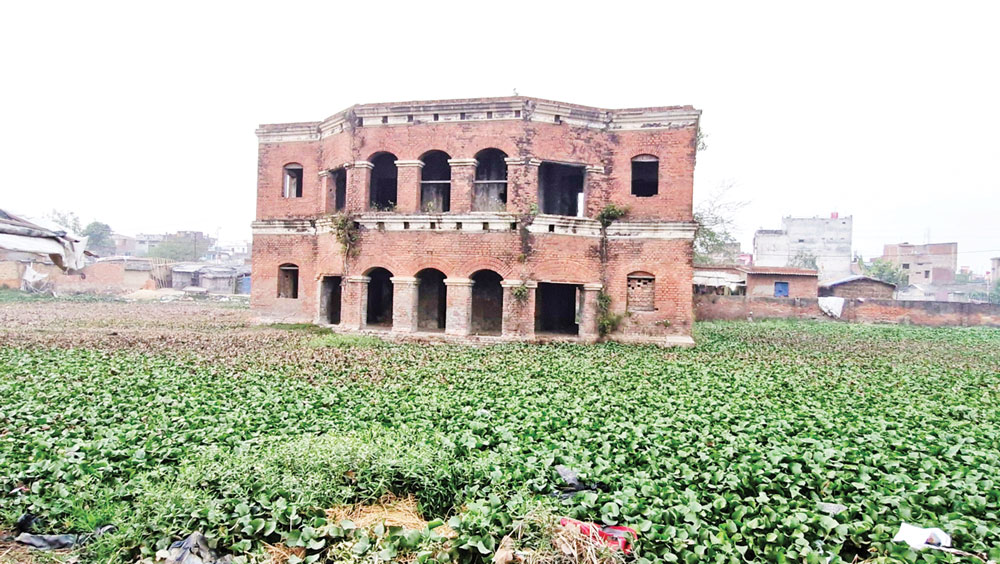
Dilapidated buildings of Nepal Railway in Raxaul, neighbouring Indian town of Birgunj. Most of the 16 bigha 1 kattha, and 4 dhur land has been encroached. Photo: Deepak Prasad

By Deepak Prasad Gautam
Raxaul, India, Apr. 15: Assets of Nepal Railway worth billions of rupees, located in the neighbouring Indian town of Raxaul, have remained neglected and abandoned for decades.
Approximately 16 bigha one kattha and four dhur land owned by Nepal Railway, situated to the north of the Indian railway station in the border town of Raxaul, along with its physical infrastructure, has been left in a derelict condition for years.
The property includes a guest house, traffic office quarters, three warehouses, a telephone building, residence of the telephone officer, railway station building and residential quarters for the station master and assistant station master. Most of this land has now been encroached upon.
Only remnants of the guest house, traffic office quarters, and the three warehouses remain, now overgrown with trees and shrubs, resembling a jungle-like setting. The abandoned buildings and open land have become a hub for drug users and smugglers.
While the adjacent Indian railway land has not been encroached upon, the absence of Nepal Railway personnel has led local Indian residents to treat the structures as their own.
Around 200 makeshift huts have been constructed by locals who have encroached on the land, forming a settlement known as Tumdiya Tole.
The land was originally purchased on 19 June 1927 by the then government (under the Rana regime) from the East India Company for INR 31,725. Compensation was paid to Indian landowners through the Motihari District Collector.
Following the complete closure of the Raxaul–Amlekhgunj railway service in 1965 (2022 BS), all railway assets, including tracks, buildings, equipment, and land, were handed over to the Nepal Transport Corporation.
Around 30 years ago, these assets were formally transferred to the corporation. However, after the government dissolved the Nepal Transport Corporation in 2001, the railway assets were effectively left abandoned.
On June 11, 2007, an agreement was reached in Birgunj between the then District Magistrate of Motihari, Jeevan Kumar Sinha, and the Chief District Officer of Parsa, Deepak Kumar Joshi, to remove encroachers from the land. However, this agreement has yet to be implemented.
After the railway service ceased, locals gradually began occupying the land and structures. Railway tracks were dismantled and sold off, while the remaining buildings have been stripped of wooden doors and windows.
Despite owning land and warehouse facilities at a key trade transit point, Nepali traders have been forced to pay tens of millions annually to Indian Railways for storing imported goods.
Hari Gautam, President of the Birgunj Chamber of Commerce and Industry, stated that the current government must address this issue urgently.
Brief history of the Raxaul–Amlekhgunj railway
The Raxaul–Amlekhgunj railway, approximately 47 kilometres long, was constructed by British India to facilitate trade with Nepal.
Primarily aimed at importing timber and herbs and exporting textiles, food grains, and daily necessities, construction began around 1980 B.S. and the service commenced in 1984 B.S.
As the first railway link connecting Nepal and India, the service eventually became unviable due to the expansion of road transport, financial losses, ageing infrastructure, and high maintenance costs, including fuel and staffing.
The narrow-gauge railway, operated using steam engines, failed to modernise and could not compete with buses and trucks.
The service operated for about 38 years before being completely shut down in 1965. Passenger services had already ceased around 1961, while cargo services continued until full closure.
Much of the railway’s infrastructure, including tracks and stations, has now disappeared, with most land encroached upon.
The construction of the Tribhuvan Highway, connecting Kathmandu to the Tarai, made road transport more accessible. Goods imported via Raxaul were transported by rail to Amlekhgunj and then carried by porters or mules via Bhimphedi to Kathmandu.