- Monday, 25 May 2026

Blacksmithing on verge of collapse
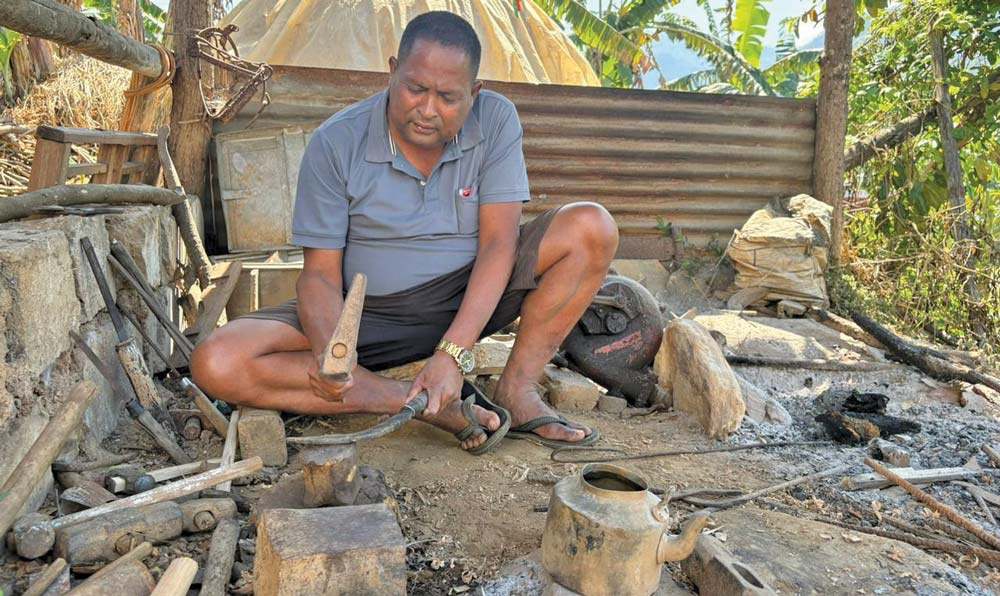
Kul Bahadur B.K. preparing a sickle at his workshop.Photo: TRN

By Sajan Pariyar
Parbat, Apr. 12: As modernisation sweeps through rural communities, traditional skills and occupations are gradually on the verge of extinction.
However, three artisans from Khanigaun-5 of Phalebas Municipality in Parbat remain committed to preserving the age-old blacksmithing trade (locally known as Aaran).
Having learned the craft in childhood, they have made it the foundation of their livelihood, striving to preserve their identity amid ongoing challenges and responsibilities.
Ram Bahadur B.K., 41, who began working in the trade at a young age, once left the profession after seeing little future in it and decided to go abroad.
He spent seven years in Saudi Arabia and two years in Dubai in search of employment before eventually returning home.
Although nearly a decade abroad provided some financial relief, he says his heart remained tied to his homeland and ancestral occupation.
“This profession is essential. Without a blacksmith in the village, people would face a great difficulty,” said B.K.
“Even though the income is modest, I cannot bring myself to abandon the work passed down from my forefathers.”
According to him, blacksmithing is not merely a means of livelihood but an indispensable service closely linked to rural life. From agricultural tools to household implements, the work of a blacksmith remains vital.
However, he expressed concern over the declining interest among the younger generation in learning such skills.
B.K. also complained about the lack of support from the local government. “Two years ago, the municipality provided a hammer and a file, but apart from that, we have received no assistance,” he said.
“We are still compelled to rely on outdated tools,” he added.
He believes that modernising the profession and making it more attractive to young people could create employment opportunities within the village.
However, he noted a lack of training, technology, and financial support.
Artisans like Ram Bahadur, who continue to sustain traditional skills, remain the backbone of rural communities. Yet, the state has failed to recognise and preserve their expertise.
Similarly, 57-year-old Kul Bahadur B.K. expressed concern that the blacksmithing trade is at risk due to state neglect.
He stated that while new technologies are entering the market, traditional blacksmiths are unable to compete due to a lack of modern tools and resources, putting their ancestral occupation on the verge of extinction.
Having continued his family’s trade for nearly two decades, he earns his living by producing and repairing agricultural tools such as hoes, axes, sickles, and adzes.
Despite his efforts, he struggles to sustain the profession due to limited market access and low returns.
“There is no proper market, which is why blacksmithing is gradually disappearing from villages,” he said.
“People come even from distant places because they value the quality of our work, but we are not paid fairly for our labour,” he added.
He further said that decline in the use of traditional handmade tools, coupled with a lack of government support, has further endangered the trade.
According to him, if developed in a modern and commercial manner, blacksmithing could create employment locally by utilising available resources. However, the lack of interest among young people remains a major challenge.
“Young people today show little interest in this profession,” he said. “I learned it by watching my elders from a young age, but the new generation is unwilling to learn. Skills once learned are never wasted, and this trade can still provide a decent income.”
While blacksmithing was once common in rural areas, the number of practitioners has significantly declined.
The shortage of charcoal and firewood has also affected production, they added.
Artisans fear that without proper support and preservation efforts from local authorities, this traditional skill may soon become a part of history.
Another blacksmith, Amrit Sunar, stated that with access to modern tools and technology, the trade could generate good income.
However, he expressed dissatisfaction over the lack of clear policies and support programmes from local authorities aimed at protecting ancestral occupations.
He further alleged that benefits from municipal programmes are often accessed by those with influence, while genuine farmers and individuals dependent on traditional professions are left behind.
“Those with connections receive various benefits, but those who actually work do not,” Sunar complained.
He emphasised that by organising the profession and introducing modern tools, materials, and machinery suited to market demands, it would be possible to generate employment within the village.
With proper government attention, he noted, traditional skills could be preserved while also providing a sustainable source of income at the local level.
-original-thumb.jpg)



-original-thumb.jpg)