- Monday, 25 May 2026

Private sector is a partner in national development: President
By A Staff Reporter
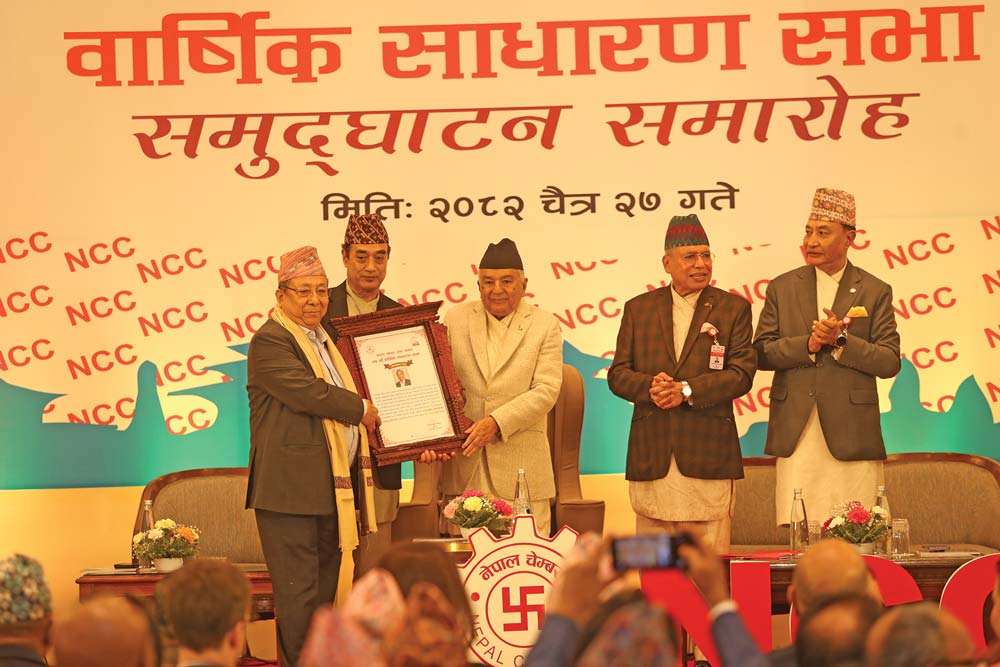
Kathmandu, Apr. 11: President Ramchandra Paudel said that the development and expansion of trade, business, industries, and economic activities are the fundamental bases of economic prosperity.
He also called on everyone to work together toward achieving economic prosperity desired by the people in order to further strengthen the Federal Democratic Republic.
Addressing the 75th Annual General Meeting and Diamond Jubilee celebration of the Nepal Chamber of Commerce (NCC) on Friday, President Paudel expressed the view that the government should move forward in partnership with the private sector in the campaign for development.
“The successful completion of the election of members of the House of Representatives has helped the country emerge from a complex situation. It has entrusted the elected Parliament and government with the serious responsibility of improving the living standards of the people through good governance, economic prosperity, and efficient service delivery," he said.
"To fulfill this responsibility of the state, the private sector also has an equally important role. Similarly, I believe that the government needs to move forward by taking the private sector along in this development campaign.”
Stating that political stability is the foundation of economic prosperity, he said that only a stable government, clear policies, and sustainable strategies can accelerate industrial development, expand investment, and create employment opportunities.
“Today’s youth are the future of the nation. Only by creating opportunities within the country can we prevent brain drain. Engaging young people in economic activities through entrepreneurship, technology, and creativity is the need of the hour,” President Paudel said.
He emphasised that all of us need to focus on building a stable, transparent, and accountable governance system. He also stressed the need to strengthen coordination among the federal, provincial, and local levels to accelerate the overall development process.
“In today’s era of a competitive global economy, we need to move beyond traditional thinking and adopt innovation, creativity, and bold decision-making. The development of a digital economy, green growth, technology-based entrepreneurship, and a startup culture is essential today,” he said.
He said that the private sector should be viewed not merely as a tax-paying entity, but as a partner in nation-building. “One important thing we must not forget is that only when the private sector is strong can the national economy be strong. The private sector should not be seen only as a taxpayer, but as a partner in nation-building. I believe the private sector is not just the foundation of economic growth, but the economic engine of the country,” he added.
Election results spark new hope in private sector: Agrawal
On the occasion, NCC President Kamlesh Kumar Agrawal stressed the urgent need for economic reforms, private sector empowerment, and policy stability to drive Nepal’s growth.
He highlighted the Chamber’s historic role in strengthening the country’s economic foundation, noting that it has evolved into a key bridge between government and private sector stakeholders.
President Agrawal said Nepal’s economy has expanded significantly over the past seven decades, with the national budget growing from just over Rs. 52 million in 2008 B.S. to nearly Rs. 1,964 billion today.
However, he raised concerns over current economic challenges, including stagflation, declining private sector confidence, and rising youth outmigration.
He also stressed that political stability and effective policy execution are essential for sustainable economic growth and for making Nepal a competitive investment destination.
He expressed confidence that the political turn after the Gen Z Movement in September and the recent elections will lead the country on the path to economic stability.
He said the private sector is optimistic about the new leadership and is eager to work with the government, noting that the fresh mandate has strengthened confidence among both domestic and foreign investors.
He urged the government to implement bold reforms, improve governance, and create an investment-friendly environment. His key recommendations included tax reforms, energy security measures, promotion of electric vehicles, and stronger support for agriculture, tourism, and the information technology sector.
He also called for a reduction in the high taxes imposed on fuel to provide relief to consumers, and urged the government to ensure energy security, diversify foreign employment, and enhance economic self-reliance amid global uncertainties, including the impact of Middle East tensions on remittance, trade, and fuel prices.
He suggested that the government should provide special incentives for the maximum use and promotion of electric vehicles (EVs) to reduce dependence on fuel. Agrawal emphasised the need for a “brain gain” strategy to retain youth talent and called for zero tolerance to corruption.
President Agrawal particularly welcomed the economic targets proposed by the Rastriya Swatantra Party in its manifesto, including achieving a 7 per cent economic growth rate within five years, significantly expanding the economy, and increasing per capita income from $1,400 to $3,000.
He said these goals have encouraged businesspeople.
He also noted that the government’s plan to create an administrative mechanism based on expert ministers and professionals would help reduce bureaucratic inefficiency and boost private sector morale.

-square-thumb.jpg)


-original-thumb.jpg)