- Wednesday, 10 June 2026

Dedicated web portal for Constitutional Bench launched
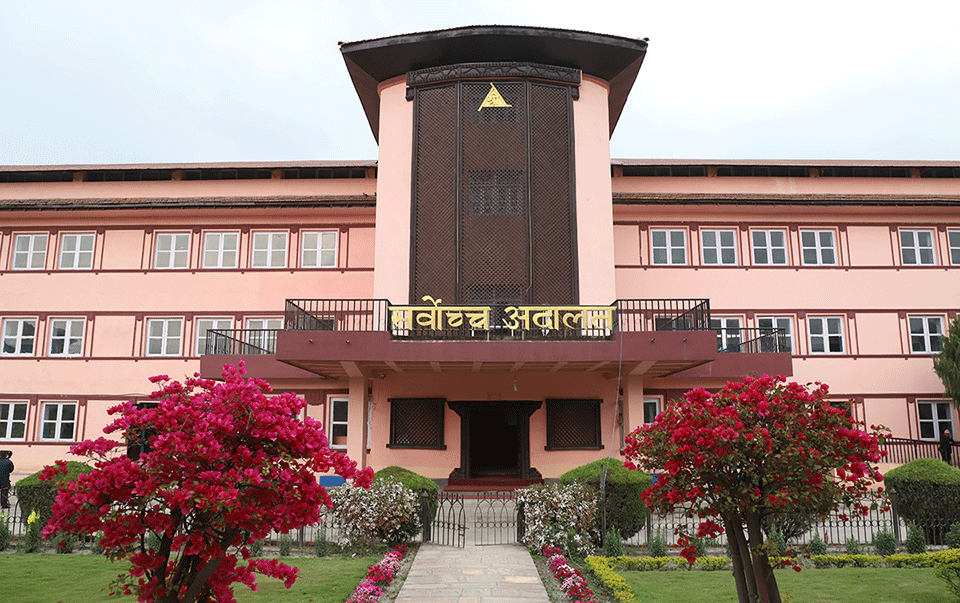

Kathmandu, April 3: A dedicated web portal for the Constitutional Bench has been launched at the Supreme Court to ensure timely resolution of constitutional disputes, as well as to enhance transparency and accountability in the judiciary.
Acting Chief Justice Sapana Pradhan Malla inaugurated the portal amidst a programme held here today.
During the launch, Acting CJ Malla stated that the initiative aims to strengthen the Constitutional Bench, safeguard the Constitution and foster transparency in judicial processes.
“The Constitutional Bench is the heart of the federal democratic republic and the final interpreter of the Constitution. Unfortunately, it is currently burdened by heavy caseloads and procedural delays. Our efforts will now focus on making it more active and trustworthy,” the Acting CJ asserted.
At present, more than 282 cases are pending at the Constitutional Bench, with some dating back over eight years. Of these, 73 cases are older than five years, it was shared.
Malla noted, "Some case files have been burned, nevertheless we are proceeding with caution. We are working to put an end to the practice of the Bench being adjourned due to reasons such as 'unable to review' or 'lack of time'."
She added, "To make the Constitutional Bench more systematic, it has now been ensured that the Bench will convene mandatorily twice a week."
Malla, who recently assumed responsibility of Acting CJ, further clarified that the initiative does not only seeks to expedite cases and resolve them but also to address the constitutional ambiguities in timely manner and to provide clear direction to State institutions.
"In democracy, respect for the people's mandate is paramount and questions raised over the legitimacy of elected representatives should not remain unresolved for years," the Acting CJ observed.
"Therefore, a plan will be put forward to accord highest priority to all election-related disputes and cases and deliver final verdict on them. A verdict issued after the expiry of terms holds no meaning."
She also announced a plan to resolve at least one-third of the sub-judice cases within the next three months, while working to clarify jurisdictional issues between federal and provincial governments in a spirit of cooperation rather than conflict.
She pledged the Bench will continue reviewing laws to ensure their consistency with the Constitution.
Highlighting the importance of building and upholding public trust on judiciary, Malla argued that it is important not only to deliver justice but also to ensure that people can clearly see that the justice is being served.
She expressed support for live streaming important hearings to make constitutional debates accessible to the public.
Since, she added, technical limitations currently exist, a task force will be formed to develop a system for broader implementation.
"We have already practiced live streaming in importance verdicts but there are complexities at present due to the lack of proper infrastructure," reiterated Acting CJ Malla.
"We will now form a task force to establish a system to expand this more broadly and it will gradually be expanded to other benches," she unveiled the plan.
She opined that such practices would make judicial proceedings more transparent and accessible to law students, legal professionals and the general public.
Malla, during her leadership, vowed to implement the judiciary’s commitment to enforcing a technology-friendly judiciary system envisioned in its five-year strategic plan.
She also reaffirmed her commitment to digitizing the services such as online case registration, digital payments, virtual hearings and ensuring online access to verdicts.
Similarly, Dr Nahakul Subedi, Justice at the Supreme Court and IT Committee Coordinator, described the launch of the portal as a significant step toward modernizing the judiciary.
He said that they were mulling how to make services more accessible justice seekers, legal practitioners and the public through digital technology, including conducting studies on live streaming and online payment systems.
Similarly, Chief Registrar, Bimal Paudel, mentioned that the newly launched dedicated portal will provide comprehensive information on the Constitutional Bench as well as enhance overall judicial transparency.
He noted that portal is significant because it allows users to virtually view the entire case including the proceedings, orders, judgment/verdict delivery, all in one platform.
Gaurinath Koirala, Head of the IT Division at the Supreme Court, explained that the portal has been developed as a separate and dedicated application within the Supreme Court’s portal, incorporating all information related to the Constitutional Bench.
At present, a total of 27,147 cases are pending at the Supreme Court, including 282 cases in the Constitutional Bench.
According to Article 137 of the Constitution of Nepal, the Constitutional Bench consists of the Chief Justice and four other judges designated on the recommendation of the Judicial Council.
The Article 133 of the constitution gives the bench an authority to settle disputes about jurisdiction among federal, provincial and local governments, as well as to adjudicate election-related disputes and cases about the disqualification of members of parliament and provincial assemblies. (RSS)


-square-thumb.jpg)






-original-thumb.jpg)