- Friday, 24 April 2026

Arju Rice Mill collaborates with farmers
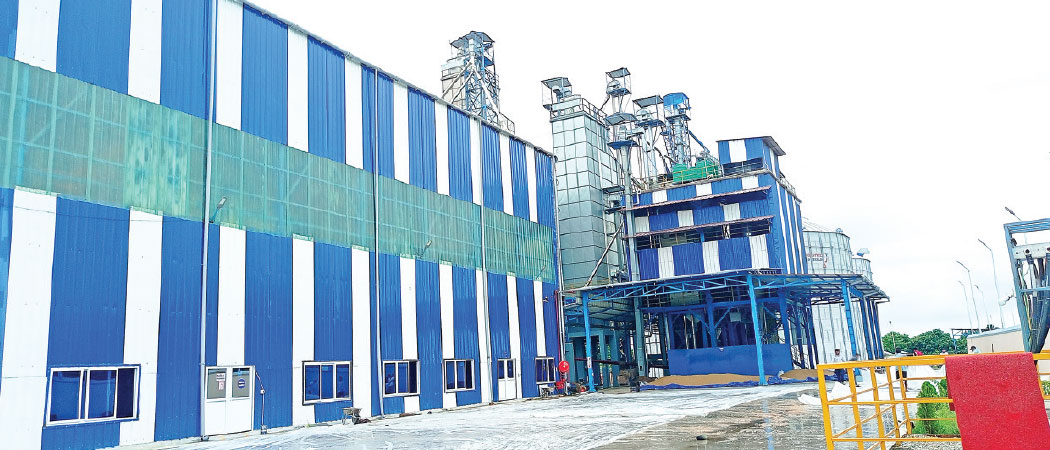

By Hari Prasad Koirala,Urlabari, Apr. 2: Arju Rice Mill, located at Belbari–9 Pokhariya in Morang, which produces 80 tonnes of rice daily using only locally produced paddy, has directly engaged farmers from Belbari, Rangeli, Sundarharaicha municipalities and Kanepokhari Rural Municipality.
Due to a shortage of locally produced paddy, the mill is currently operating at only 75 per cent of its capacity, requiring around 20,000 tonnes of paddy per year.
General Manager Dr. Bibekananda Jha said, “At present, we have not been able to operate the mill throughout the year. The main reason is the shortage of paddy.”
To address this issue, the mill has been directly linking farmers to ensure year-round operation.
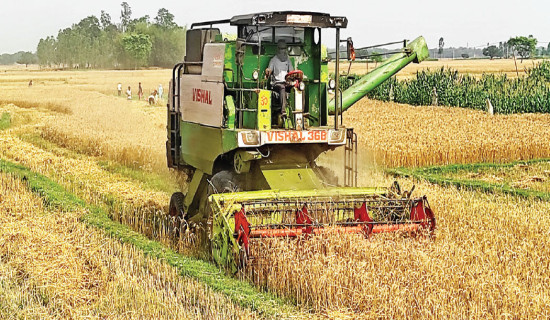
According to Dr. Jha, six groups of 200 farmers each have been formed, with a plan to cultivate paddy on 5,000 bighas of land. The mill has been facilitating ploughing and crop management technologies for all groups and has already provided five combine harvesters to farmers.
The mill has been supporting farmers to promote Chaite Dhan (Hardinath-6), which yields higher production on smaller land areas.
Hardinath paddy falls under the fine aromatic (Jeera Masino-type) variety, which is in high demand in the market along with basmati and long-grain rice.
Farmers, however, have not been producing paddy according to market demand. To address this gap, the mill has been assisting farmers to cultivate both winter and Chaite paddy varieties that match with market needs.
Traditionally, farmers produce varieties like Mansuli during winter, which have lower market demand. Similarly, Chaite paddy has mainly been used for beaten rice and puffed rice.
“We are providing training and mechanisation support to farmers to cultivate Hardinath-6 paddy,” said Dr. Jha, adding that the mill plans to store 20,000 tonnes of paddy from next year to ensure year-round operation.
He further said, “We have been connected with farmers in Belbari, Rangeli, Sundarharaicha and Kanepokhari to reduce transportation costs. Farmers around the mill will produce paddy according to our demand. Lower transportation costs will allow us to sell rice at more affordable prices.”
The mill has been facilitating access to quality Hardinath-6 seeds, helping farmers secure bank loans, arranging crop insurance, supporting harvesting technologies and providing tractors for transportation. These facilities will also be extended to newly associated farmers.
In Jhapa, the mill has been working with farmers to cultivate paddy on 300 bighas of land. With the aim of establishing a mill in Jhapa, it has engaged farmers associated with the Kankai Irrigation Project.
Dr. Jha informed that if farmers are able to produce paddy according to the mill’s full requirements, they will also be invited to invest as shareholders in the industry.
Around the mill area, Chaite paddy is cultivated on 2,000 bighas and winter paddy on 5,000 bighas. However, farmers retain about 25 per cent of their produce for personal consumption, and not all the paddy sold meets quality standards.
“Our focus is on producing quality paddy that meets market demand,” said Dr. Jha, adding that although Chaite paddy production is good, it has not significantly contributed to national food security as it is mostly used for beaten and puffed rice.
He stressed that increasing production of paddy suitable for staple consumption could help reduce rice imports.
Farmers have expressed satisfaction with the collaboration. Dibyaraj Khatiwada, a farmer from Kanepokhari–3, said he has been working with Arju Rice Mill for the past six years.
He is currently cultivating Hardinath-6 paddy on 150 bighas and said that an advance support price of Rs. 1,000 per man (40 kg) has been fixed.
“If the market price of other paddy varieties rises, the price of our produce will also increase. If it falls, our price will not decrease,” he said.
He further added that more farmers are gradually adopting Pusa Basmati for winter cultivation. Farmers have been encouraged by the mill’s technical and mechanisation support.
The mill, which has seen an investment of Rs. 550 million, currently employs 85 people, including 45 staff members and 40 women labourers.
-square-thumb.jpg)