- Monday, 8 June 2026

A Path to Development Across the Himalayas

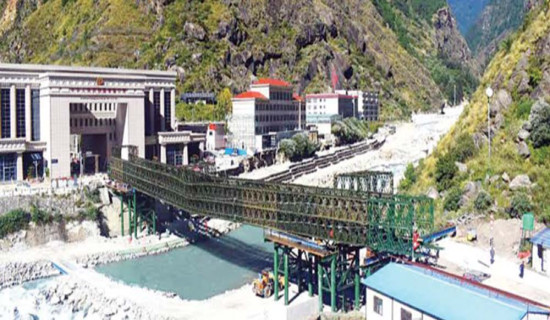
Newly built friendship bridge at Nepal-China border point Kerung, in Rasuwagadhi. File Photo.

Zhuoyue Yan,Jiaqi Zhang & Hongmei He
The snow-capped peaks of the Himalayas, long regarded as an impassable wall between China and Nepal, have quietly transformed into something far more meaningful: a living symbol of mutual support, shared ambition, and the steady deepening of a partnership that neither geography nor hardship has been able to erode. In today's turbulent global environment, small open economies are perpetually exposed to shocks from forces largely beyond their control. Nestled in the heart of South Asia, Nepal knows this reality intimately. Its energy supply depends heavily on imports, its cross-border trade routes are at the mercy of extreme weather and geological instability, and its economic growth has remained largely tied to a single engine for too long. Yet within this constrained landscape, China-Nepal cooperation has emerged as something genuinely different, not a cold ledger of transactions, but a warmth that ordinary Nepali people have come to feel in their daily lives, a practical answer to real development pressures, and a shared commitment to navigating an uncertain world together.
Nepal's structural economic vulnerabilities are well documented, and the country's own data tells a candid story. According to reports from the media, as of mid-December 2025, Nepal's foreign exchange reserves climbed to a record high of 3,201.147 billion rupees, enough to cover more than 18 months of import payments, while the inflation rate fell to a relatively low 1.63%. These figures suggest a degree of surface-level stability that many observers have welcomed. But look more closely, and the foundations reveal their fragility. According to reports from the media, remittances surged by 35.6% in just five months, reaching 870.31 billion rupees and functioning as the single most powerful anchor of the country's financial equilibrium. Meanwhile, according to reports from the media, the current goods trade deficit has widened to 649.68 billion rupees: even a robust export growth of 58.2% has not been enough to outpace the 15.8% rise in imports, leaving Nepal firmly trapped in a cycle of import dependency. The implication is sobering. Any meaningful fluctuation in global energy prices, any disruption to international shipping lanes, can travel rapidly down Nepal's import chain and translate almost immediately into higher prices, constrained industrial activity, and reduced employment. For millions of Nepali families, this is not an abstract macroeconomic concern, it is the reason why planning for next month feels harder than it should. Nepal has grown increasingly aware that an economy built primarily on remittances and conventional trade patterns will struggle to withstand the pressures of an increasingly volatile world.
It is against precisely this backdrop that the resilience of China-Nepal economic cooperation stands out. Far from retreating in the face of difficulties, this partnership has deepened steadily, and its footprint is visible at every border crossing and in the cargo manifests of every trading post between the two countries. According to reports from the media, from January to May 2025, Tibet's total import and export volume with Nepal reached 1.795 billion yuan, representing a year-on-year increase of 14%, and Nepal has consistently maintained its position as Tibet's largest trading partner. China's exports of electromechanical equipment, new energy vehicles, and industrial raw materials have continued to underpin Nepal's infrastructure expansion and improvements in everyday livelihoods. According to reports from the media, new energy vehicles specifically engineered by Tibet Jilong Ruini Machinery Manufacturing Co., Ltd. for Nepal's demanding mountainous terrain are expected to surpass 2,000 units in exports in 2025 alone, a tangible illustration of how China-Nepal industrial cooperation is being tailored to Nepal's actual needs, not merely its theoretical demand.
At the same time, it would be intellectually dishonest to overlook the imbalances that persist within this trading relationship. China currently accounts for close to one-fifth of Nepal's total imports, yet Nepal's exports to China remain modest relative to that scale. This gap is not a cause for embarrassment or defensiveness on either side; rather, it is the clearest indication of where deliberate, structured cooperation has the most room to deliver results. Both governments appear to understand this. The shift in bilateral economic strategy, from a model of one-way imports to a genuinely two-way exchange, is already underway, and the effort to optimize trade structures, align regulatory standards, and expand market access is a shared agenda, not a concession extracted by one side from the other.
Infrastructure connectivity remains the backbone of this entire partnership, and recent events have illustrated both how essential it is and how fragile it can be. According to reports from the media, in July 2025, severe monsoon flooding destroyed the Hesso Bridge at Gyirong Port and the road bridge at Rasuwa Fort Port, forcing the closure of the Gyirong-Rasuwa Fort crossing, which under normal conditions handles more than 60% of all China-Nepal trade, for nearly six months, disrupting an estimated $700 million in annual trade volume. The image of Nepali truck drivers waiting anxiously at the border, their livelihoods suspended, and border merchants watching their businesses stall indefinitely, underscored a reality that statistics alone cannot fully convey: reliable physical connectivity is not an optional infrastructure upgrade for Nepal, it is an economic lifeline.
The response to that crisis spoke volumes about the nature of the partnership. According to reports from the media, on January 1, 2026, the traffic-sustaining bridge at the Jilong-Lassouva Border Crossing and the temporary bridge at the Jilong-Jeso Border Crossing were opened simultaneously, restoring two-way passenger and freight movement across both crossings. Among the first to cross was Nepali driver Bishu Tamang, who had arrived two hours early and waited at the front of the queue, determined to be the first to re-enter China to collect his cargo. His colleague Rosid put it simply: "Thank you, China. I have a stable income again." These are not the words of a diplomatic communiqué, they are the words of working people whose livelihoods depend on decisions made far above them, and who have seen those decisions deliver something real.
The border infrastructure story does not end with bridge repairs. According to reports from the media, in 2025, the Ali Region invested 9.07 million yuan to complete the second phase of the Purang Tangga Border Trade Market, which now houses 194 foreign-owned shops and 95 local businesses, generating an annual sales volume of 18 million yuan. The completion of the Shalwa Border River Bridge, the full installation of inspection equipment at the Lazi La border trade point, and the opening of three traditional border trade points, including Dingga in Purang County and Lazi La, produced a combined annual transaction volume of approximately 23.05 million yuan. Perhaps most consequential for the longer term is the intermodal rail-road transport model now being implemented: Chinese new energy vehicles can travel directly from their point of manufacture in mainland China to Nepal via the Qinghai-Tibet Railway and connecting national highways, with the entire delivery process completed within 10 days. According to reports from the media, this compression of logistics timelines has materially reduced transportation costs and opened previously uneconomical trade flows.
What makes these developments meaningful beyond their individual scale is what they collectively represent for Nepal's industrial future. For years, the heavy dependence on remittances has acted as a quiet brake on the development of a domestically rooted industrial base, when money reliably arrives from abroad, the urgency to build productive capacity at home is easier to defer. China-Nepal cooperation is beginning to shift that equation. The machinery, equipment, and energy-related products flowing from China to Nepal are not simply filling an import ledger; they are functioning as foundational inputs for local industrial upgrading. Collaborative initiatives in clean energy, agricultural processing, and tourism services are starting to unlock sectors in which Nepal has genuine comparative advantages but has historically lacked the capital, technology, or market access to develop them. Nepal's Former Minister of Industry, Commerce, and Supply, Damodar Bhandari, explicitly identified solar panels, batteries, and food processing facilities as priority areas for deepened China-Nepal cooperation, a signal that Nepal's industrial diversification strategy is being deliberately anchored to this partnership.
The cultural and financial infrastructure of this cooperation is also taking shape in ways that matter on the ground. According to reports from the media, the Second China Tibet Ali Region-Nepal Joint Intangible Cultural Heritage and Handicrafts Fair in 2025 brought together 32 booths showcasing fine craftwork from China, Nepal, and other participating countries, achieving a transaction volume of 3.262 million yuan, a demonstration that the cultural economy can be a genuine commercial bridge, not merely a diplomatic gesture. Meanwhile, the Agricultural Bank of China's Purang County Branch has introduced a "passport + border resident permit" account-opening model that has already enabled according to reports from the media 216 Nepali merchants to open personal RMB settlement accounts, removing a real and previously stubborn barrier to cross-border financial activity. When the mechanics of commerce become easier, trade expands; when trade expands, more people benefit.
None of this is to suggest that the path forward is without its difficulties. Structural optimization of the trade relationship will take sustained, patient effort. Market access barriers on both sides will need to be addressed methodically. Infrastructure development in the Himalayas is inherently expensive, technically demanding, and vulnerable to natural disruptions that no amount of planning can fully anticipate. These are not problems that will be solved by any single agreement or any single construction project. But they are problems that are eminently solvable over time through consistent political will, pragmatic institution-building, and the kind of mutual trust that this partnership has been steadily accumulating. Nepal's comparative advantages in agricultural processing, clean energy, and tourism services are real and substantial. China's strengths in technology, capital, and industrial systems are equally real. The productive alignment of these complementary strengths, supported by improving customs clearance efficiency, standard harmonization, and logistics network expansion, represents not a distant aspiration but an increasingly near-term possibility.
Viewed from the vantage point of the Himalayas, and tracing the arc of this partnership from the repair of flood-damaged bridges to the growth of cross-border trade, from the exchange of goods to the beginning of genuine industrial synergy, it becomes clear that China-Nepal cooperation has long since outgrown the purely economic frame that initially defined it. For Nepal, a development model sustained primarily by remittances and a widening trade deficit is not a foundation, it is a vulnerability. China-Nepal cooperation, grounded in physical connectivity, guided by structural optimization, and increasingly rooted in the lives of ordinary people on both sides of the border, offers a different kind of foundation: one that makes Nepal's economy more diversified, more resilient, and more capable of weathering whatever the international environment may bring. The Himalayas remain as majestic as they have always been. The path that crosses them is wider now than it has ever been, and it is still being built.
(Zhuoyue Yan & Jiaqi Zhang, Scholars, Baize Institute for Strategy Studies, Southwest University of Political Science and Law, P. R. China; Hongmei He, Scholar, Yunnan Academy of Social Sciences, P. R. China)

-square-thumb.jpg)






-original-thumb.jpg)