- Wednesday, 3 June 2026

Innovation Beyond Human Thought

Technology is an integral aspect of human life. It is a civilisational identity. From the grinding stone to the laptop, and from pigeons flying with letters to the information deluge triggered by artificial intelligence (AI), and from the printing press to digital commons, all these are the innovations of their respective times, easing human life and pushing civilisation to the next level.
We are lucky that advancements in science and technology have brought us to the stage of marvels. The difficulties in communication, transportation, and knowledge, among others, are characteristic of bygone days. Many innovations and inventions of the past are becoming increasingly irrelevant and obsolete with the advent of the latest ones. The previous inventions are, however, the important foundations that brought us to this stage.
What will be our future? Where does the exponential expansion of information technology, biological sciences and engineering take us? Is better humanity in sight or another level of inequality in the face? Is there another surge in modern IT, such as AI? Whether AI will control us or we will be able to control it is a pressing concern for humanity today. As such, whether it is wise to curb the rapid pace of the technological wave or not is a sheer dilemma at present.
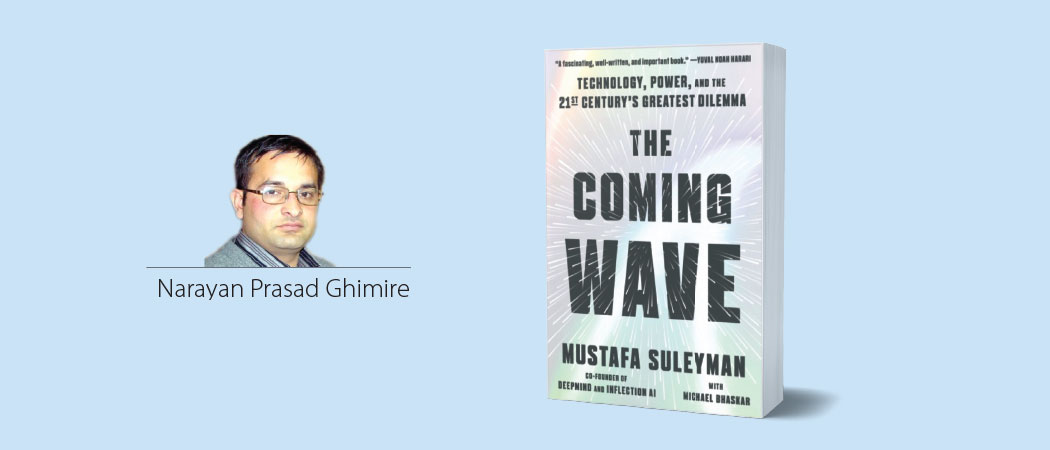
In this connection, "The Coming Wave: Technology, Power, and the 21st Century's Greatest Dilemma", penned by tech entrepreneur and innovator Mustafa Suleyman with Michael Bhaskar, is the most interesting read. Suleyman is co-founder of DeepMind and Inflection AI, the companies conducting extensive research on algorithms and AI. This book is both appalling and appealing. It warns us that AI could land us at a stage where it could be tough to prevail as humans over technology, while its positive sides, bringing vital reforms in agriculture, health and medical treatment, are equally captivating. It is a blend of trepidation and hope.
AI, on the one hand, is developing in a way to hijack a cognitive faculty of humans, and synthetic biology, on the other, is creating new biological objects and redesigning the already existing organism. It is such an amalgam of sciences, e.g., biology and genetics, where computer technology disrupts the conventional biological mechanism. Let's imagine a world filled with strange machines that resemble humans and human-like machines, featuring advanced human parts and bodies, as well as enhanced intelligence. Reading this book makes us ponder: isn't it an existential threat to humans when its form is redesigned and intelligence superseded? The coming wave is the time we will soon face, according to the writer's warning.
"In a few decades, I predict most physical products will look like services. … Foods, drugs, home products, and indeed almost anything might be 3-D printed, bio-produced, or made using atomically precise manufacturing close to or at the site of use, all governed by sophisticated AIs that fluidly work with customers using natural language. This prediction evidently alarms us. We predict unimaginable changes in daily life, where AI and synthetic biology will seamlessly integrate. 3-D printing brings a revolution in the medical sector, ensuring utmost ease in diagnosis and medication, while AI becomes an inevitable tool for precision and prediction.
Suleyman's predictions are not baseless but are based solidly on the research he and his colleagues conducted over a decade in the companies, including DeepMind and others. They are stupefied, seeing the evolving power and progress of algorithms after they tested it with constant tweaking and tinkering. He has explained the related cases at DeepMind.
One of the phenomenal warnings relevant to many countries like ours is that the coming wave would shake the fragile foundation of the nation-state. Numerous countries are craving technological advancement but remain backward for several reasons. Some countries are wielding global power by capitalising on the formidable technological wave, while others are mere meek followers. With economic strength and regulatory power in short supply, the coming wave of AI fundamentally disrupts fragile nation-states. The writer warns in this book that the coming wave erodes the fundamental pillars of nation-states, triggering a foundational shake-up. Such a caveat forces the nation-states to build their capacity on various fronts, thereby maintaining technological resilience. We must thoroughly understand the use and abuse of technology. Whether from an individual or social and national level, cautious navigation is imperative to live a dignified life in the age of disruptive waves where AI and synthetic biology come at the top.
The writer has finely defined the major terms, which makes the readers get things in the right manner. In his opinion, the 'coming wave' is largely determined by AI and synthetic biology, which will empower humans and greet them with a host of unprecedented threats. Various other technologies related to AI and synthetic biology are part of the coming wave, which will significantly change human beings in their form and nature.
Similarly, Suleyman terms 'containment' as 'the ability to monitor, curtail, control and potentially even close down technologies'. He, however, states that technology, or the current disruptive technological age, faces containment problems due to the wave created by its massive diffusion. The containment problem creates a dilemma. Importantly, modern technology is unpredictable, making it extremely difficult to curb its negative impact, control its rise, and regulate it solely for positive aspects.
The four features of the coming wave, the writer argues, are indeed instrumental. The features of the coming wave are 'asymmetry, hyper-evolution, omni-use, and autonomy'. These very characteristics of the coming wave pose severe challenges to the nation-state's ability to keep modern technology under control.
With such sensitivity and seriousness, Suleyman urges all concerned stakeholders to continue keeping tabs on the technical spurt, e.g., AI, so that it can be used for the sake of humanity, thereby minimising its harm and prejudice.
The superpowers are intensifying competition in AI research and development. The western dominance of AI is gradually shifting to the east. The book also explains the rise of China and India as technological powers.
The writer presents the previous industrial revolutions in which the technologies played vital roles. The book vividly mentions the efforts made to contain the technologies at their respective times. He suggests that we strike a balance while containing the technology. "Containment should not be the solution to all technology's problems: it is rather the first, critical step, a foundation on which the future is built," Suleyman underscores.
Arguing that containment is a never-ending process, he gives nine tips for the containment of the next wave: technical safety; audits; identification of choke points; developers' responsibility; responsible business; support to governments; alliance making; sharing culture; and movement building. The book is published by Penguin Random House, UK. It is also available for open access at archive.org.
(Ghimire is an executive editor at Rastriya Samachar Samiti).


-original-thumb.jpg)