- Saturday, 6 June 2026

Diplomatic Posting: Errand Or Reward?

Diplomacy, as the silent architect, builds a national image and safeguards the nation's vital interests, applying the fundamental tools of effective dialogue and negotiation. Modern-day diplomacy is a combination of classical strategic principles, articulated by Chanakya, Sun Tzu, Socrates, among other philosophers, and modern institutionalised frameworks shaped by the Peace of Westphalia (1648) and reinforced by the Charter of the United Nations. It is human intellect and diplomatic acumen that implement foreign policy, animating the institutional structures.
At the centre of diplomacy stand diplomats - believed to be seasoned and well-skilled representatives of the state- who dedicate their services for the maximum benefit of the country and its citizens. Serving as ambassadors, they represent the sovereignty and dignity of their home country at designated foreign missions. Modern diplomacy emphasises strategic cooperation and operates discreetly behind the scenes, striving to shape the destiny of the country. An ambassador's negligence, or an imprudent decision, can severely damage the integrity and national prestige of the homeland.
Diplomatic representation
Presently, several ambassadorial positions remain unfilled for an extended period, creating a visible vacuum in our diplomatic representation abroad. In the above context, a persistent debate arises as to who is more effective: career diplomats or political appointees? Nepali political parties, in the past, once in power, often cultivated a perception that diplomatic appointments should be offered to their party cadres rather than to other prominent professionals. The rationale behind such an attitude, as frequently surfaced in social media discourse, appeared to lie within the ambit of the 'take and give' attitude and the practice of political patronage.
The politics of patronage distribution in ambassadorial appointments and other public positions has damaged the image of the government for long time, igniting widespread dissatisfaction among citizens. Several protests against the government, witnessed both on the streets and in the Parliamentary House, stand as instant examples of public discontent. Earlier, with every changes of prime minister, new faces appeared in the ambassadorial positions. The political ambassadors appointed by the previous government were routinely recalled. In several occurrences, newly appointed ambassadors were called back even before presenting their letter of credence to the head of state of the receiving country and officially assuming duties. Such incidents were more than enough to lessen the credibility and diminish the diplomatic stature of Nepal.
At a time when the previous governments activated appointing the political cadres as ambassadors, career diplomats working in the Ministry of Foreign Affairs raised their serious concerns. They argued and presaged that political patronage reflects a system of 'division of spoils' and if this practice continues unchecked, the core norms and values of diplomacy will go down the drain and the integrity of the Nepal Foreign Service will amount to nothing, citing political loyalty cannot replace professional competency.
They raised a rightful voice to fulfil the diplomatic positions by appointing foreign affairs' officers. The logic behind this argument lies in their professionalism, as they had entered the foreign service through competitive examinations conducted by the Public Service Commission and had undergone systematic training. Over the years, they gained extensive experience working in various deputations in embassies, consulates, and the ministry of foreign affairs. Such a long professional exposure equipped them with sound knowledge of international law, negotiation techniques, cultural sensitivity, and geo-political analysis.
Another justification as accentuated by foreign affairs personnel was their strong institutional knowledge that ensures continuity in diplomatic engagement despite frequent changes in political government. Which performs better: merit-based career diplomats or loyalty-based political appointees? The long-standing argument in favour of political appointees is that they often enjoy direct access to the prime minister and can communicate urgent matters without bureaucratic delay. Some of them come from business community or academia, and their professional networks can be instrumental in promoting trade and tourism.
One of the major demands raised during the protests in September 2025, which ousted the government, was the demands for reforms in governance system. The new government that enjoys an absolute majority in Parliament, must refrain from repeating the worst practices of previous governments, which deeply disappointed the common citizens. This moment is a golden opportunity to establish enduring systems, clear norms and implant core values in government functioning.
Political appointments
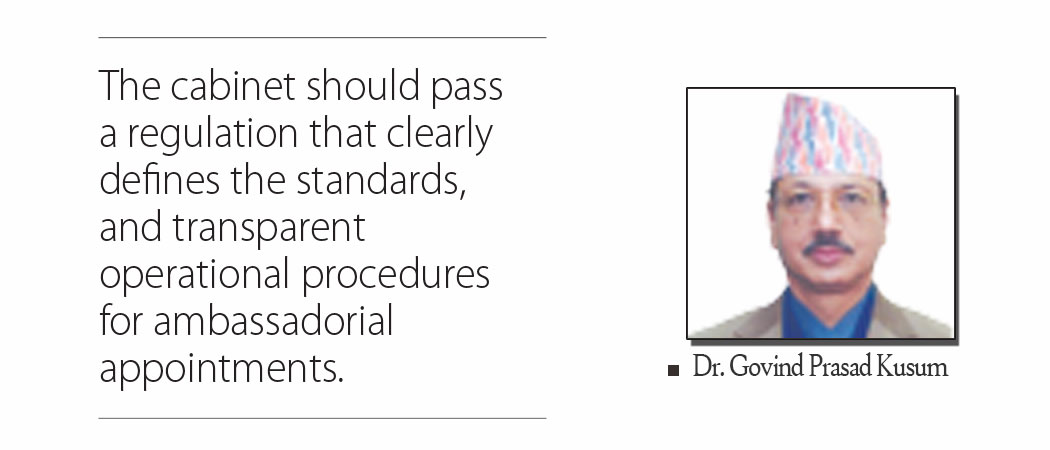
Making political appointments as ambassadors merely because someone belongs to one's own political party is neither ethical nor appropriate. The cabinet should pass a regulation that clearly defines the standards, and transparent operational procedures for ambassadorial appointments. Their objective evaluation must be conducted periodically by the ministry, as it serves as the cornerstone for ensuring effective diplomacy. It does not mean that ambassadors appointed from outside the diplomatic service are not competent enough. Regrettably, a few have deviated from established diplomatic norms, which tarnished the image of the country. For example, one Nepali ambassador in Saudi Arabia was allegedly found involved in the mishandling of funds, while another was recalled from Qatar for undiplomatic remarks.
In this situation, the prudent model is a balanced approach. A limited number of posts such as 20 per cent of total positions should be assigned to qualified political appointees who demonstrate exceptional communication skills, ethical integrity, cultural intelligence, and unwavering commitment to national interest, deep patriotism, and strategic thinking ability. In the context of career diplomats, it should not be assumed that they all inherently are engrained with these qualities. The success of diplomacy is determined not solely by one's career trajectory but rather by knowledge and ethical leadership.
(The author is former secretary of the government of Nepal.)