- Thursday, 30 April 2026

Loving Awareness Heals
 Radhule B. Weininger
Radhule B. Weininger
Radhule B. Weininger
Most of us come into the world needing the same things: to be held, to be seen, and to have someone turn toward us with reliable warmth. When this happens consistently, something settles inside body and mind — a quiet confidence that we are welcome here, that care exists, and that we matter. But for many people, early caregiving fell short of this. Not necessarily through dramatic disruptions, but through subtler losses: a parent too exhausted to be fully present, love that was genuine yet unpredictable, attention erratic in ways the child could not understand. Others faced deeper wounds — abandonment, neglect, or the disorientation of immigration or war.
Some of us may carry within a silent memory of wanting to be recognised for who we are and having that recognition tend to us. These are what researchers may refer to as early attachment wounds — not always obvious in their stories, but deeply influential, shaping how we love, give, receive, and ultimately find peace.
There is a paradox embedded in these wounds. Those shaped by early relational uncertainty often develop a careful attentiveness to others — a sensitivity driven by necessity, a deep understanding of what it means to go unseen. Psychiatrist Ervin Staub’s research on “altruism born of suffering” captures this well: some of those most wounded become the most fiercely motivated to ease others’ pain. Yet they often struggle to receive care themselves, having learned early that it cannot be relied upon.
The wound is fundamentally relational — it heals most profoundly through connection. Resilience research shows that even one dependable, caring adult — like a teacher, grandparent, or therapist — can help change what feels possible. But what if there was a source of care that didn't rely on any specific person? One that couldn't be withdrawn, lost, or made conditional?
This is what meditation teacher and Buddhist scholar John Makransky highlights in his Sustainable Compassion practices, especially the practice he calls the Field of Care. It starts simply: recall a moment of true care. Someone who made you feel safe, acknowledged, or loved — a grandparent, a teacher, a beloved dog, a moment in nature. Nearly everyone, regardless of their difficult early history, can find at least one such memory.
What happens next is remarkable. By allowing that memory to fully settle into the body — the breath, the chest, the felt sense — something becomes clear: the warmth is not something we created. It is something we uncovered. As Makransky teaches, care, warmth, and acceptance are qualities already present within the nature of awareness itself, temporarily hidden by fear and the weight of old wounds. Neuroscientist Zoran Josipovic describes this as non-dual awareness — a background awareness present before all mental activity, carrying qualities of warmth and knowing.
For those with attachment wounds, this distinction matters enormously. Being told to “imagine someone who loves you” can feel hollow when the inner landscape offers little to work with. But the Field of Care practice does not ask us to pretend. It invites us to recall a real moment of care — and then to recognize that the quality of that care points to something deeper than any single relationship: a warmth woven into awareness itself.
With consistent practice, something shifts. The nervous system, conditioned by early experiences to brace for withdrawal of care, begins to encounter a form of care that does not withdraw. An inner restlessness starts to settle — like a frightened child relaxing into the arms of someone trustworthy. Research shows measurable increases in compassion and well-being in regular practitioners, alongside reductions in the empathic distress that leads to burnout.
From this new foundation, something remarkable becomes possible. The compassionate attunement that early adversity forged — the finely calibrated sensitivity to suffering and the deep understanding of what it means to go unmet — can now flow from a different source. No longer driven by the anxious need to earn love, care begins to emerge freely from a well that does not run dry.
And then the circle naturally expands. We find ourselves drawn toward others who carry pain similar to ours — those who know what it feels like to be unseen, to brace for abandonment. There is understanding rather than pity in this shift, a kinship born from shared experience. And further still: toward those whose suffering appears different from ours, toward those who have caused harm, even toward the caregivers whose inconsistency initially shaped our wound. The compassion doesn’t need to be forced. It happens because the centre has grown large enough to hold more than we once believed possible.
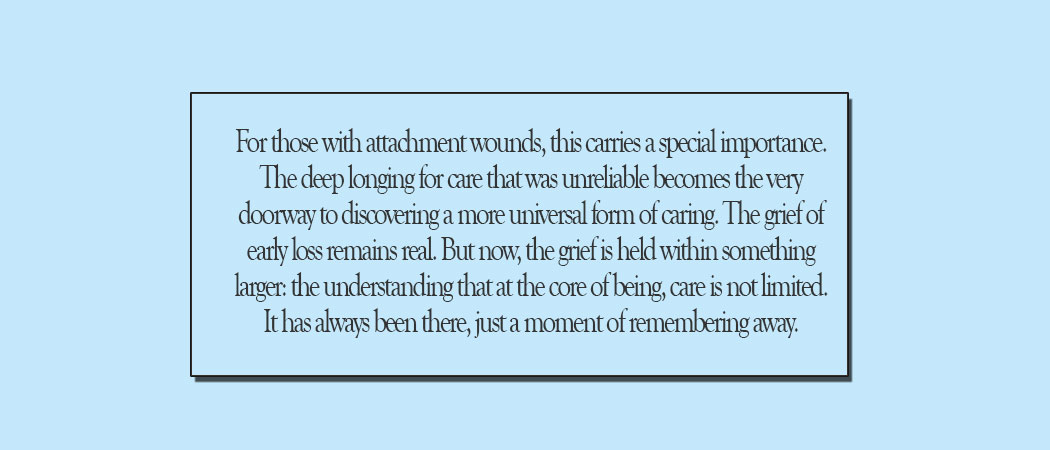
For those with attachment wounds, this carries a special importance. The deep longing for care that was unreliable becomes the very doorway to discovering a more universal form of caring. The grief of early loss remains real. But now, the grief is held within something larger: the understanding that at the core of being, care is not limited. It has always been there, just a moment of remembering away.
-Psychology Today

-square-thumb.jpg)