- Saturday, 4 April 2026

Study recommends policy reforms to enhance election fairness, impartiality, and austerity
Kathmandu, March 13: The election to the members of the House of Representatives (HoR) concluded recently and was acknowledged for its managerial aspects. The government was also applauded for successfully holding the elections in a largely peaceful atmosphere while ensuring maximum security.
However, a research conducted under the Chetana Project highlighted the need for certain policy reforms to further enhance election fairness, impartiality, and austerity.
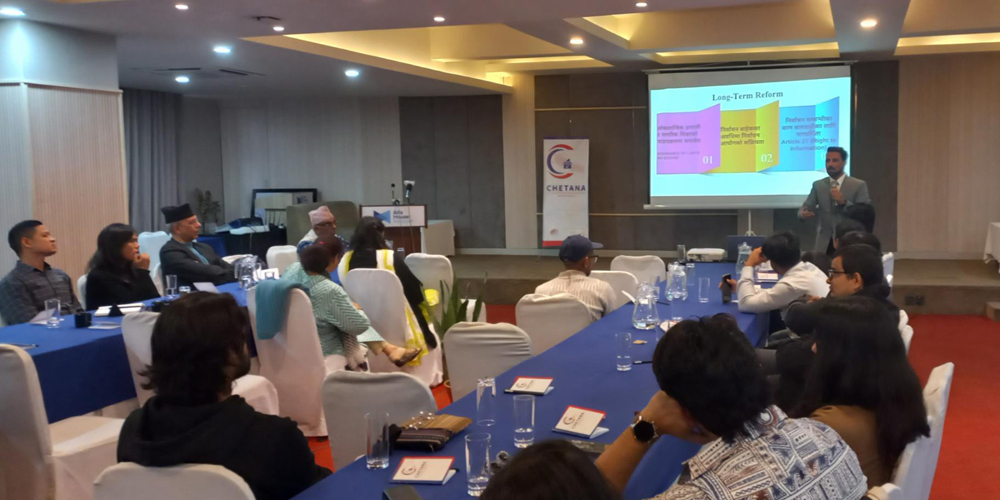
The research focuses on the period following the announcement of the election. At a programme organised by the Holistic Development Service Center and Freedom Studio, project director Dr Prem Raj Dhungel said that some policy reforms are necessary regarding the full implementation of the election code of conduct.
He advised announcing the date of periodic elections within the Constitution and ensuring provisions that mandate compensation for candidates and relief for candidates and voters affected by violent conflicts and disputes.
According to him, conflict is not limited to physical assault. He added that disagreements, challenges, and election-related disputes should be addressed peacefully in order to conduct elections in a healthy atmosphere.
The study also highlights the need to enact a separate election code of conduct targeting social media so as to deal with hate speech, propaganda, and materials that incite conflict online.
Likewise, it recommends banning the change of political affiliations by election candidates and party members for a specific period after the announcement of the election. It also suggests introducing educational curricula on democratic systems and civic education starting from the school level.
Furthermore, the study calls for mandatory transparency in election expenditures while ensuring intra-party transparency, internal democracy, and accountability.
The study report states, “It is necessary for political parties to ensure safety and privacy to promote women candidates. The Election Commission should also determine policy and legal responsibilities to operate election-related monitoring, evaluation, and reform programmes annually.”
The speakers said that it is necessary to develop an early warning system that provides advance notice if political tension and special risks are observed in any electoral area, and to ensure a policy framework that guarantees action in cases of violence, conflict, or illegal activities during the electoral process.
It has been suggested to strictly enforce and implement the election code of conduct, take immediate action against violators, and make provisions to examine and publicly disclose, in transparent manner, the details of candidates' personal, political, financial, and other institutional affiliations.
The said project, based on content from mainstream media, online media and social network sites, recorded over 300 conflict-related incidents during a three-month study, of which 112 were related to peace and security.
It has been reported that most of these incidents occurred in Bagmati Province and Kathmandu district. The report stated that political parties and their activists were found to be involved in such incidents, and in some cases, representatives of the state were also found to be involved.
This time, it has been reported that the election officer was involved in some incidents and the issue of 'no vote' has also been raised in some areas.
Presenting a working paper on Nepal's elections, advocate Sagar Ghimire said that in order to make the elections more free and fair, and credible, it is necessary to revise related standards, procedures, policies, acts, and rules as well as amend the constitution.
Emphasising the need to reassure voters curious about how a candidate they voted for could end up on a blacklist before being elected, he stressed that the state should already be attentive to such incidents as they could render the votes of the electorate redundant.
He pointed out the need for developing a method to verify whether the expense details submitted by political parties and candidates are correct and drew the state's attention towards using electronic voting devices to make the upcoming election efficient and organised.
The participants expressed the view that it is necessary to make provisions for 'advance voting' in the upcoming local level by-elections and to explain that the 'no voting' system can encourage candidates and political parties.
The organisation has highlighted that while implementing the 'open list' system for proportional representation, arrangements should also be made to allow voters to directly select individuals as well as parties.
It has also suggested making provision for establishing a special mechanism that provides independent and speedy justice to resolve such election disputes. (RSS)