- Saturday, 2 May 2026

Initiative to operate tea testing, promotion centre
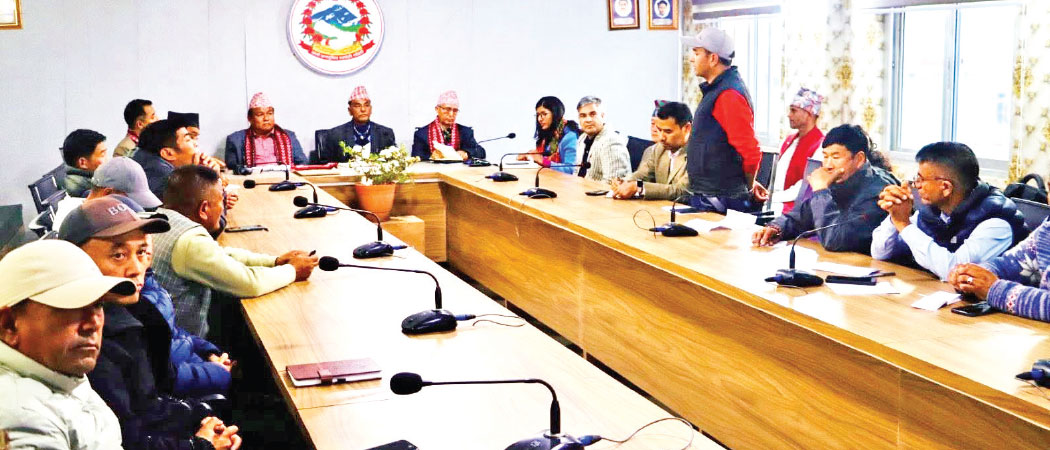

By Prem Adhikari,Pashupatinagar (Ilam), Feb. 24: An initiative has been taken to bring a tea testing, promotion and research centre built in Kanyam of Suryodaya Municipality-7, Ilam, into operation. The provincial government has taken initiative to oper
ate the tea testing, promotion and research centre, which was built for the first time in Nepal at a cost of more than Rs. 180 million, with 75 per cent of the Koshi provincial government and 25 per cent of the Suryodaya Municipality.
Although the building has been completed, the centre has not come into operation due to the lack of equipment and technical manpower.
A delegation, including Minister for Economic Affairs and Planning of Koshi provincial government Bidur Kumar Lingthep, Vice Chairperson of the Provincial Planning Commission Taranath Niraula, and Chairperson of Central Campus of Technology, Dharan-14, Hattisar, Professor Dr. Dhan Bahadur Karki, visited the centre and held discussions with stakeholders to move forward with the operational process.
Minister Lingthep said that operational procedures and modality must be prepared to run the already constructed centre.
He emphasised the need to initiate the approval process and operate a quality laboratory.
He said that the lab should be operated in coordination with Nepal Academy of Science and Technology (NAST) and Hattisar so that the tea tested at the centre can be recognised in the world market.
Minister Lingthep said, "The provincial government will manage the budget in the policy and programmes of the coming year for the operation of this centre, but the achievements of the centre should be visible."
Ilam district, including Suryodaya—known as the capital of tea—is the largest producer of orthodox tea in Nepal.
However, since 95 per cent of Nepal’s tea market depends on India, tea entrepreneurs and traders face difficulties every year due to testing requirements during the export.
When exporting tea to India, testing takes a long time, and India often imposes restrictions on Nepal’s tea exports, citing higher pesticide residue levels.
Vice Chairperson of the Provincial Planning Commission Niraula said that it would not be possible for the government alone to operate the centre and suggested adopting a Public-Private Partnership (PPP) model.
He said that Suryodaya Municipality should prepare the operational guidelines for running the centre.
Acting Mayor of Suryodaya Municipality, Durga Kumar Baral, said that the municipality would immediately draft the operational procedures as agreed in the discussion.
However, he expressed doubts whether tea tested at the centre would receive recognition in the global market during export.
Among the 45 tea-producing countries in the world, Nepal ranks 16th.
According to Indra Adhikari, Regional Chief of the National Tea and Coffee Development Board’s Tea Expansion Project, Nepal produces 7.5 million kilograms of orthodox tea annually, generating over Rs. 15 billion in economic transactions both domestically and internationally each year.
He said that the provincial government should make the operational procedures public.
Adhikari said that due to a lack of technical manpower and software limitations in Nepal, testing is expensive.
He suggested that the government should introduce a separate Tea Act.
According to the municipality, at least Rs. 40 million is required immediately to operate the centre.
Prof. Dr. Karki said that as testing in Nepal is expensive, the centre should operate in coordination with NAST.
Gopal Kattel, General Secretary of Suryodaya Tea Producers Pvt. Ltd., emphasised that before operating the testing centre, a management committee, including experts, should be formed and the private sector should be included.
Due to recurring problems in the tea sector, farmers have not been receiving fair prices.
To promote international marketing of tea, the provincial government is planning to organise a tea conference in the month of Baishak in Suryodaya and other districts of Koshi Province.
-square-thumb.jpg)