- Saturday, 2 May 2026

19 dead in Dhadhing bus mishap, probe committee formed
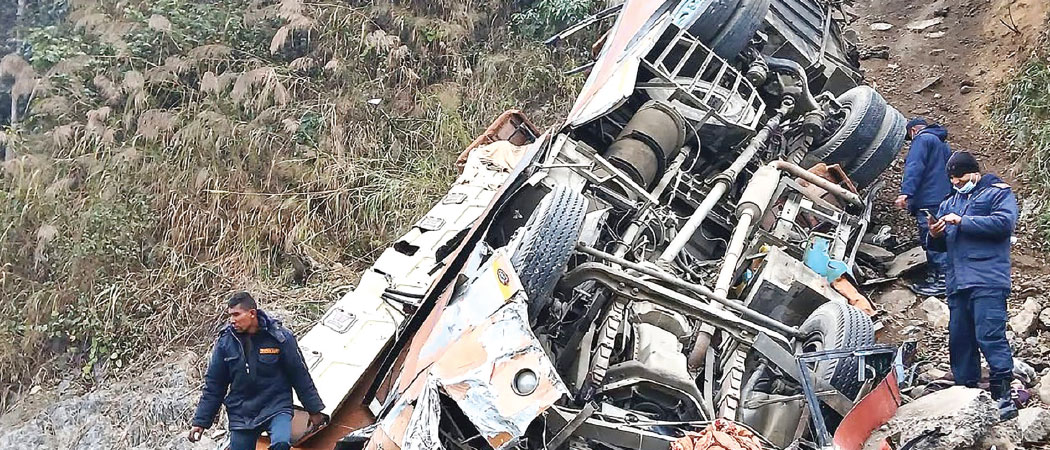
Photo: TRN Nepal Police personnel searching the belongings of victims at the Dhading bus accident site on Monday.

By A Staff Reporter,Kathmandu, Feb. 24: In yet another fatal bus accident near Charaundi of Beni Ghat-Rorang Rural Municipality-7, Dhading, along the Prithvi Highway, 19 passengers died at 1: 30 am on Monday.
The crash occurred when a bus carrying passengers from Pokhara to Kathmandu (registration G.2 Kha 1421) plunged down a cliff near Trishuli River. Authorities have confirmed that nine of the 19 persons who died in the bus accident in Dhadhing Sunday night have been identified, while the identities of the remaining 10 victims remain unknown.
Among the identified deceased are one foreign national and eight Nepali citizens.
Police Spokesperson Deputy Superintendent of Police (DSP) Prakash Dahal said that the deceased include 24-year-old British citizen Stewart Dominic Ethan; 40-year-old Bibek Basnet of Ward 30, Pokhara Metropolitan City; and 63-year-old Chandra Bahadur Dhankar of Waling-14, Syangja, who resided in Nagarjun Municipality-6, Kathmandu.
Other identified Nepali victims include, Om Kumar Malla, around 40, from Ward 4, Byas Rural Municipality, Tanahun, Engineer Dhungana, around 30, from Tripurasundari Rural Municipality-4, Dhadhing, Bishnumaya Dhakal, around 55, from Shukla Gandaki Rural Municipality-7, Tanahun, Lomang Gole, around 29, from Bauddha Tusal, Kathmandu, Hari Prasad Sigdel, around 46, from Bhiman Municipality-6, Tanahun, Nabindra Shrestha, around 55, from Tansen Municipality-1, Palpa, DSP Dahal confirmed that identification of the remaining 10 deceased is still unknown.
According to police, 25 persons injured in the accident are receiving treatment at various hospitals. Among them, 14 at the Trauma Centre, Kathmandu, 10 at National Medical College, Kalanki, and one at Tribhuvan University Teaching Hospital, Maharajgunj. The bus had a total of 44 passengers on board.
According to the police, 14 individuals including 48-year-old Angie Sherpa, 30-year-old Bibek Manandhar and 50-year-old Norbu Palden were receiving treatment at Trauma Centre, Kathmandu.
Similarly, 10 individuals are receiving treatment at National Medical College in Kalanki, including 25-year-old Krishna Tiwari and Mari Evaide, 27, from New Zealand, with minor injuries receiving treatment at TU Teaching Hospital, Maharajgunj.
Reasons for road accidents
Talking to The Rising Nepal, following the meeting at the Ministry of Home Affairs, Acting Chairperson of the Nepal National Transport Entrepreneurs’ Federation, Saroj Sitaula, said many task forces or probe committees were formed prior to this, but in lack of stringent implementation of the suggestion of the report, such accidents are not new in Nepal.
After the Shimaltal bus accident last year, a similar committee submitted a 12-point report, including references to natural causes. Yet its recommendations were never implemented.
“This is the country’s misfortune; after a major tragedy, there is urgency and attention, but once public concern fades, reports are shelved,” said Sitaula.
According to his understanding, road accidents generally stem from three causes: human error, poor road infrastructure, and mechanical faults. Currently, unhealthy competition and weak state policies are major issues.
Most rural roads in Nepal are built without proper engineering surveys or standards, often by bulldozers operating haphazardly. These roads lack safety measures and become even more dangerous during the monsoon.
“Our clear recommendation is that safety barriers must be installed along hilly roads. Without them, vehicles plunge off cliffs.
Even installing basic barriers could significantly reduce accidents and casualties,” suggested Sitaula.
Meanwhile, reducing road accidents cannot be achieved by the effort of just one party. It requires the support and cooperation of the government, the private sector, and the general public, explained road infrastructure expert Madhav Parajuli.
There are three main causes of accidents in Nepal: the roads, the vehicles, and the drivers. According to him, accidents increase because all three are not in a robust condition. If these conditions are satisfactory, accidents can be reduced; if not, road accidents tend to rise.
“If the government wants to reduce road accidents, it is appropriate to focus on these three areas and take proper measures. Otherwise, no matter how many investigative committees are formed or reports prepared, accidents cannot be effectively reduced,” suggested Parajuli.