- Saturday, 6 June 2026

Translate Democratic Values Into Action

Today, Falgun 7, corresponding to February 19, 2026, marks the 76th National Democracy Day. This day became possible because of the relentless struggle and sacrifice of known and unknown martyrs for the cause of democracy. Precious lives were lost to overthrow the 104-year-old autocratic Rana regime that deprived people of their fundamental rights, e.g., civil and political rights. Even writers and poets raised their voices against the oppressive Rana regime.
One such powerful voice was that of Yugkavi Siddhicharan Shrestha, who used the word 'revolution' for the first time in his poetry and wrote lines like this: So easily can't your rights be regained; struggle you must and resort to revolution. The Rana rulers were enraged and gave him a prison sentence for 18 years and confiscated his property.
Senior politician Ganesh Man Singh, another intrepid critic of the Rana regime, who met Yugkavi in prison, admits in his Atmakatha that had it not been for Siddhicharan, he would have lost his mental equipoise. Late Singh was profoundly inspired by Yugkavi's poetry.
Mangalman's saga
Siddhicharan's Mangalman, a long poem which was posthumously published, received critical attention from all quarters and has been hailed as the poet's magnum opus. Mangalman, a person of humble background, is an eyewitness to the ghastly execution of four heroic activists against the repressive Rana regime. He joins forces with several youths opposed to the Rana rule. He is mercilessly beaten, and later he is told that he will be released if he signs a petition for an apology, but he refuses to do so.
Mangalman and other political prisoners are released following the revolution of BS 2007, culminating in the people's victory for democratic rule. Real change in the living conditions of people, particularly the poor and illiterate, was still a far cry. There was no end of social anomalies, aberrations and malpractices, and Mangalman is utterly disillusioned. He dies a martyr to a cause.
We are reminded of a parallel situation when the Gen Z movement led by energetic but disillusioned youths protested last year the failure of the government in power to ensure good governance, deliver service expeditiously and curb mounting corruption. Several youths were crushed and killed, followed by arson and vandalism. The government was toppled, and an interim government headed by Sushila Karki, former chief justice, was formed with a mandate to hold free, fair and fearless elections to the House of Representatives on March 5 this year, in just two weeks from now.
Security has been ensured. President Ramchandra Poudel and PM Karki have appealed to all people to cast their votes peacefully and without fear. The country is looking forward to a newly elected government capable of meeting the legitimate demands of Gen Z youths and promoting national development at an accelerated pace.
On the foreign policy front, during the Rana rule, Nepal's external relations were confined to a few countries, such as British India, later independent India, the United States of America and France. Nepal opened up to the world outside after the overthrow of the Rana regime in 1951. In 1955, the country attended the Afro-Asian Conference at Bandung, Indonesia, established diplomatic relations with the People's Republic of China in August the same year and was also admitted to the UN in the same year.
These 3 significant events of 1955 confirm, in unmistakable terms, Nepal's efforts to diversify its external relations and forge new links of friendship and cooperation with other countries of the world. Commenting on such efforts, senior diplomat the late Prof. YN Khanal observes, "Nepal has a distinct foreign policy which takes care of its national interests and which is in line with its own national aspirations."
Nepal became a founding member of the Movement of Nonalignment (NAM) in the early sixties of the last century and has actively participated in all NAM summits at the highest political level. Non-aligned foreign policy is one of the basic parameters laid down in all constitutions, including the latest constitution of 2015 adopted and promulgated by the constituent assembly composed of more than 600 people's representatives. Other parameters include such principles as are enshrined in the UN Charter, Panchsheel, or the five principles of peaceful coexistence and respect for international law and world peace.
Major changes
During the last seven and a half decades of democratic rule, Nepal has witnessed major political changes ranging from three decades of absolute monarchy, the restoration of parliamentary democracy in 1990, a decade-long Maoist insurgency, the abolition of monarchy, the promulgation of a new constitution and the recent Gen Z movement culminating in the formation of an interim government entrusted with a mandate to hold free, fair and impartial elections. It is quite obvious that Nepal's domestic and foreign policy formulation and implementation are beset with both challenges and opportunities.
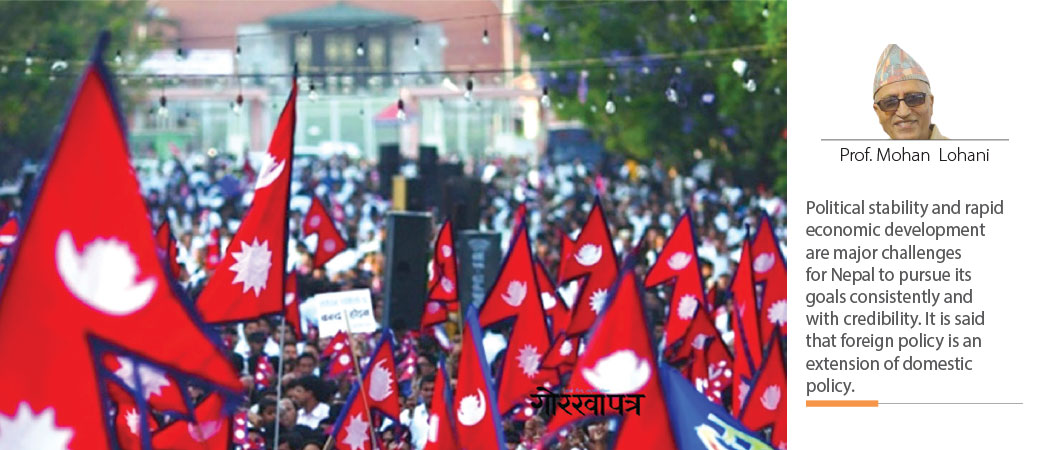
Political stability and rapid economic development are major challenges for Nepal to pursue its goals consistently and with credibility. It is said that foreign policy is an extension of domestic policy.
Nepal would do well to put its own house in order before it can achieve success and boost its image in the community of nations. Since people are at the centre of development in all sectors, it is necessary to build a national consensus on major issues of national interest and concern.
The message of National Democracy Day is: democracy cannot be taken for granted, and democratic norms and values need to be upheld and practised by citizens at all levels.
(The author is a former ambassador.)