- Friday, 29 May 2026

Institutionalise Gains Of Gen Z Movement

The Gen Z protests that took place on September 8 and 9, 2025, have changed the political landscape in Nepal. The protests toppled the KP Sharma Oli-led government within 48 hours but at the cost of 76 people, with hundreds injured. An interim government was formed on September 11 under the premiership of former Chief Justice Sushila Karki. And the House of Representatives was dissolved soon as per the demand of the Gen Zers. The government set March 5, 2026, as the date for the election to the House of Representatives
The Gen Z protests erupted over a ban on 26 social media platforms by the then-government. As the Gen Zers grew up with social media and as they were simmering with rage over the widespread malpractices and anomalies such as nepotism, favouritism, cronyism and corruption, they resorted to nationwide protests. The Gen Zers also raised the issue of the lavish lifestyles of nepobabies, the children of the political leaders.
Misrule
After the formation of the present government, the people were happy that the misrule of the previous governments would cease to exist and that the traditional political parties would reform themselves as per the aspirations of the people. Although some political parties affirmed that they would reform themselves, their affirmations seem to be just lip service. In the meantime, the Nepali Congress underwent a great transformation in leadership, with Gagan Thapa assuming the mantle of president of the party through a special convention held in January 2026. Sher Bahadur Deuba has now been deprived of contesting the forthcoming election.
The CPN-Maoist Centre and CPN-Unified Socialist got unified and became the Nepali Communist Party by bringing over a dozen groups on board. However, Oli was elected chairman of the party in the 11th general convention held in December 2025. The Gen Zers want youth leadership over a gerontocracy. Out of the top leaders of the three traditional parties, the Nepali Congress, the UML and the Nepali Communist Party, Gagan Thapa, has become the youngest at 49 years old.
The excitement over the toppling of the Oli-led gerontocratic government and the formation of the present government seems to have faded now. Although the government and the Gen Z leaders inked a ten-point agreement in December 2025 aiming at initiating reforms on key issues as identified by the Gen Zers, the materisalisation of such reforms seems to be a far cry. The demands of the Gen Zers are varied and include, inter alia, providing for a directly elected Prime Minister, reforming the system of governance through amendments to the constitution, rewriting the constitution, restoring the monarchy and dissolving the federal setup. But in the absence of the House of Representatives, the government lacks the power to amend or rewrite the Constitution.
The present government is busy making preparations for holding the election to the House of Representatives now. The government is an electoral government with a mandate to hold the election on March 5. But it seems it is ignoring the demands of the Gen Zers regarding maintaining good governance by extirpating political anomalies and corruption.
During the initial days, there was a commitment to establish a high-level constitutional amendment recommendation commission to review the constitution, conduct inclusive public consultations and propose improvements in the constitution, with work to begin in three months. The present government formed an inquiry commission on September 21, 2025, to investigate the Gen Z protests and cases of widespread arson and vandalism. The tenure of the commission has been repeatedly extended, with the latest extension until March 7, 2026, when the election will have been held.
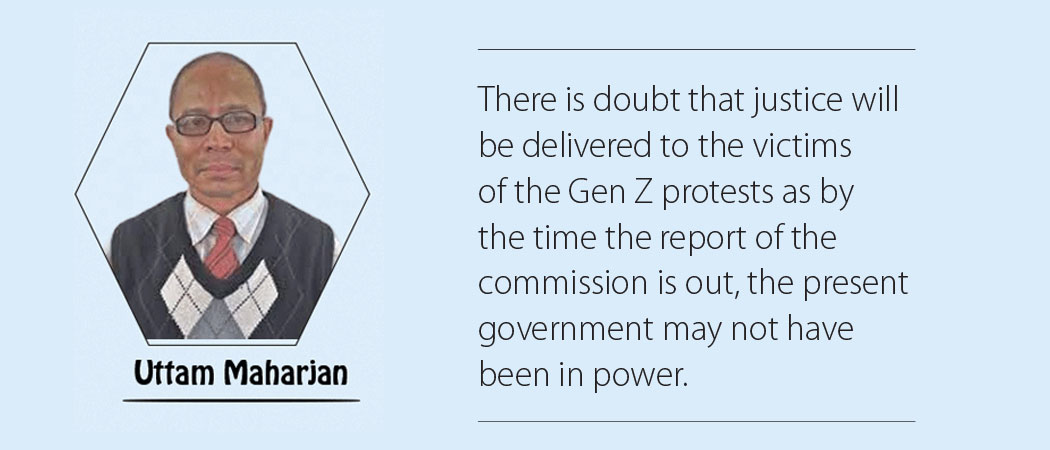
There is doubt that justice will be delivered to the victims of the Gen Z protests as by the time the report of the commission is out, the present government may not have been in power. If a new government favouring the Gen Zers is formed, the report may be implemented. On the contrary, if a new government is formed under the leadership of a traditional party, the Nepali Congress, the UML or the Nepali Communist Party, or under that of a coalition government dominated by a traditional party, the report may not be acted upon. It seems the government is afraid to take action against the perpetrators of violence during the Gen Z protests. It is speculated that making the report of the inquiry commission public may disrupt the forthcoming election.
On the other hand, the Gen Zers are not united; there are several groups representing their own ideologies and agendas. Key groups include the Gen Z Movement Alliance, the Gen Z United Movement Paribartan and the Nepal Gen Z Front. There is also a Facebook group called Gen Z Nepal. These groups have differing views and principles, which makes them a weak force. However, around two dozen new political parties have been registered for the upcoming election. These parties are mostly merit-based and anti-gerontocracy.
Investigation
The present government seems to be apathetic towards taking action on corruption. Investigation into high-profile corruptions, such as the case of fake Bhutanese refugees and cooperative scams, seems to be on the back burner. It seems the government’s focus is on holding the election only. The Gen Zers want reforms in governance. If traditional political parties come to power after the election, the achievements of the Gen Z protests may go by the wayside.
For the political parties, it will be just a hiatus of six months. When they are in power again, they may take action against the Gen Z protesters. And the demands for reform in governance and elimination of corruption and other anomalies may be thrown on the scrap heap. So it follows that there is a high possibility of the demands of the Gen Zers remaining unfulfilled.
(Maharjan has been regularly writing on contemporary issues for this daily since 2000.)